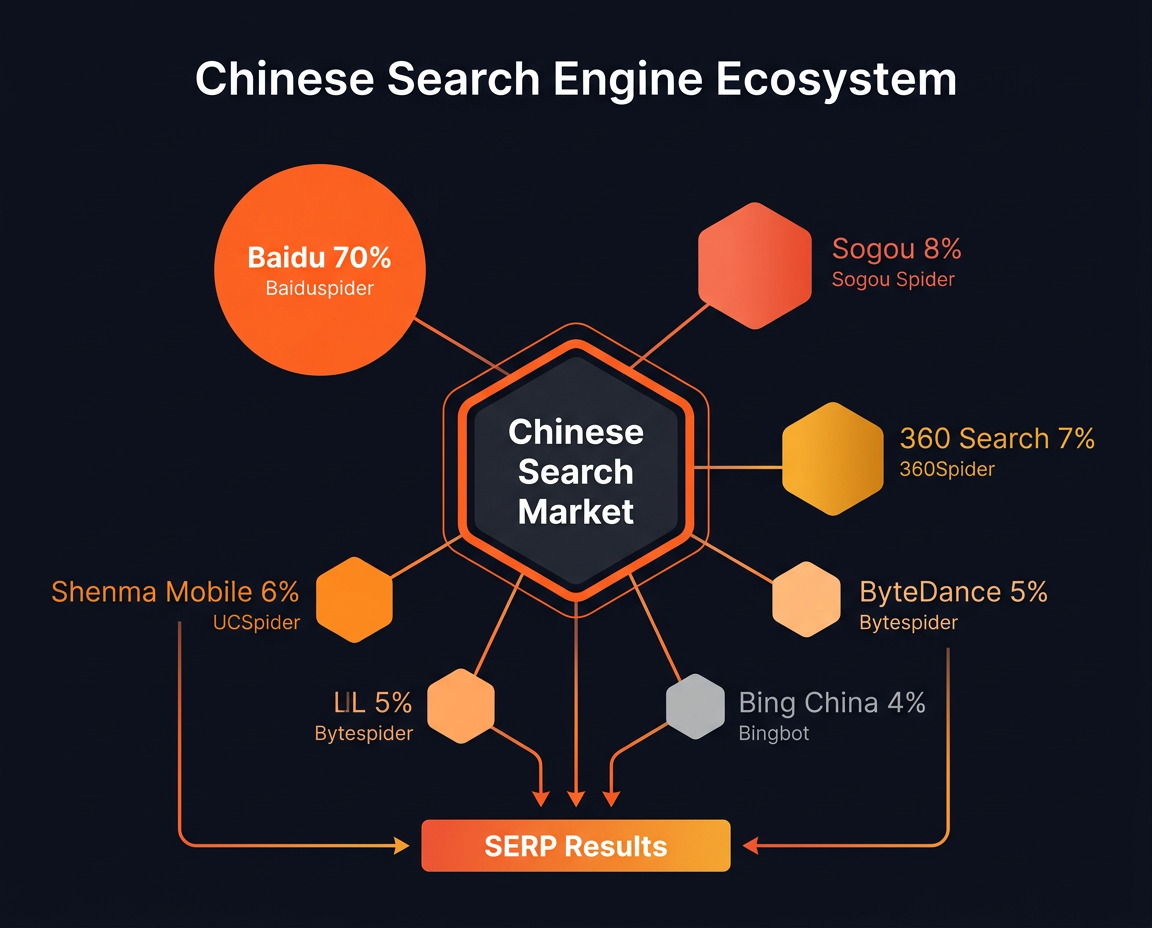
China's digital ecosystem operates on completely different rules from the Western web. Google does not exist there. Neither does Facebook. Instead, Baidu captures roughly 70% of searches, while Sogou, 360 Search, Shenma, and ByteDance share the remainder. For any company doing business with China, understanding these differences is not optional: it's the starting point.
This guide covers the complete cycle: from the technical requirements that Chinese crawlers impose, to how Chinese generative AI models consume and cite content (GEO and AEO), plus the composite scoring formula we use at Transgenia to measure real progress in a China visibility strategy.
Part I: The Chinese Search Landscape
Market Share and Crawlers
| Engine | Estimated Share | Primary Crawler | Note |
|---|---|---|---|
| Baidu (百度) | ~70% | Baiduspider + Baiduspider-render | Render = separate JS bot |
| Sogou (搜狗) | ~8% | Sogou web spider | Acquired by Tencent |
| 360 Search / So.com | ~7% | 360Spider | Popular in govt/enterprise |
| Shenma (神马) | ~6% | YisouSpider | Alibaba / UC Browser ecosystem |
| ByteDance / Toutiao | ~5% | Bytespider | Powers Douyin (Chinese TikTok) |
Unlike Google, which unified its crawler in 2019, Baidu maintains two separate bots: Baiduspider for static HTML and Baiduspider-render for JavaScript content. If your site loads critical data via JS, you must explicitly allow Baiduspider-render in robots.txt.
The Great Firewall and Its Technical Implications
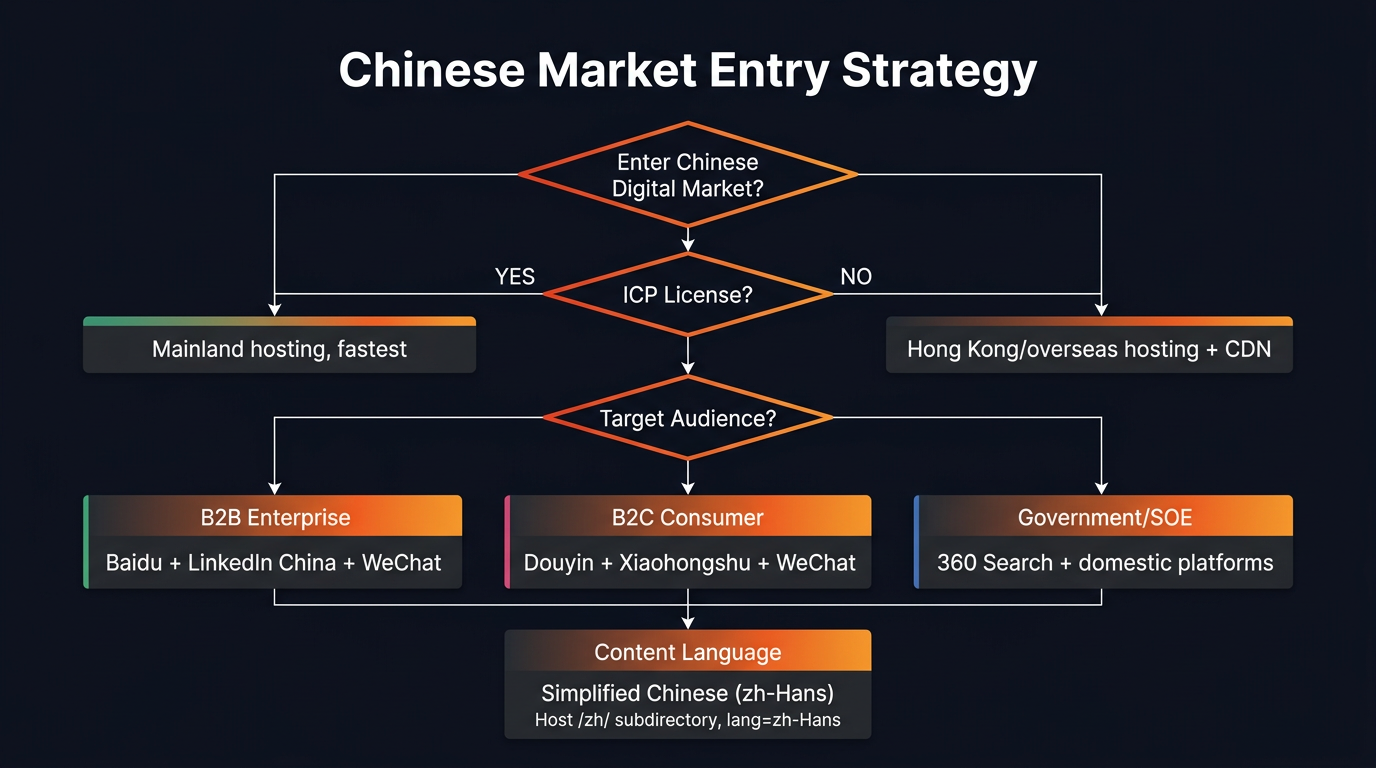
The Great Firewall (防火长城) blocks Google Fonts, many Cloudflare CDN endpoints, and Western JS CDNs. For a China-optimized site:
- Vendor all critical resources: Bootstrap, Alpine.js, web fonts served from your own domain or CDNs with Chinese presence.
- ICP License: Required only if your server is physically hosted in mainland China.
- Latency from China: Consider a CDN with PoPs in Hong Kong, Singapore, or Japan. Latency between the US/EU and Shanghai can exceed 400ms without a CDN, directly impacting Baidu rankings.
Part II: Technical SEO Requirements for Chinese Sites
robots.txt
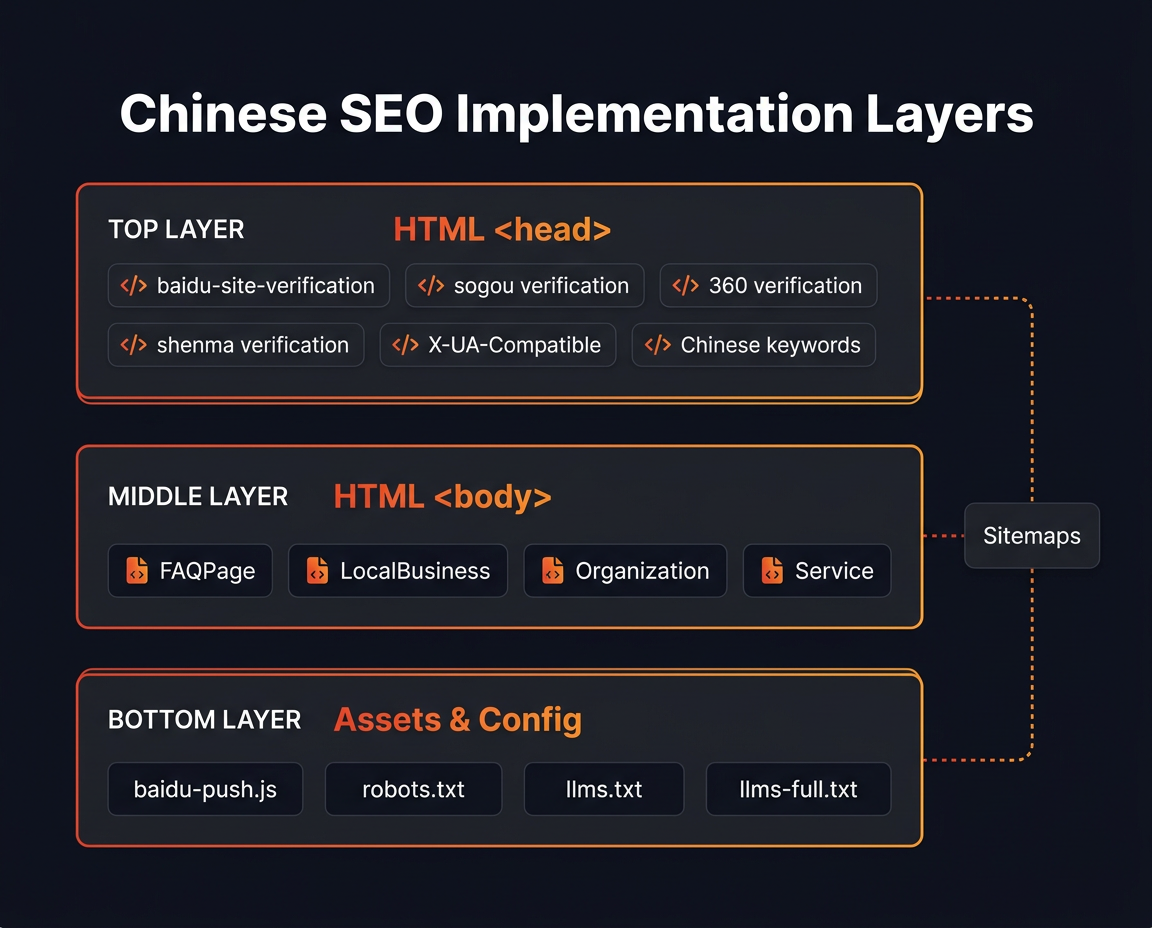
Your robots.txt must explicitly include all Chinese crawlers. A generic User-agent: * alone is not sufficient:
# Baidu
User-agent: Baiduspider
Allow: /
Crawl-delay: 1

User-agent: Baiduspider-render
Allow: /
Crawl-delay: 2

# Sogou
User-agent: Sogou web spider
Allow: /
Crawl-delay: 2

User-agent: Sogou Pic Spider
Allow: /

# 360 Search
User-agent: 360Spider
Allow: /
Crawl-delay: 2

# Shenma (神马) Alibaba ecosystem
User-agent: YisouSpider
Allow: /
Crawl-delay: 1

# ByteDance
User-agent: Bytespider
Allow: /
Crawl-delay: 1
Mandatory Meta Tags for ZH Pages
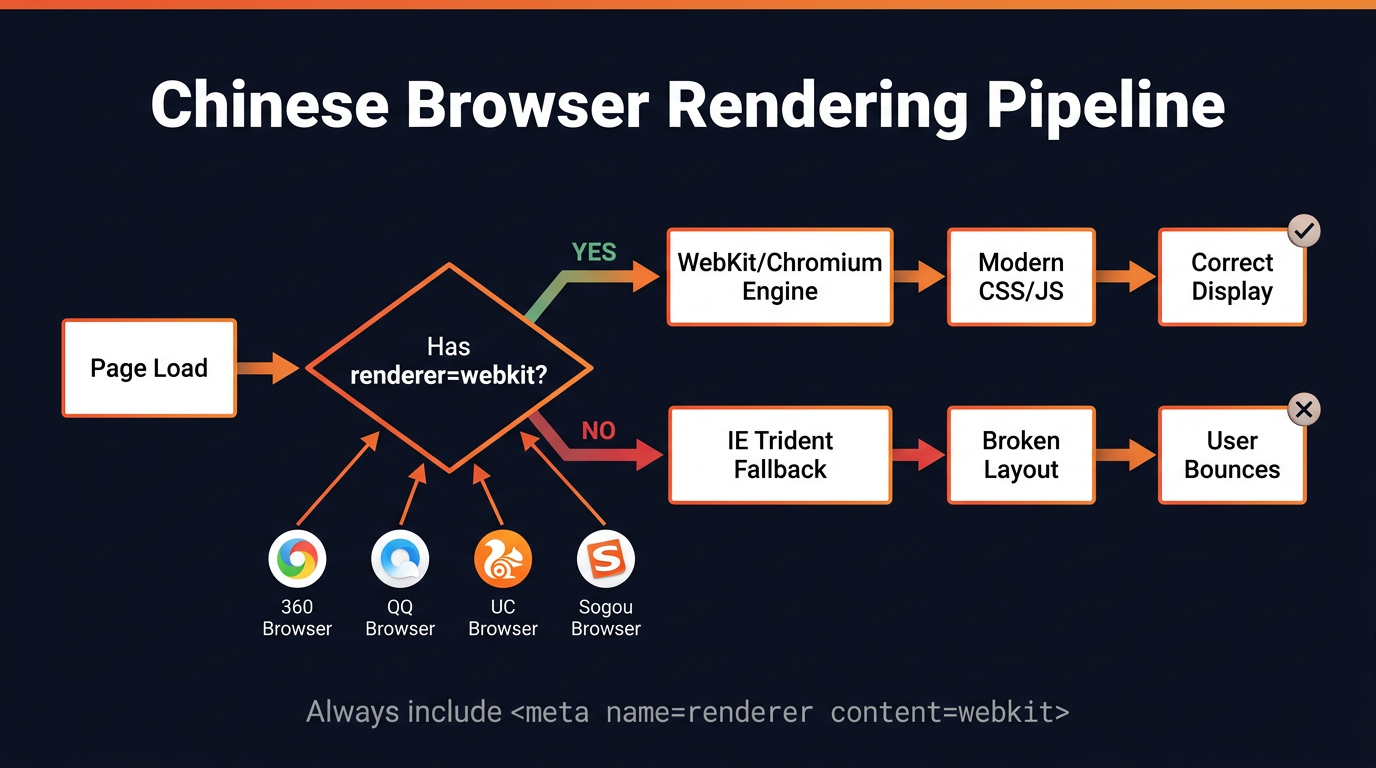
Chinese browsers use dual rendering engines and must be instructed to use webkit:
<meta name="renderer" content="webkit">
<meta name="force-rendering" content="webkit">
<meta http-equiv="X-UA-Compatible" content="IE=edge,chrome=1">
Meta keywords: Unlike Google, Chinese search engines still process this tag. Include 8-15 relevant Simplified Chinese terms:
<meta name="keywords" content="SEO优化,中文网站,百度SEO,搜索引擎优化,GEO,AEO,AI搜索,百度,搜狗,墨西哥,Transgenia">
Webmaster Verification Tags
Each Chinese engine requires its own site verification code:
<meta name="baidu-site-verification" content="YOUR-BAIDU-CODE">
<meta name="sogou_site_verification" content="YOUR-SOGOU-CODE">
<meta name="360-site-verification" content="YOUR-360-CODE">
<meta name="shenma-site-verification" content="YOUR-SHENMA-CODE">
Structured Data (JSON-LD)
Baidu consumes BlogPosting similarly to Google, with two critical additions:
inLanguage: "zh-Hans"(Simplified Chinese)dateModifiedalways present (Baidu uses it for freshness scoring)
{
  "@context": "https://schema.org",
  "@type": "BlogPosting",
  "headline": "Your headline here",
  "inLanguage": "zh-Hans",
  "datePublished": "2026-07-24",
  "dateModified": "2026-07-24",
  "author": {
    "@type": "Person",
    "name": "Efraín Carreón Ortiz"
  },
  "publisher": {
    "@type": "Organization",
    "name": "Transgenia",
    "url": "https://transgenia.org"
  }
}
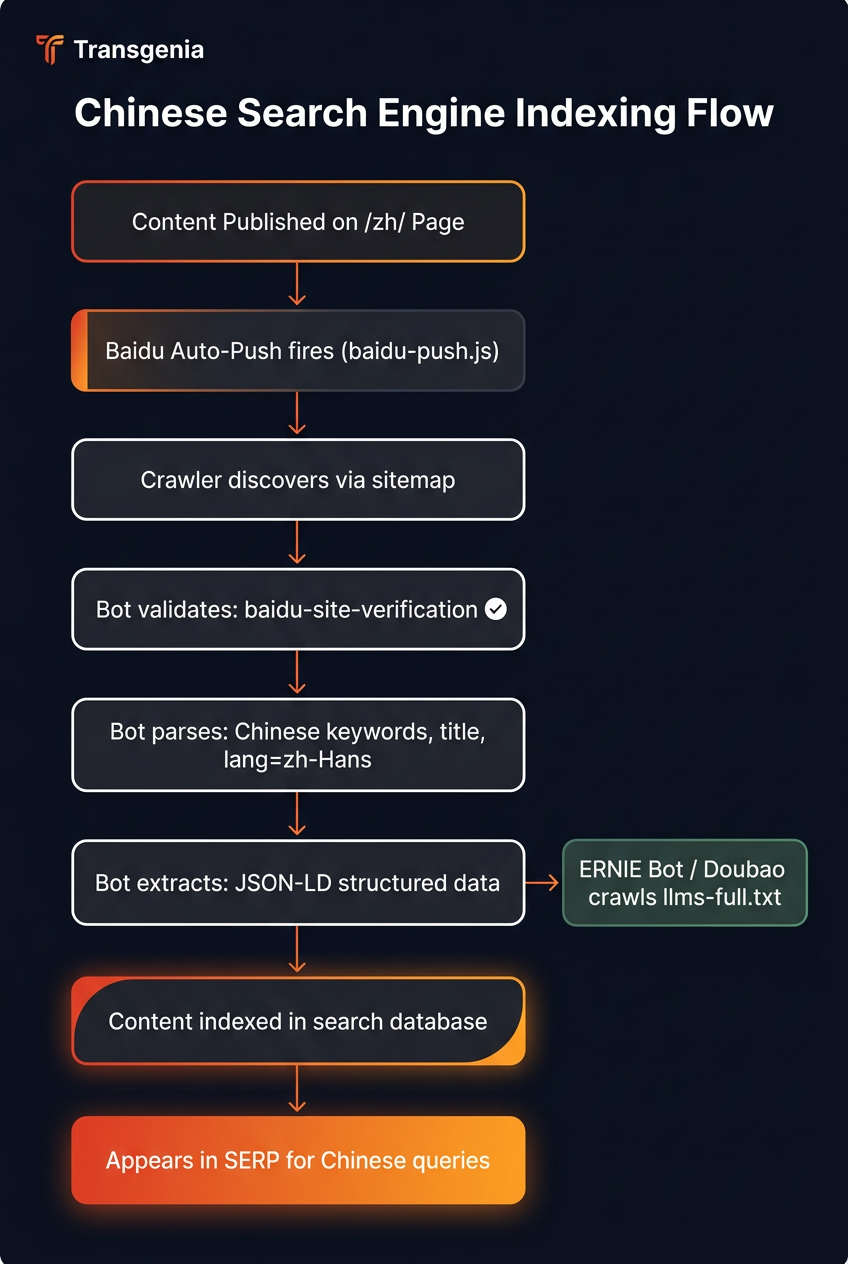
Baidu Auto-Push: Accelerated Indexing
This script notifies Baidu every time a user visits the page, the fastest path to indexation for new sites:
<!-- Add just before </body> on ZH pages -->
<script>
(function(){
  var bp = document.createElement('script');
  var curProtocol = window.location.protocol.split(':')[0];
  if (curProtocol === 'https') {
    bp.src = 'https://zz.bdstatic.com/linksubmit/push.js';
  } else {
    bp.src = 'http://push.zhanzhang.baidu.com/push.js';
  }
  var s = document.getElementsByTagName("script")[0];
  s.parentNode.insertBefore(bp, s);
})();
</script>
Part III: GEO for Chinese AI Engines
The five major Chinese generative AI models:
| Model | Company | Ecosystem |
|---|---|---|
| ERNIE Bot (文心一言) | Baidu | Integrated into Baidu Search |
| Doubao (豆包) | ByteDance | TikTok / Douyin ecosystem |
| Tongyi Qianwen (通义千问) | Alibaba | Taobao / Alibaba Cloud |
| Hunyuan (混元) | Tencent | WeChat / QQ ecosystem |
| Kimi | Moonshot AI | Independent; popular for long documents |
Signals Chinese AI Models Evaluate
Unlike Western LLMs, Chinese models give significant weight to:
- Presence in Baidu Baike (百度百科): an entry there noticeably increases model citations.
- Verifiable Chinese media mentions: 36Kr, TechCrunch China, PingWest for tech topics.
- Content on Chinese platforms: Zhihu (知乎) articles, WeChat Official Account posts, Bilibili videos with transcriptions.
- Consistent structured data:
Organization,Service,BlogPostingwithinLanguage: zh-Hans. llms.txtaccessible from China: verify Cloudflare is not blocking it for Chinese IPs.
Structuring llms.txt for Chinese Models
# Your Company

> Brief description (multilingual models handle English well).

## Key pages (ZH)
- ZH home: https://yourdomain.com/zh/
- ZH blog: https://yourdomain.com/zh/blog/
Part IV: AEO for Direct Answers in China
Baidu integrates generative answers directly into its SERP (百度生成式摘要). Content rules:
- Direct-answer paragraphs: 40-120 words (80-200 Chinese characters)
- Section heading must contain the exact question
- Use comparison tables when the query implies comparison
- Cite verifiable sources (Baidu penalizes unsourced content)
FAQPage JSON-LD:
{
  "@context": "https://schema.org",
  "@type": "FAQPage",
  "mainEntity": [{
    "@type": "Question",
    "name": "How long does it take for Baidu to index a new site?",
    "acceptedAnswer": {
      "@type": "Answer",
      "text": "Between 2 and 8 weeks without Baidu Auto-Push; with the push script active, it can drop to 3-7 days for high-priority pages."
    }
  }]
}
Part V: The Composite Scoring Formula
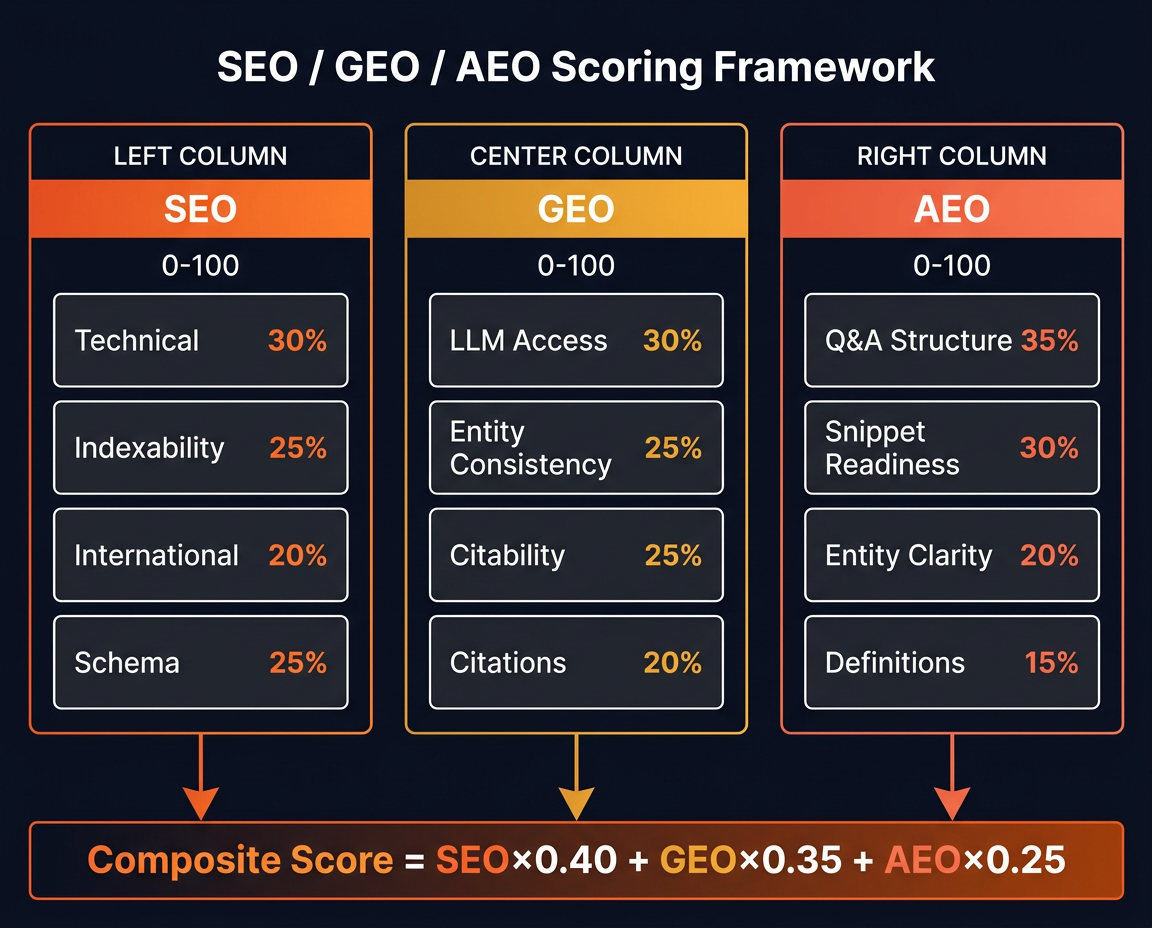
Composite Score = (SEO x 0.40) + (GEO x 0.35) + (AEO x 0.25)
Realistic Baseline for New Sites in China
| Month | SEO | GEO | AEO | Composite |
|---|---|---|---|---|
| 1-2 | 5-15 | 0-5 | 0 | 3-8 |
| 3-6 | 20-45 | 10-25 | 5-15 | 16-32 |
| 7-12 | 45-70 | 25-50 | 15-35 | 32-55 |
Most foreign sites start at 0-8 composite points. Reaching 50+ in 12 months requires consistent work across all three dimensions plus at least one reference Chinese media mention.
Part VI: Most Common Mistakes
- Ignoring Baiduspider-render: 60% of modern sites load critical content via JS; the render bot must be explicitly allowed.
- Using Google Fonts or blocked CDNs: a single call to
fonts.googleapis.comcan add 8+ seconds of load time from China. - Traditional Chinese instead of Simplified: mainland China uses 简体中文; verify
lang="zh-Hans". - Skipping the keywords meta tag: Baidu, Sogou, and 360 still process it; omitting it loses a relevance signal.
- Not registering on Chinese webmaster platforms: Baidu, Sogou, 360, and Shenma Webmaster Tools are free and China-specific.
- Underestimating guanxi (关系) in SEO: editorial backlinks from Chinese community sites carry more weight than generic directories.
Quick Checklist
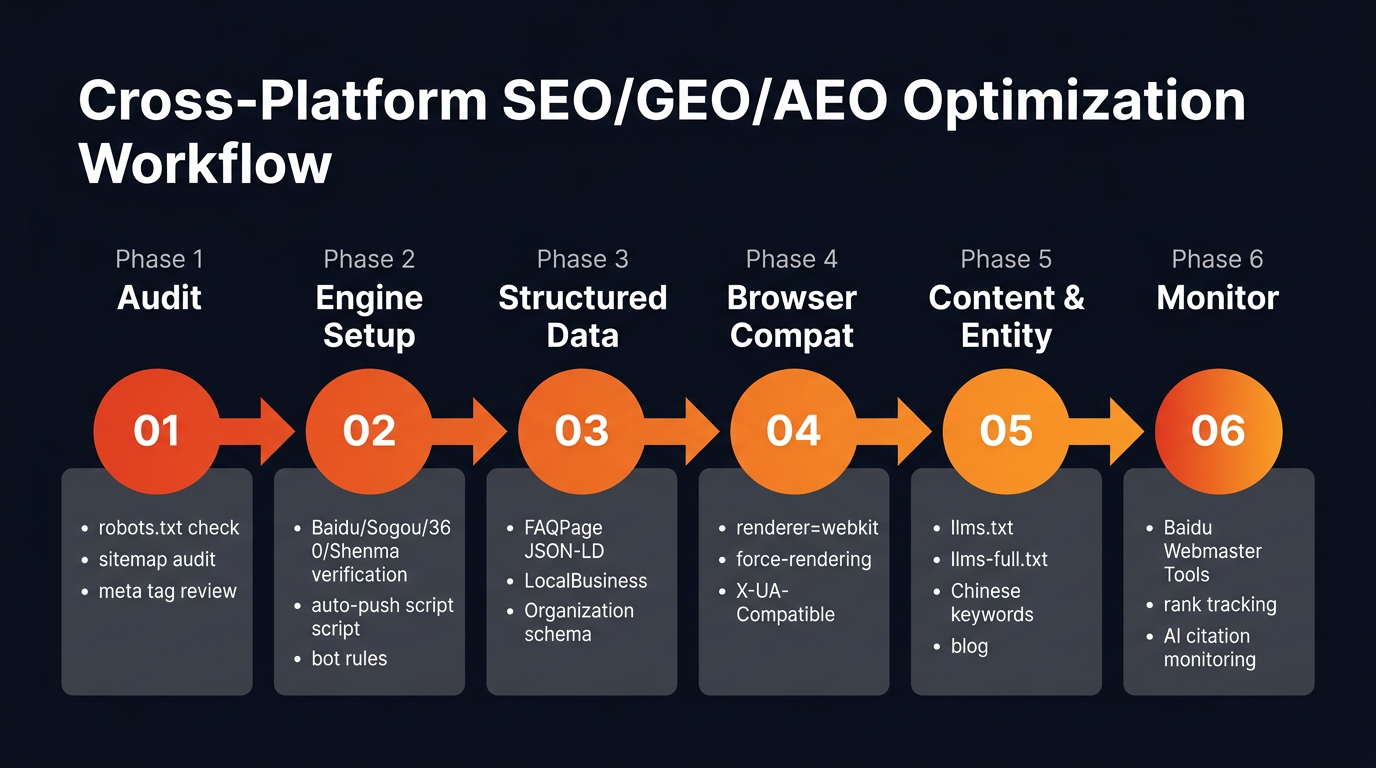
Before publishing any Chinese-language page:
- [ ]
robots.txtincludes all 5 Chinese crawlers with appropriateCrawl-delay - [ ]
<html lang="zh-Hans">on all ZH pages - [ ]
renderer,force-rendering, andX-UA-Compatiblemeta tags present - [ ]
keywordsmeta with 8-15 Simplified Chinese terms - [ ] JSON-LD
BlogPostingwithinLanguage: "zh-Hans"anddateModified - [ ] Baidu Auto-Push script before
</body> - [ ] All CSS/JS assets vendored locally (no Google Fonts, no blocked CDNs)
- [ ] URL submitted to Baidu Webmaster Tools after deploy
- [ ]
sitemap-blog.xmlupdated with the new ZH URL - [ ]
llms.txtaccessible from China and referencing ZH content
Conclusion
Chinese website SEO is not a minor variant of Western SEO. It is an ecosystem with its own rules, distinct crawlers, different AI engines, and a business culture that values long-term presence.
At Transgenia, we design and deploy trilingual digital strategies for Latin American companies targeting the Chinese ecosystem. Contact us to evaluate your current China visibility.
This guide will be updated as Baidu policies and Chinese generative AI models evolve. Last reviewed: July 2026.