1. Why rewrite this guide in August 2026
There are widely cited English guides on "what Claude.ai is" still describing the lineup as the Haiku, Sonnet, Opus trilogy. They are well written, they earned their traffic. But they were frozen before Anthropic made two moves that reorder the market conversation.
First: Fable 5 landed above Opus 5, and with it Anthropic finally opened a fourth public tier. Second, and this is what almost no English guide is covering well: Claude Mythos appeared, the class above anything publishable. It is not available on the open market, but its very existence reorders how a decision maker should think about the catalog, and explains why the next wave of Claude projects is not "just another API."
This guide is what an implementer with a Partner Badge · Claude Code issued by Anthropic sees as of August 22, 2026, told with the same discipline Transgenia uses to build client pilots: no fabricated figures; when we illustrate with a number, the public source is cited, or it is left as a diagnostic question for the reader's case.
Transgenia is a registered Claude partner (Anthropic), building toward full certification, with real deployment evidence. Not a certified partner (the final evaluation is still pending). Not a candidate. The distinction exists because the market is full of providers hanging off the Anthropic logo without being able to show the path. And its director, Efraín Carreón Ortiz, holds the Partner Badge · Claude Code issued by Anthropic on Credly, verifiable by name and date at the end of this article.
2. What is Claude.ai, in a sentence that actually holds up?
Claude is the family of language models built by Anthropic, the company founded in 2021 by Dario and Daniela Amodei with a handful of former OpenAI researchers. Its thesis is not "bigger AI"; it is "AI that can be used in domains where errors matter." The product name settled into two spellings: Claude.ai (official domain, the web interface) and Claude.ia (transliteration common in LATAM Spanish content). Both point to the same system.
As a product, Claude is four things at once today, and that multiplicity is what confuses the new user:
- a family of models with different capabilities and prices,
- a set of surfaces it is consumed through (Chat, Cowork, Code, Design),
- an API for other companies to build applications on top of,
- and a partner network implementing those applications in real clients.
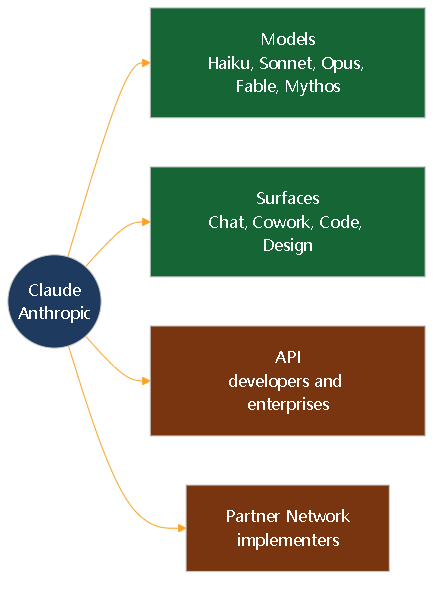
See Mermaid diagram
flowchart LR
    C(("Claude
Anthropic"))
    M["Models
Haiku, Sonnet, Opus, Fable, Mythos"]
    S["Surfaces
Chat, Cowork, Code, Design"]
    A["API
developers and enterprises"]
    P["Partner Network
implementers"]

    C --> M
    C --> S
    C --> A
    C --> P

    style C fill:#1e3a5f,color:#fff
    style M fill:#166534,color:#fff
    style S fill:#166534,color:#fff
    style A fill:#78350f,color:#fff
    style P fill:#78350f,color:#fff
3. Anthropic in 90 seconds (for context)
Anthropic did not come out of nowhere. It was founded in 2021 by Dario Amodei (former VP of Research at OpenAI) and Daniela Amodei (former VP of Safety at OpenAI), along with several other former OpenAI researchers. Their stated reason for leaving was a disagreement about how much weight OpenAI gave to safety relative to shipping speed.
That is where Claude's first design decision comes from: Constitutional AI, a proprietary method to align the model with explicit rules instead of letting alignment be implicit and opaque. It is the reason Claude is recognized, even by those who prefer other models, as the most consistent in scenarios where errors carry real cost (health, legal, code in production).
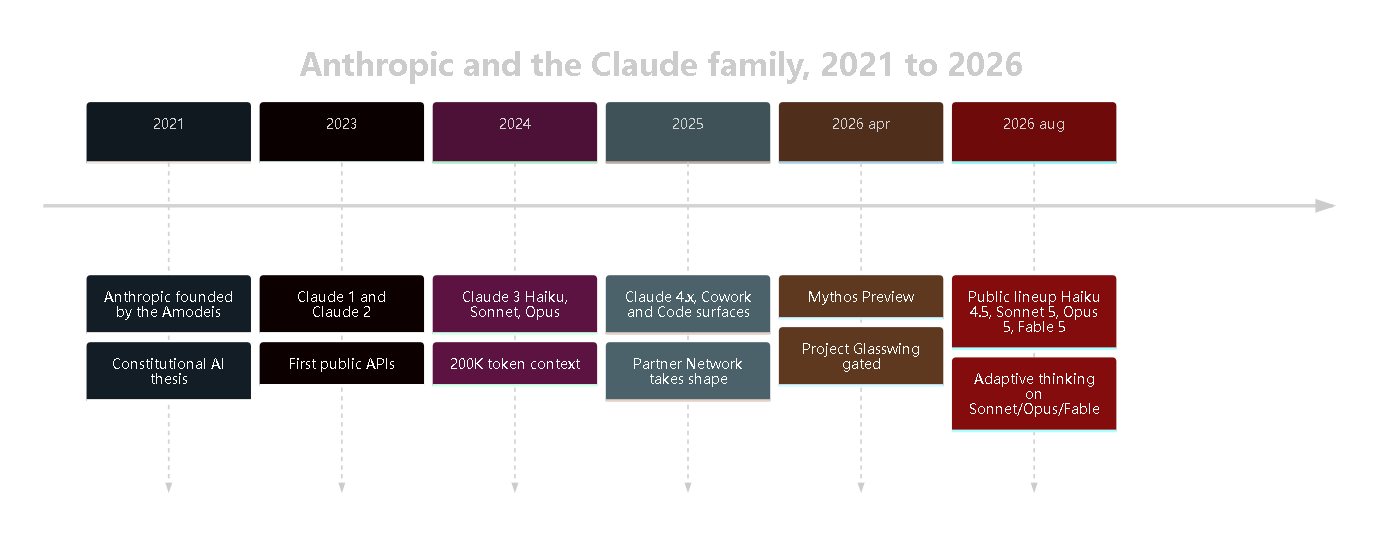
See Mermaid diagram
timeline
    title Anthropic and the Claude family, 2021 to 2026
    2021 : Anthropic founded by the Amodeis
         : Constitutional AI thesis
    2023 : Claude 1 and Claude 2
         : First public APIs
    2024 : Claude 3 Haiku, Sonnet, Opus
         : 200K token context
    2025 : Claude 4.x, Cowork and Code surfaces
         : Partner Network takes shape
    2026 apr : Mythos Preview
             : Project Glasswing gated
    2026 aug : Public lineup Haiku 4.5, Sonnet 5, Opus 5, Fable 5
             : Adaptive thinking on Sonnet/Opus/Fable
4. The public lineup as of August 2026
Today there are four models available to the general public and one gated that we cover separately. Prices in USD per million tokens (input/output), per Anthropic's official catalog.
| Model | Position | Price (in/out) | Context | For what |
|---|---|---|---|---|
| Haiku 4.5 | Fast and cheap | $1 / $5 | 200K | High frequency, simple tasks, low latency |
| Sonnet 5 | The balance | $2 / $10 | 200K | Day to day work, best capability/price ratio |
| Opus 5 | Complex agents | $5 / $25 | 1M | Agentic coding, long reasoning, adaptive thinking |
| Fable 5 | Public frontier | $10 / $50 | 1M | Frontier work with bio and cybersec safeguards |
Two operational details rarely explained and that decision makers actually care about:
Adaptive thinking. Sonnet 5, Opus 5, and Fable 5 no longer spend a fixed "hidden reasoning" budget. The model decides how much to think based on prompt difficulty. That one change, which sounds technical, is what makes paying for Opus 5 viable on mixed tasks without burning budget on trivial questions.
Sonnet 5 froze its price. Anthropic had announced a rise from $2/$10 to $3/$15 scheduled for September 2026. They canceled it. The model most used by SMBs is now permanently in the low band.
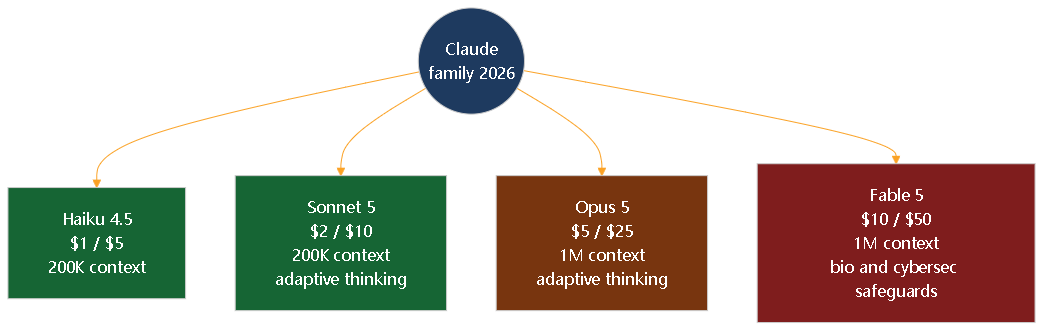
See Mermaid diagram
flowchart TB
    Root(("Claude
family 2026"))
    H["Haiku 4.5
$1 / $5
200K context"]
    S["Sonnet 5
$2 / $10
200K context
adaptive thinking"]
    O["Opus 5
$5 / $25
1M context
adaptive thinking"]
    F["Fable 5
$10 / $50
1M context
bio and cybersec safeguards"]

    Root --> H
    Root --> S
    Root --> O
    Root --> F

    style Root fill:#1e3a5f,color:#fff
    style H fill:#166534,color:#fff
    style S fill:#166534,color:#fff
    style O fill:#78350f,color:#fff
    style F fill:#7f1d1d,color:#fff
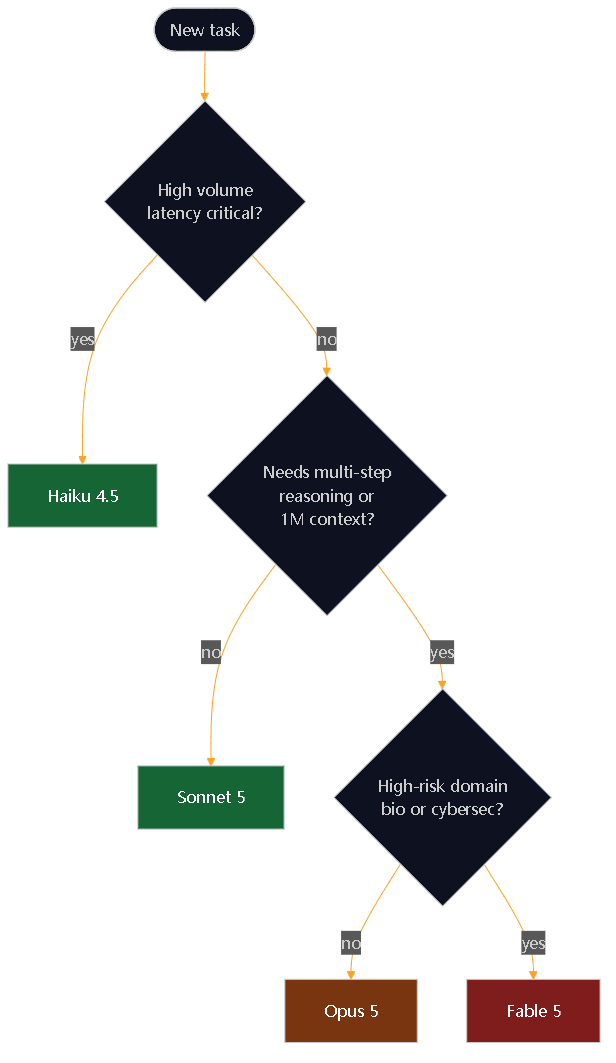
See Mermaid diagram
flowchart TD
    Start(["New task"]) --> Q1{"High volume
latency critical?"}
    Q1 -- "yes" --> H["Haiku 4.5"]
    Q1 -- "no" --> Q2{"Needs multi-step
reasoning or
1M context?"}
    Q2 -- "no" --> S["Sonnet 5"]
    Q2 -- "yes" --> Q3{"High-risk domain
bio or cybersec?"}
    Q3 -- "no" --> O["Opus 5"]
    Q3 -- "yes" --> F["Fable 5"]

    style H fill:#166534,color:#fff
    style S fill:#166534,color:#fff
    style O fill:#78350f,color:#fff
    style F fill:#7f1d1d,color:#fff
5. Mythos: the tip of the iceberg (this is where partners are separated from snake oil sellers)
In April 2026 Anthropic officially announced Claude Mythos, a model above Fable 5 on the capability tree. Internal codename: Capybara. It is, according to Anthropic, "state of the art at cybersecurity, biology research, and healthcare."
This is where an honest guide separates itself from the noise. Because what matters about Mythos is not the marketing; it is three uncomfortable facts most articles are omitting.
5.1 Mythos is not available on the open market
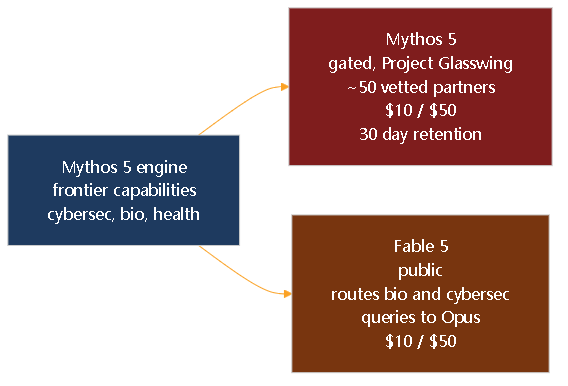
Access is only inside a gated program called Project Glasswing, with approximately 50 vetted partners. Anthropic's stated reason is direct: the same capabilities that find vulnerabilities can be used to exploit them. It is the economic model of "capability under lock": unlocking capability does not mean democratizing it; it means allocating it responsibly.
Any provider telling you today "we integrate Mythos into your company" is selling smoke. And this is the first cheap test you can apply to any consultant pitching AI: ask them if their company is in Project Glasswing. If they cannot answer with name and URL, the conversation is marketing.
5.2 Fable 5 is the public reflection of Mythos
It shares the same base model but adds safeguards that automatically route sensitive biology and cybersec queries to Opus 5. In practical terms, the public user does not consume Mythos; they consume Fable 5, and that is already a frontier model.
It is literally the same engine with two different doors. The difference is not in the horsepower; it is in the filter Anthropic places on top before letting the response out.
See Mermaid diagram
flowchart LR
    Core["Mythos 5 engine
frontier capabilities
cybersec, bio, health"]
    M["Mythos 5
gated, Project Glasswing
~50 vetted partners
$10 / $50
30 day retention"]
    F["Fable 5
public
routes bio and cybersec
queries to Opus
$10 / $50"]

    Core --> M
    Core --> F

    style Core fill:#1e3a5f,color:#fff
    style M fill:#7f1d1d,color:#fff
    style F fill:#78350f,color:#fff
5.3 The Project Glasswing numbers are why the lock exists
In the preview phase of the program, partners identified more than ten thousand vulnerabilities of high or critical severity in systemically important software, according to Anthropic's own Mythos page. That number is what justifies keeping Mythos under lock: if a model can find ten thousand critical vulnerabilities, it can also teach someone to exploit them. The mandatory 30-day retention of every Mythos query exists for that reason.

See Mermaid diagram
flowchart LR
    A["Anthropic"]
    P["~50 vetted
partners"]
    M["Mythos Preview
research access
30 day retention"]
    V["+10,000 vulnerabilities
high or critical severity"]
    R["Responsible disclosure
reports"]

    A --> P
    P --> M
    M --> V
    V --> R

    style A fill:#1e3a5f,color:#fff
    style P fill:#166534,color:#fff
    style M fill:#7f1d1d,color:#fff
    style V fill:#78350f,color:#fff
    style R fill:#166534,color:#fff
5.4 What this means for a decision maker
Three concrete things:
One: if a consultant sells you Mythos, now you know they are lying. That is the first filter. If they cannot even describe Project Glasswing well and what makes Mythos different from Fable 5, they are not qualified to touch your operation with Claude.
Two: frontier capability already reaches the public market, packaged as Fable 5. A well-designed pilot on Sonnet 5 or Opus 5 covers 95 percent of serious cases in a distributor or a clinic; Fable 5 is only justified when the case touches sensitive bio or cybersec data.
Three: the very existence of Mythos changes the price conversation. When Anthropic says $10/$50 horsepower is available to the public with safeguards (Fable 5), and another share is kept under lock for frontier research (Mythos), the "the trendy model" argument dissolves. What matters is what is built around it. It is the conversation Anthropic pushed in writing in its Partner Basecamp: the model is a commodity; the application layer is the product.
At Transgenia we work with Opus 5, Sonnet 5, and Haiku 4.5 for our client pilots. We use Fable 5 internally when we need to review our own sensitive code. We do not have and do not claim access to Mythos. That honesty is part of the criterion by which we evaluate any consultant.
6. The four surfaces: not all Claude runs in a chat
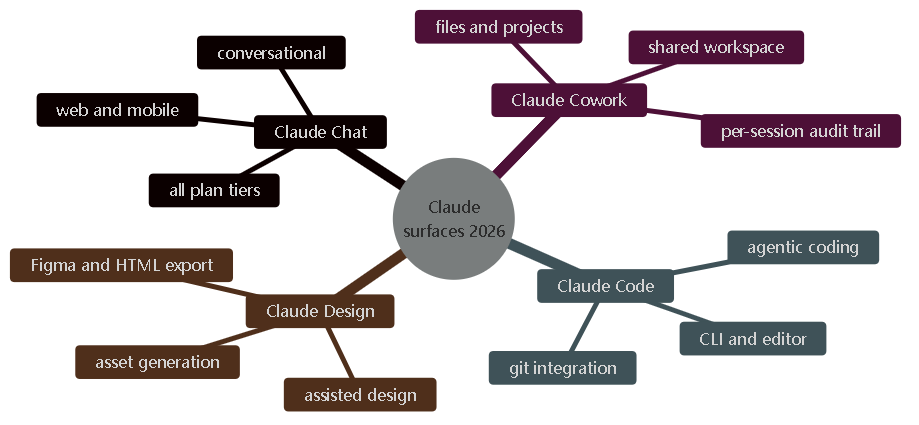
One of the least announced and most useful changes of 2026 was Claude unfolding into four distinct surfaces, each with its own logic and its own plan.
See Mermaid diagram
mindmap
  root((Claude
surfaces 2026))
    Claude Chat
      conversational
      web and mobile
      all plan tiers
    Claude Cowork
      shared workspace
      files and projects
      per-session audit trail
    Claude Code
      CLI and editor
      agentic coding
      git integration
    Claude Design
      assisted design
      Figma and HTML export
      asset generation
- Claude Chat: the entry point, what most people know. Web and mobile interface.
- Claude Cowork: shared workspace with files, projects, and per-session traceability. This is where serious collaborative work happens.
- Claude Code: the CLI and editor integrations for agentic code work, wired to git. It is the surface Transgenia uses for its own pilots, and the one the Delivery Methodology Badge is designed around.
- Claude Design: specialized surface for visual tasks with Figma and HTML export.
Picking a surface is a process decision, not a taste one. In the implementation manual we document how that mapping is done in a 30-day pilot.
7. Plans and pricing: what each tier buys

See Mermaid diagram
flowchart LR
    Free["Free
Sonnet 5 with limits
basic Chat"]
    Pro["Pro
Sonnet 5, limited Opus 5
Chat + Cowork + Code
individual use"]
    Max["Max
Opus 5 without practical limits
all surfaces
teams"]
    API["API
token consumption
models per endpoint
custom integration"]

    Free --> Pro --> Max
    Max -.-> API

    style Free fill:#166534,color:#fff
    style Pro fill:#78350f,color:#fff
    style Max fill:#7f1d1d,color:#fff
    style API fill:#1e3a5f,color:#fff
Exact numbers and fine print change month to month; always verify on Anthropic's official page. The stable rule is the one above: do not jump from Free to API. Walk.
8. Why a partner when the API is one click away (and how to tell them apart from a salesperson)
Anthropic itself raised this question in the introduction of its Partner Basecamp: "if models are commodities anyone can access, why bring in a partner when anyone can call the same APIs?" We work through the answer in detail in the implementation manual, but the summary is useful here.
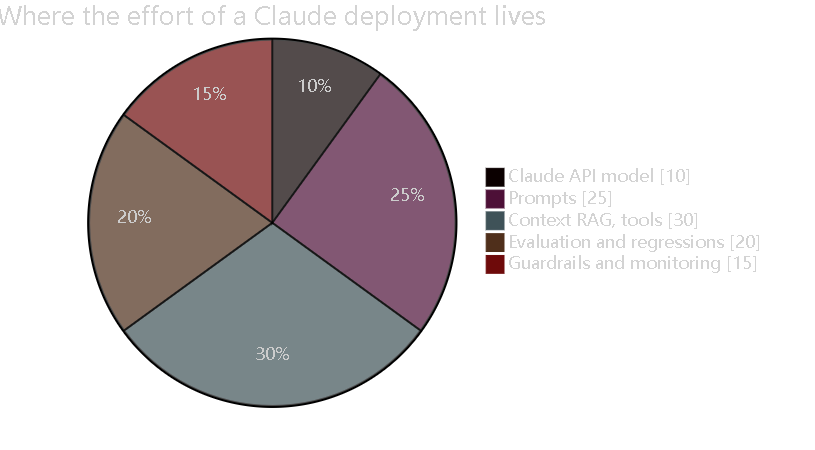
The bottleneck moved. It is no longer in the model. It is in the application layer, which weighs around 90 percent of the real effort of a deployment.
See Mermaid diagram
pie showData
    title Where the effort of a Claude deployment lives
    "Claude API model" : 10
    "Prompts" : 25
    "Context RAG, tools" : 30
    "Evaluation and regressions" : 20
    "Guardrails and monitoring" : 15
This is where it is worth putting numbers to the test we apply when a consultant walks into the room. Registered Anthropic partners have a documented path: we went through the Delivery Methodology, we delivered a real pilot, and we can show a public credential. An average consultant who "uses Claude" cannot show any of those three things, and that is not a detail. It is the difference between a decision with evidence on day 30 and an interesting demo forgotten by week 3.
Five questions to apply to anyone selling you AI with Claude, and a registered partner answers without hesitation:
- What is your public Credly credential and under which name is it issued?
- Which exact version of the lineup are you working on today? (If they say "Claude 3" or just "Claude Opus" without a 5, they are stuck in 2024.)
- What is the difference between Fable 5 and Mythos, and which one are you using in the project you are proposing?
- What is your baseline BEFORE the pilot and how will you measure it?
- Who becomes the internal champion when you leave?
If three of the five come back unclear, this is not a partner. It is someone selling with a borrowed Anthropic logo. In an industry where three new models ship every month, knowing the details is not tech snobbery; it is the minimum proof that the consultant is living the wave, not reading the marketing.
If your company operates with multiple brands, multiple suppliers, or a high-SKU catalog, the conversation becomes concrete in the specific guide for B2B trading companies. If yours is a private clinic, the conversation becomes concrete in the guide for clinics and practices.
9. What this looks like in a real Mexican distributor
At Transgenia we have qualified four repeatable structural use cases in B2B distributors, all anchored to metrics an operations director is already watching:
- Real landed cost per SKU (freight, tariff, exchange rate, port handling, customs broker fees), instead of average costing that hides negative margins.
- International supplier follow-up agent and PO ETA, with reading of emails and attachments.
- Predictive inventory to reduce stockouts and free capital immobilized in slow-moving stock.
- Automatic reading and classification of customs documents: commercial invoices, pedimentos, packing lists, certificates of origin.

See Mermaid diagram
flowchart LR
    Question["Initial question
which process qualifies"]
    F0["Qualification
4 filters"]
    F1["Design
cohort and scope"]
    F2["Measurement
baseline and ROI"]
    F3["Adoption
4 stretches, day 1 to 30"]
    F4["Day 30 decision
scale, adjust, or discard"]

    Question --> F0 --> F1 --> F2 --> F3 --> F4

    style Question fill:#78350f,color:#fff
    style F0 fill:#166534,color:#fff
    style F1 fill:#166534,color:#fff
    style F2 fill:#1e3a5f,color:#fff
    style F3 fill:#1e3a5f,color:#fff
    style F4 fill:#7f1d1d,color:#fff
If you are interested in how this AI layer connects to real Odoo operations, multi-brand inventory, and project margin, we have it documented in Stabilize Before You Migrate Odoo · Wholesale Inventory.
10. Five mistakes to avoid when starting with Claude
See Mermaid diagram
mindmap
  root((5 mistakes
when starting
with Claude))
    Overpaying tier
      Opus for everything
      when Sonnet is enough
      burns budget
    Chatting without process
      loose questions
      no repeatable flow
      never generates evidence
    No baseline
      no before
      no after
      unfalsifiable ROI
    No internal champion
      peer referent
      not the most technical
      adoption stalls week 3
    No evaluation
      quality unmeasured
      silent regressions
      confidence without basis
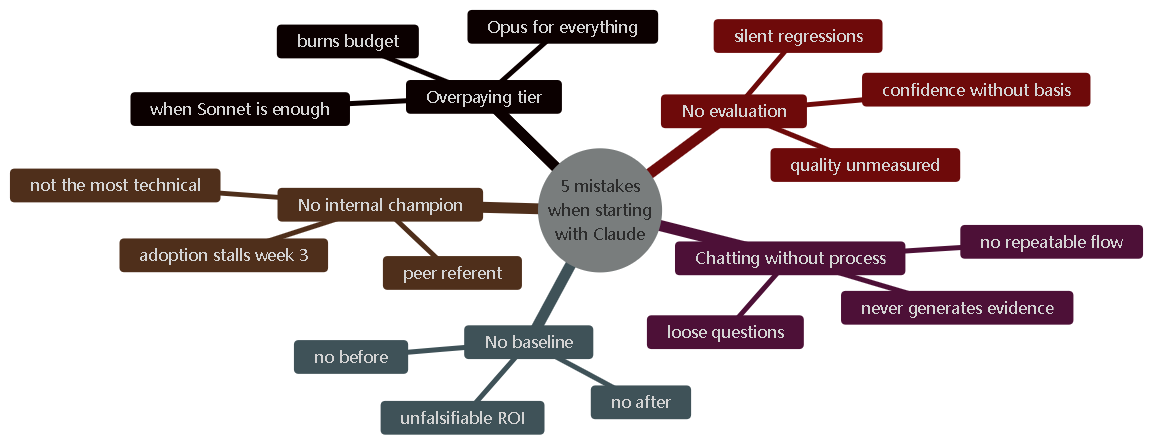
One: overpaying tier. Opus 5 for tasks that Sonnet 5 handles equally well. The most common silent overspend.
Two: chatting without process. A team using Claude as a search engine never generates evidence.
Three: starting without a baseline. A pilot with no prior number is a pilot with no possible ROI.
Four: no internal champion. Adoption dies in week 3 without a peer referent.
Five: no evaluation. Without measured regressions, trust in the agent is faith, not evidence.
11. How to start: the shortest possible step
Before writing any prompt, ask yourself four questions about the process you would like to automate:
- Does it happen often enough to be worth it?
- Does it have clear rules or does it depend on undocumented judgment?
- Does a baseline number exist today, even in a spreadsheet?
- Is the person who lives the process willing to change their flow for 30 days?
If your answer is "yes" to at least three, you probably have a qualified case for a pilot. If not, that is exactly the work you must do before signing anything, and before believing any consultant.
The first step is not signing an AI project. It is a 15-minute diagnostic with these filters. Nothing more.
Claude Partner Badge · Claude Code
Issued by Anthropic to Efraín Carreón Ortiz. Accredits readiness to size, deploy, configure, and operate Claude Code activations end to end. The program is 8 courses plus a final scenario-based evaluation.
This article is an educational guide by Centrum Transgenia SAS, updated to August 22, 2026. Transgenia is a registered Claude partner (Anthropic); not a certified partner. No figure in this article represents a specific client result and we do not have or claim access to the Project Glasswing program.
Cited sources:
- Anthropic, Claude Mythos.
- Anthropic, Introducing the Services Track and Partner Hub of the Claude Partner Network.
- Anthropic, Anthropic invests $100 million into the Claude Partner Network.
- Credly, Claude Partner Badge · Claude Code (Efraín Carreón Ortiz).
- Wikipedia, Claude (language model).