There are dozens of guides on how to implement Claude in a company. Most share the same flaw: they are written by people who have not done it in real production. This text is written from the engine room. Centrum Transgenia currently operates twelve governed Claude agents in its own production, plus verifiable client implementations in the health and B2B sectors. This is the method.
By 2026, almost every SME in Mexico has received at least one "AI agents" proposal from a consultant or platform. Their offers vary in form but converge on the same substance: an impressive demo, a promise of automation and, after the contract is signed, a language model that does exactly what you tell it, for better or worse, with no one having built any governance around it.
This guide starts from a different premise: the competitive advantage of implementing Claude well is not in the model, it is in the method. The model is available to anyone who pays for the API. The method is what separates a pilot from an operation.
What does implementing Claude in a company mean? (And what it is NOT)
Implementing Claude is not activating an API account and hooking a chatbot up to your website. It is an organizational transformation process with a specific scope: moving repetitive, high-frequency decisions from ad-hoc human judgment into the workflow of a governed agent.
What implementing Claude is not:
- It is not magic without configuration. Claude knows nothing about your company until you give it structured context: reference documents, operational rules, allowed tools and explicit constraints.
- It is not people replacement. Implementations that try to replace whole roles almost always fail. Ones that augment specific capabilities of existing people have much higher adoption rates.
- It is not an IT decision. It is a process and governance decision that requires sign-off from the process owner, not just the technical team.
An honest disclosure about our position before we continue: Centrum Transgenia is a registered partner of Anthropic in the official Claude Partners program (the first of four tiers in that program). We are not a "certified consultant"; that category does not exist in Anthropic's program. We are not "the best partner in LATAM"; that claim has no verifiable backing. What we do have is documented in-house operation in production and verifiable client cases, detailed further below.
The 6 implementation phases

Diagram source (Mermaid)
flowchart LR
    F1["Phase 1\nDiagnosis\nMap before touching\ntools"] --> F2["Phase 2\nPrioritization\nDAP-D Framework"] --> F3["Phase 3\nGovernance\nDraft-first\nHuman sign-off"] --> F4["Phase 4\nAdoption\nProjects · Skills"] --> F5["Phase 5\nROI\nReal metrics"] --> F6["Phase 6\nContinuous governance\nQuack · MCP · OTel\nMultiplication"]
    style F6 fill:#E14228,stroke:#E14228,color:#FFFFFF
Phase 1: Diagnosis. Map before touching tools
The first implementation mistake is starting from the tool ("how much does the Claude API cost?") instead of from the task ("which repetitive decisions consume the most of our team's time?").
The diagnosis looks for three things:
Inventory of candidate tasks. Meetings with each team to list the tasks with high frequency, low strategic value and a predictable pattern: answering order-status questions, classifying support tickets, drafting follow-up emails, reviewing documents against fixed criteria.
Estimate of the current cost. How many person-hours are invested in those tasks per week. Without this number, the ROI in Phase 5 will always be an estimate, never a measured result.
Governance risk map. What happens if the agent gets this task wrong? Is it reversible? Does it have direct customer impact or affect critical data? High-risk tasks are not necessarily out of scope; they require a stricter lock.
The Phase 1 deliverable is a map of candidate tasks with estimated cost, risk profile and basic technical feasibility. No code yet.
Phase 2: Prioritization with the DAP-D framework
There are dozens of AI prioritization frameworks. The one we developed internally after multiple implementations is the DAP-D framework (Pain, Abundance of data, operational Leverage, Design), with four criteria:
| Criterion | Key question | High-priority signal |
|---|---|---|
| Pain | How costly is this task without AI? | More than 4 person-hours per week |
| Abundance of data | Do we have examples of how to do it well? | Yes, in documents or accessible history |
| Leverage (operational) | If it is automated, does it free up strategic decision time? | The team can do more with the same headcount |
| Design | Can the process be redesigned so Claude is the right actor? | The flow fits into a structured prompt |
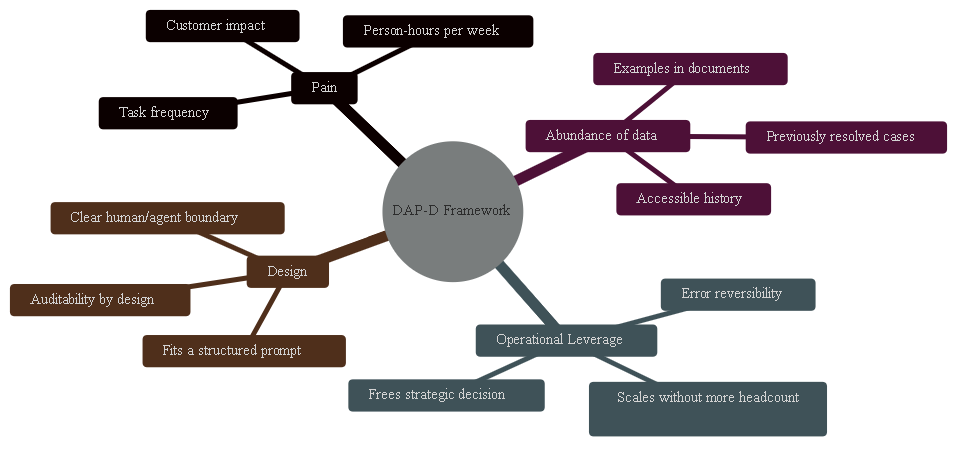
Diagram source (Mermaid)
mindmap
  root((DAP-D Framework))
    Pain
      Person-hours per week
      Customer impact
      Task frequency
    Abundance of data
      Examples in documents
      Accessible history
      Previously resolved cases
    Operational Leverage
      Frees strategic decision
      Scales without more headcount
      Error reversibility
    Design
      Fits a structured prompt
      Clear human/agent boundary
      Auditability by design
A task with high DAP-D on all four criteria is a candidate for a first agent. One with high Pain but low Design needs process redesign before the agent.
Placing Design last is intentional: the business process leads, the technology adapts. Many implementations fail because the agent's design is built first and the process then tries to fit into it, which is exactly the wrong way around.
Phase 3: Governance. The lock almost nobody installs
This is the phase that gets skipped most often and the one that costs the most to skip. Governance is not a policy in a PDF. It is a systems architecture with three concrete elements:
Draft-first as a universal protocol. Every agent delivers a draft; no agent executes without explicit human approval in a fixed format. An agent that can send an email without approval is a time bomb. An agent that drafts the email and waits for a human "Send" before executing is a reliable productivity tool.
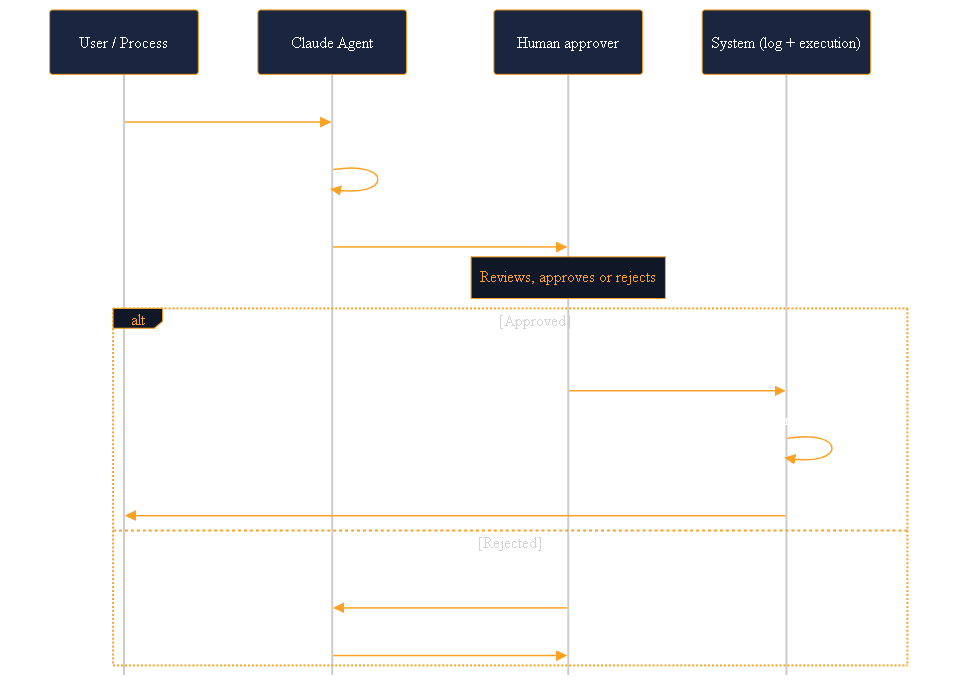
Diagram source (Mermaid)
sequenceDiagram
    participant U as User / Process
    participant A as Claude Agent
    participant H as Human approver
    participant S as System (log + execution)
    U->>A: Requests action
    A->>A: Drafts output
    A->>H: Delivers draft with context
    Note over H: Reviews, approves or rejects
    alt Approved
        H->>S: Exact sign-off phrase
        S->>S: Logs: model, tokens, tool, timestamp
        S->>U: Executes action
    else Rejected
        H->>A: Returns with corrections
        A->>H: New draft
    end
Explicit write boundary. The agent's tools are split into two lists: read_tools (free reads) and write_tools (gated writes). An agent can read the CRM, email, reports, dashboards. It cannot modify a record, cancel an order or send a notification without crossing the approval lock.
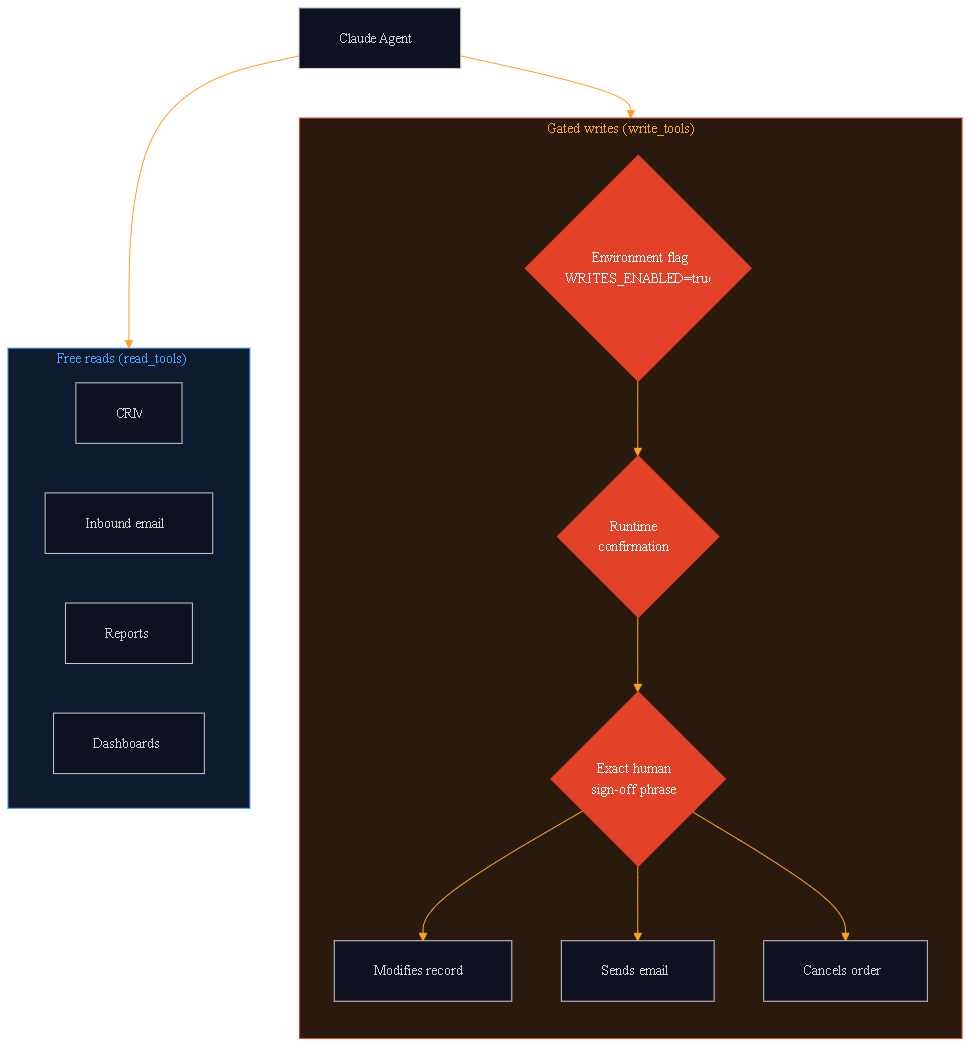
Diagram source (Mermaid)
flowchart TB
    subgraph READ[" Free reads (read_tools) "]
        R1["CRM"]
        R2["Inbound email"]
        R3["Reports"]
        R4["Dashboards"]
    end
    subgraph WRITE[" Gated writes (write_tools) "]
        C1{"Environment flag WRITES_ENABLED=true"}
        C2{"Runtime confirmation"}
        C3{"Exact human sign-off phrase"}
        W1["Modifies record"]
        W2["Sends email"]
        W3["Cancels order"]
        C1 --> C2 --> C3 --> W1
        C3 --> W2
        C3 --> W3
    end
    A["Claude Agent"] --> READ
    A --> WRITE
Auditability by design. Every agent action produces a structured log: which task, which model, how many tokens, which tool, who approved, when. Without this log it is impossible to run continuous improvement or diagnose errors precisely. The article How we govern a team of twelve AI agents documents the nine operational practices we derived from in-house operation.
The open-standard reference for AI governance is the NIST AI Risk Management Framework 1.0 (doi.org/10.6028/NIST.AI.100-1), published in January 2023, which defines four functions: Govern, Map, Measure, Manage. The DAP-D framework lives inside the Map function; draft-first and the write boundary live inside Govern and Manage.

Diagram source (Mermaid)
flowchart LR
    subgraph NIST["NIST AI RMF 1.0"]
        G["GOVERN"]
        M["MAP"]
        ME["MEASURE"]
        MA["MANAGE"]
    end
    subgraph TG["Transgenia Method"]
        DAPD["DAP-D Framework"]
        DF["Draft-first + Boundary"]
        ROI["ROI metrics"]
        GC["Continuous governance"]
    end
    M -.-> DAPD
    G -.-> DF
    MA -.-> DF
    ME -.-> ROI
    G -.-> GC
    MA -.-> GC
We have interactive demos with simulated data from the health sector (clinics) and the B2B wholesale sector. Access with a corporate email, no passwords, no sales demos, no mandatory prior call.
See the demo by sector →
Phase 4: Adoption and enablement
A technically perfect agent nobody uses is wasted investment. Adoption is a human design problem, not a technological one.
The three adoption pillars that work in Mexican teams of 10 to 100 people:
Claude Projects. Claude Projects lets you create a persistent workspace with instructions, reference documents and memory of prior conversations. For sales, finance or customer-support teams, Projects is the fastest way to start without writing code: the agent "learns" the business context from the documents you upload.
Skills and declarative capabilities. Claude Skills let you define reusable workflows the team can invoke with a command. They are the equivalent of Excel macros, but for structured reasoning flows.
Model Context Protocol (MCP). MCP (modelcontextprotocol.io) is the open standard for connecting Claude with external systems: databases, CRMs, ERPs, APIs. A mature implementation connects the agent to the real data sources of the business, not to data manually copy-pasted into the chat. That is the jump from "individual productivity tool" to "organizational operating system."
The enablement that works is incremental: first a "champion" user per area, then that champion trains the team using their own contextual use cases, not generic demos.
Phase 5: ROI measurement
The "reduce costs by 40%" promise that shows up in every AI presentation is, at best, an extrapolation from case studies with very different contexts. Real measurement is more modest and more useful.
The metrics that are actually measurable from month one:
- Time-per-task before vs. after. If the Phase 1 diagnosis measured person-hours, the ROI is the direct difference. Without Phase 1 there is no baseline; without a baseline there is no measurable ROI.
- Draft approval rate. If 80% of the agent's drafts are approved without significant editing, the agent is useful. If 60% are rejected or rewritten, the context or the process design needs adjustment.
- Cost per AI task. Every Claude API call has a token cost. Monitoring cost per task avoids surprises on the monthly bill.
- Volume of tasks displaced. How many tasks from the Phase 1 inventory are running through the agent. This is the real adoption indicator.
The Stanford AI Index 2026 (hai.stanford.edu/ai-index) documents that companies with higher AI maturity invest proportionally more in measurement and governance than in model capability. The correlation between governance maturity and real ROI is much stronger than the correlation between model power and ROI. The model is only the starting point.
Phase 6: Continuous governance and multiplication
This is the phase that almost no market guide includes. This is where the difference between a successful pilot and a governed operation that scales lives.
A pilot has one agent. An operation has a team of agents with roles, constraints and communication channels between them. The system we use at Transgenia is called Quack and today runs twelve specialized Claude agents under a common delegation protocol.
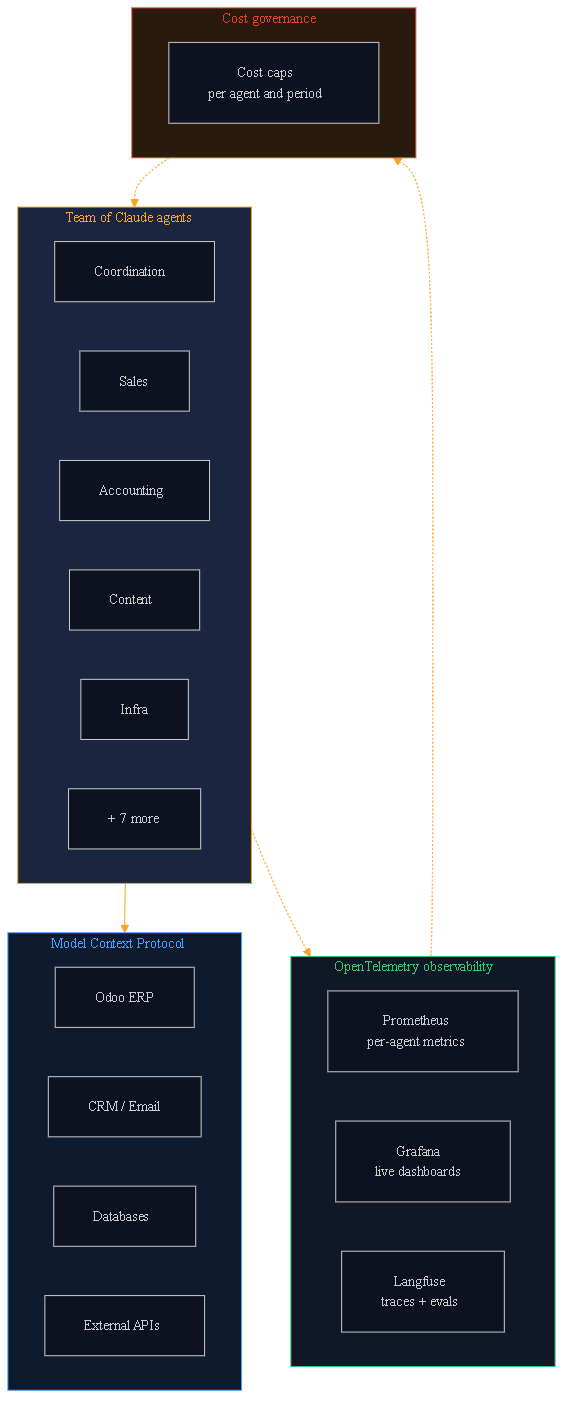
Diagram source (Mermaid)
flowchart TB
    subgraph AGENTS["Team of Claude agents"]
        A1["Coordination"]
        A2["Sales"]
        A3["Accounting"]
        A4["Content"]
        A5["Infra"]
        A6["+ 7 more"]
    end
    subgraph MCP["Model Context Protocol"]
        M1["Odoo ERP"]
        M2["CRM / Email"]
        M3["Databases"]
        M4["External APIs"]
    end
    subgraph OBS["OpenTelemetry observability"]
        O1["Prometheus"]
        O2["Grafana"]
        O3["Langfuse"]
    end
    subgraph COST["Cost governance"]
        CC["Per-agent cost caps"]
    end
    AGENTS --> MCP
    AGENTS -.-> OBS
    OBS -.-> COST
    COST -.-> AGENTS
The three elements of continuous governance:
Cost governance. AI costs grow with usage. Without explicit per-agent and per-period limits, total cost can become unpredictable. Cost caps on the Claude API and per-agent usage dashboards are as important as the business metrics.
Evolution of Skills and MCPs. The stack's capabilities must evolve with the business. MCP makes connecting new data sources incremental, not a full re-engineering. Every new integration adds value without breaking what already works.
Pattern multiplication. Once Phase 3 governance is solid, replicating the pattern to a new business area takes days, not months. Continuous governance is the infrastructure that makes that multiplication possible without losing operational control.
For private clinics, the implementation pattern is described in detail at /en/clinics.html. For B2B trading companies, at /en/trading-companies.html.
DIY, freelance consultant or registered Anthropic partner?
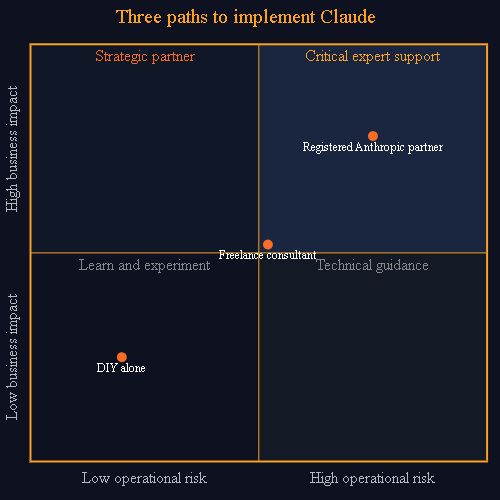
Diagram source (Mermaid)
quadrantChart
    title Three paths to implement Claude
    x-axis Low operational risk --> High operational risk
    y-axis Low business impact --> High business impact
    quadrant-1 Critical expert support
    quadrant-2 Strategic partner
    quadrant-3 Learn and experiment
    quadrant-4 Technical guidance
    DIY alone: [0.20, 0.25]
    Freelance consultant: [0.52, 0.52]
    Registered Anthropic partner: [0.75, 0.78]
The three paths all have legitimate use cases. The right decision criterion is not price but risk profile:
DIY alone. Works well when the team has internal technical capacity, the use case is low risk (email drafting, document summarization, meeting assistant) and the goal is learning. Claude.ai with Projects is functional without a line of code. The main risk is getting stuck at the "individual productivity tool" level and never reaching "organizational operating system."
Freelance consultant. Useful for scoped projects with clear specifications: integrating Claude into an existing tool, building a specific flow, training the team on the API. The market has competent consultants at reasonable prices. The limitation is that once the project is delivered, maintenance falls on the internal team, which sometimes lacks the technical context to sustain it.
Registered Anthropic partner. The Anthropic Partners program distinguishes firms that have a formal relationship with Anthropic and operate real production cases. The practical difference for the client is twofold: access to up-to-date technical guidance directly from the model maker, and verifiable evidence of in-house operation (not just client projects). The partner is accountable not only for the code but for the method.
None of these three options is "the right one" in the abstract. The choice depends on the use case, the budget and the organization's risk tolerance.
Three verifiable Claude implementation cases
Below are three real implementations. The first two follow the Transgenia anonymization policy: no client name, no specific amounts. The third one is ourselves: the only case where a name appears.
Case 1: A private bariatric clinic in CDMX
A private bariatric clinic in Mexico City had a concrete problem: post-operative follow-up consumed between 3 and 4 person-hours per day of its nursing team, split between routine reminders, review of symptom questionnaires and updates to the clinical record.
The implementation covered Phases 1 to 4: diagnosis of the follow-up process, prioritization of high-frequency tasks with DAP-D (reminders and symptom review scored the maximum on Pain and Abundance of data), governance with draft-first for every clinical note, and adoption through Claude Projects integrated into the existing flow.
The agent drafts the follow-up note from the patient questionnaire; the physician reviews and approves it before it enters the record. Per-note review time is substantially lower than the time it took to draft the note manually. The clinical flow demo available at /demos/ shows a simulation of this process with synthetic data.
Case 2: A B2B trading company with +80 brands, multi-country
A B2B trading company with more than eighty brands in its portfolio and operations across several Latin American countries had a bottleneck at its service desk: response time on support requests was breaching the contractual SLA on a significant share of tickets.
The implementation prioritized Phases 2 and 3: the DAP-D framework identified that classification and first-response drafting were the tasks with the highest Pain (SLA breaches had direct cost in penalties) and the highest Abundance of historical data (thousands of prior tickets with documented resolutions). Governance established that the agent classifies, prioritizes and drafts the first response; the human agent reviews and sends.
The B2B service-desk demo available at /demos/ includes simulated data with the same pattern, with SLA metrics verifiable in real time.
Case 3: Transgenia, twelve governed Claude agents in production
This is the only case in which we use a real name, because it is us. Centrum Transgenia currently runs twelve specialized Claude agents under the Quack system: project coordination (Jack), accounting and tax compliance (Ariadna), sales and prospecting (Valentina), SEO/GEO content generation (Satira), infrastructure and DevOps (Kelsey), public relations and authority (Antoni), and others with specific functions.
Each agent has a bounded role, a set of read and write tools with distinct permissions, and a draft-first rule that blocks any irreversible action without explicit human approval. Governance is not a document: it is a technical architecture that includes OpenTelemetry telemetry into Prometheus, Grafana and Langfuse to measure each agent's cost and performance in real time.
The article How Transgenia runs with governed AI agents describes the system. The article How we govern a team of twelve AI agents documents the nine operational practices with technical detail.
Common mistakes when implementing Claude in Mexico and LATAM
After in-house and client implementations in the Mexican context, these are the mistakes that recur most often:
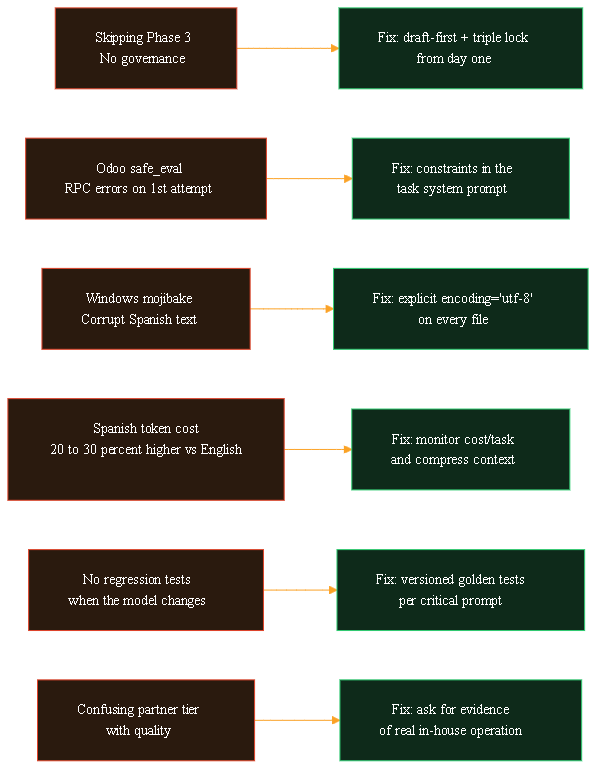
Diagram source (Mermaid)
flowchart LR
    E1["Skipping Phase 3"] --> F1["Draft-first + triple lock"]
    E2["Odoo safe_eval"] --> F2["Constraints in system prompt"]
    E3["Windows mojibake"] --> F3["Explicit encoding=utf-8"]
    E4["Spanish token cost"] --> F4["Monitor cost/task"]
    E5["No regression tests"] --> F5["Versioned golden tests"]
    E6["Confusing tier with quality"] --> F6["Ask for in-house operation evidence"]
Skipping Phase 3 because "first we want to see if it works." A pilot without governance builds uncontrolled usage habits that are very hard to correct later. Governance is cheaper to install on day one than to remediate in month six, when there are already users depending on the system.
Using Odoo safe_eval with Claude-generated code without warning it. In Odoo SaaS implementations (the most common ERP setup in Mexico), the server-actions environment uses safe_eval, which forbids imports, user-defined functions and several standard Python constructs. Code generated by Claude without this specific context errors out on the first attempt. The fix is to include the safe_eval restrictions as part of the task's system prompt.
Mojibake in text processing on Windows environments. Windows systems with default regional settings use the cp1252 codepage as default. Claude generates UTF-8. Without an explicit encoding="utf-8" on every Python file operation, Spanish text (accents, ñ, ü) is silently corrupted. It is not a model error; it is a local infrastructure configuration problem.
Spanish vs English token cost. Claude tokenizes Spanish with higher token density per word than English. For long prompts in Spanish, per-call cost can be between 20 and 30% higher than the English equivalent. It is not a blocker, but it is a real factor in Phase 6 cost governance that few guides mention.
Not having a governance plan for when the model changes. Anthropic updates Claude periodically. A prompt that works on one version may produce different results on the next. Phase 6 continuous governance includes a regression-testing process before updating the production model.
The reference for security risks in production LLMs is the OWASP GenAI LLM Top 10 2026, which documents the most common risks in production LLM systems: prompt injection, insecure output handling, model supply-chain vulnerabilities, among others.
Frequently asked questions
How long does a full Claude implementation in a company take?
It depends on scope. An implementation covering Phases 1 to 3 (diagnosis, prioritization and first governed agent) can be completed in four to six weeks with a dedicated team of two or three people. Phases 4 to 6 (adoption, ROI and continuous governance) are ongoing processes measured in quarters.
A working pilot with measurable value can be ready in less than a month; a mature operation with multiple agents requires three to six months of active engagement.
Does Claude work with Odoo, the most common ERP in Mexican SMEs?
Yes. Transgenia runs Claude connected to Odoo via Model Context Protocol (MCP). The integration lets agents read and write in Odoo under the governance constraints described in Phase 3. Integration detail for clinics is at /en/clinics.html and for trading companies at /en/trading-companies.html.
What is the difference between using Claude.ai directly and contracting an implementation?
Claude.ai (Anthropic's chat interface) is enough for individual productivity: drafting, summarizing, analyzing documents. An implementation adds three layers that Claude.ai alone does not provide:
(1) integration with the company's real data systems via MCP; (2) governance and workflow approval with draft-first; and (3) telemetry and operational ROI measurement. Without those three layers, Claude is an excellent personal tool but not a scalable organizational system.
Can Claude work with Spanish documents, including Mexican contracts and invoices?
Yes. Claude 3.5 Sonnet and Claude 4 have native Mexican Spanish capability, including tax terminology (CFDI, SAT, RFC, DIOT) and sector-specific vocabulary. In CFDI-invoice implementations, the agent can process the XML directly with the right instruction.
Handling accents and special characters requires explicit UTF-8 encoding in the runtime environment (see the mojibake point in the common-mistakes section).
Is programming required to implement Claude in a company?
For Phases 1 to 4 (diagnosis, prioritization, basic governance, adoption with Projects and Skills), no. Claude Projects and Skills are functional without programming.
For Phases 5 and 6 (measurement with telemetry, continuous governance with MCP and integrations to external systems), technical capability or a partner with that stack is required. The programming level needed scales directly with how deep the integration to existing systems goes.
What is the Anthropic Partners program and why does it matter when contracting an implementation?
Anthropic maintains a partners program for firms that implement Claude with clients. The program has four tiers. Contracting a registered partner guarantees the firm has a formal relationship with Anthropic and has passed a minimum validation process.
It does not guarantee project success; that depends on the method and specific experience with cases similar to yours. The right criterion for choosing is verifiable evidence of in-house operation, not tier.
Conclusion: method over tool, continuous governance over successful pilot
Implementing Claude well in a Mexican enterprise is not a technology project; it is a process-transformation project with technology as leverage. The model is the same for everyone. The method and the governance are the real differentiators.
The six phases in this guide are not dogma: they are a map of the decisions an organization has to make so the implementation produces sustainable value. The DAP-D framework is a prioritization tool, not a guarantee of results. Phase 3 (governance) is the one most often skipped and the one most expensive to skip.
Centrum Transgenia is a registered partner in Anthropic's official Claude Partners program. We are not the biggest, nor the longest-standing in that program. We are probably the firm in Mexico that runs its own stack of Claude agents with the deepest documented production operation: twelve agents, nine governance practices, verifiable continuous operation. The shoemaker actually wearing the shoes.
If you want to see how this applies in your specific context: start with the private clinics or B2B trading companies sector, request an O1 diagnosis from our AI solutions, or verify that we are a registered partner in the official Anthropic Partners directory.