In August 2026, Bing overtook Baidu on Chinese desktop with 39.37 % against 36.95 %. The easy reading is that Baidu is collapsing. The useful reading is different.
The useful reading is that the physics of visibility did not change: crawling, rendering, latency, structured data, and citable sources are still what a site trades on. What changed, in a matter of months, is who controls the infrastructure that applies those rules inside China. The July guide we published on this blog still holds on the technical layer; this update covers the three blocks that shifted since then: the engine map, the sources each one cites, and the compute stack behind them. If you sell in China or plan to, from outside China, this is where the method stands today.
Who rules Chinese search in September 2026?
Nobody alone. According to StatCounter, in August 2026 the all-platform picture is Baidu 59.26 %, Bing 18.92 %, Yandex 11.41 %, Haosou 6.48 %, Sogou 2.25 % and Google 1.41 %. Split by device: on mobile Baidu keeps 73.49 %; on desktop Bing sits above with 39.37 % versus Baidu's 36.95 %. The same tracker placed Baidu at 58.23 % in January and 50.83 % in July: volatility is real, and quoting a single "2026 figure" no longer describes the market.
Two methodology warnings agencies tend to skip. StatCounter's Chinese sample is small, skewed toward outward-facing sites, and distorted by VPN traffic. And a competitor guide sitting in the top three has not touched its page since June 2024 (per its own sitemap): in 2026, saying "Baidu is 68 %" is no longer data. It is a historical note.
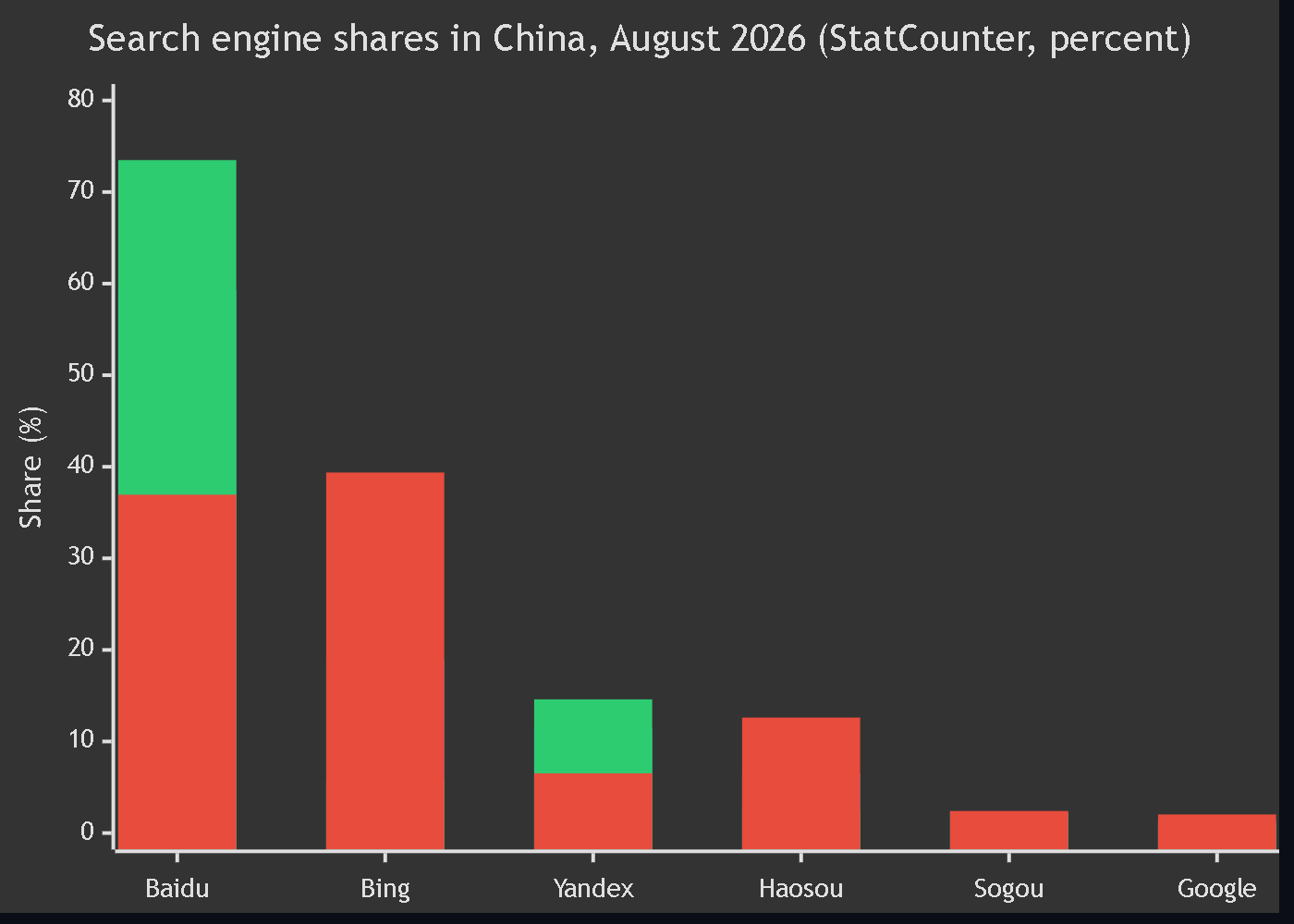
See Mermaid diagram
---
config:
  theme: dark
  themeVariables:
    primaryColor: '#0b0d17'
    lineColor: '#8892b0'
---
xychart-beta
    title "Search engine shares in China, August 2026 (StatCounter, percent)"
    x-axis ["Baidu", "Bing", "Yandex", "Haosou", "Sogou", "Google"]
    y-axis "Share (%)" 0 --> 80
    bar [59.26, 18.92, 11.41, 6.48, 2.25, 1.41]
    bar [73.49, 5.69, 14.6, 2.6, 2.2, 1.03]
    bar [36.95, 39.37, 6.52, 12.61, 2.41, 2.03]
How does Baidu's AI search work now, and who else answers?
Baidu is not a results engine anymore, it is an answer engine with agents. In October 2025 the company itself reported that 70 % of mobile results pages carried AI-generated content. In April 2026 it launched its dual-agent engine with the MCP protocol, and the "Baidu-AI智能搜索" app reached 644 million monthly active users in June (Q2 2026, SEC 6-K). In its August 18 earnings call Baidu declared a deliberate delay in AI-search monetization; the online marketing line fell 19 % year over year as a consequence. On Qianfan, its cloud platform, it published a Baidu AI Search API with source traceability ("一键溯源": one click to the source).
Around Baidu, a constellation of answer engines with large audiences and different trackers. QuestMobile reported in May 2026 that native AI apps reached 499 million monthly active users, with Doubao at 382 million, the Qwen app at 167 million and DeepSeek at 130 million. Statista, for Q1 2026, gave a different picture: Doubao 260 million, ERNIE Bot 220 million, Quark 180 million. The numbers are not interchangeable because the methodologies differ; the rule is: always cite the tracker.
Where do Chinese answer engines pull their citations from?
From their own garden, most of the time. A July 2026 study measures citation source distribution per engine: Doubao pulls 60 % of its citations from ByteDance properties (Toutiao 35 %, Douyin 25 %); ERNIE pulls 55 % from the Baidu ecosystem (Baijiahao 35 %, Baidu Baike 20 %); DeepSeek leans on CSDN (20 %) and Zhihu (15 %); Kimi favors Zhihu (18 %). In ERNIE, a definition placed in the first paragraph has more than 70 % chance of a direct citation; in Doubao, content loses weight in the answer one month after publication.
The catch for sellers is that referrer trails are gone. DeepSeek stopped passing headers; the ERNIE app strips them; Doubao passes them inconsistently. In 2026, AEO measurement in China runs on substitute metrics: Citation Penetration Rate (what fraction of a fixed prompt list cites you), AI Share of Voice (what percent of the sector's answers mention you), and Prompt Mention Rate (how often you appear against a fixed prompt).
The editorial consequence is even more direct: inverted pyramid on every page (answer up front, argument after); consistent entity across Baidu Baike, Sogou Baike and Baike.com; distribution inside the gardens each engine reads, not on your own domain. In China, engines do not cite what ranks; they cite what the operator has already published.
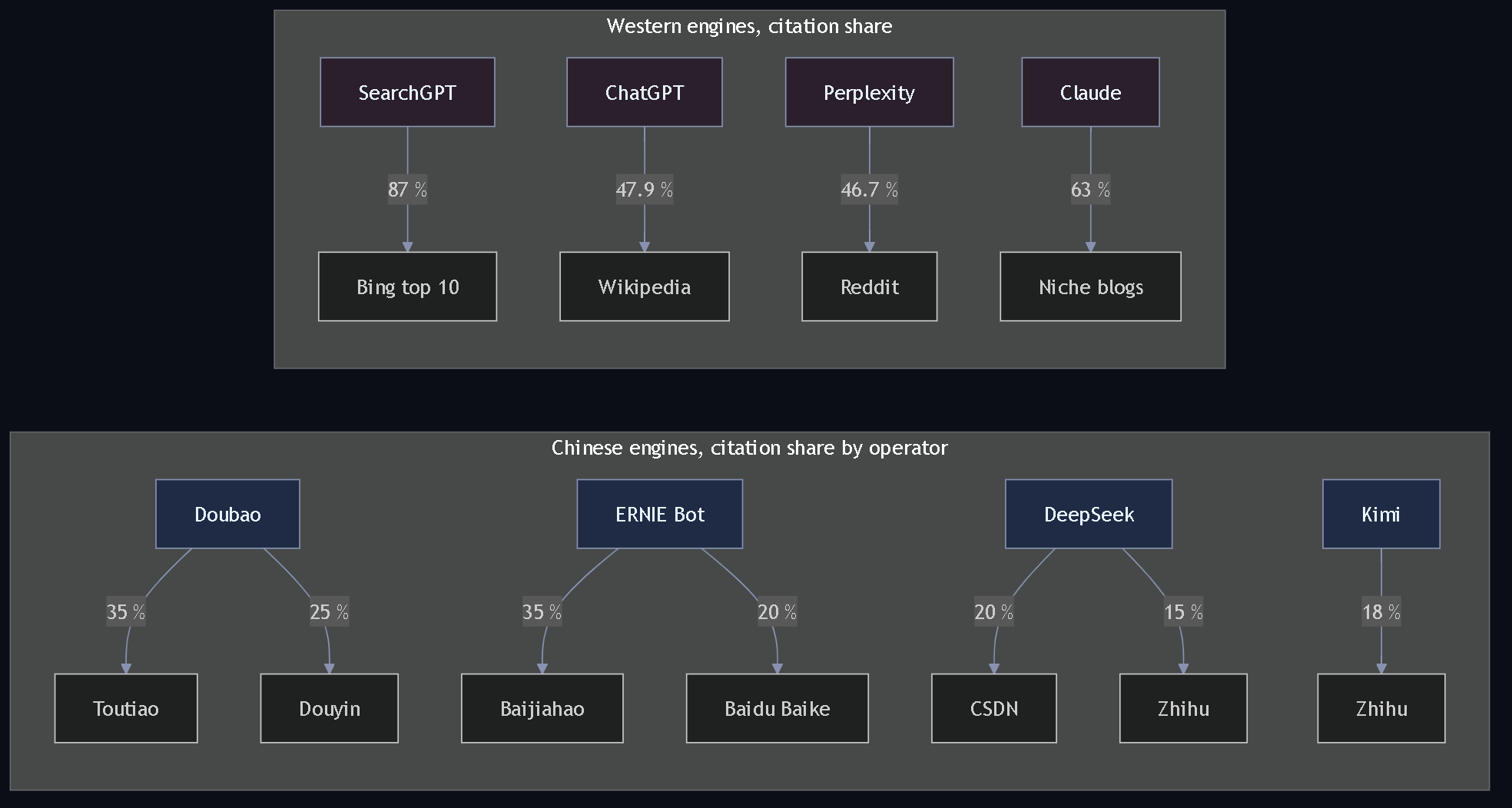
See Mermaid diagram
---
config:
  theme: dark
  themeVariables:
    primaryColor: '#0b0d17'
    primaryTextColor: '#e6f1ff'
    lineColor: '#8892b0'
---
graph LR
    subgraph China["Chinese engines, citation share by operator"]
        Doubao["Doubao"] -->|35 %| Toutiao["Toutiao"]
        Doubao -->|25 %| Douyin["Douyin"]
        ERNIE["ERNIE Bot"] -->|35 %| Baijiahao["Baijiahao"]
        ERNIE -->|20 %| Baike["Baidu Baike"]
        DeepSeek["DeepSeek"] -->|20 %| CSDN["CSDN"]
        DeepSeek -->|15 %| Zhihu1["Zhihu"]
        Kimi["Kimi"] -->|18 %| Zhihu2["Zhihu"]
    end
    subgraph West["Western engines, citation share"]
        SearchGPT["SearchGPT"] -->|87 %| Bing["Bing top 10"]
        ChatGPT["ChatGPT"] -->|47.9 %| Wiki["Wikipedia"]
        Perplexity["Perplexity"] -->|46.7 %| Reddit["Reddit"]
        Claude["Claude"] -->|63 %| Blogs["Niche blogs"]
    end
    style Doubao fill:#1f2a44,stroke:#8892b0,color:#e6f1ff
    style ERNIE fill:#1f2a44,stroke:#8892b0,color:#e6f1ff
    style DeepSeek fill:#1f2a44,stroke:#8892b0,color:#e6f1ff
    style Kimi fill:#1f2a44,stroke:#8892b0,color:#e6f1ff
    style SearchGPT fill:#2a1f2a,stroke:#8892b0,color:#e6f1ff
    style ChatGPT fill:#2a1f2a,stroke:#8892b0,color:#e6f1ff
    style Perplexity fill:#2a1f2a,stroke:#8892b0,color:#e6f1ff
    style Claude fill:#2a1f2a,stroke:#8892b0,color:#e6f1ff

See Mermaid diagram
---
config:
  theme: dark
  themeVariables:
    primaryColor: '#0b0d17'
    primaryTextColor: '#e6f1ff'
    lineColor: '#8892b0'
---
flowchart LR
    Content["Inverted-pyramid
content:
direct answer
in first paragraph"]
    Schema["JSON-LD:
FAQPage, HowTo,
Organization,
speakable"]
    Entity["Consistent entity
in Baidu Baike,
Sogou Baike,
and Baike.com"]
    Distrib["Distribution in
walled gardens:
Zhihu, WeChat OA,
Toutiao, 36Kr"]
    Push["Baidu URL
submission API
and Auto-Push
where applicable"]
    Metric["Substitute metrics:
Citation Penetration Rate,
AI Share of Voice,
Prompt Mention Rate"]
    Refresh["Monthly refresh
of content
Doubao no longer
cites"]
    Content --> Schema --> Entity --> Distrib --> Push --> Metric --> Refresh
    Refresh -.->|"every 30 days"| Content
What compute stack sits under all this?
Domestic chips, aggressive capex, and open weights released in a chain. DeepSeek V4 (MIT license, 1.6 trillion total parameters, 49 billion active, one-million-token context) runs on Huawei Ascend 950PR from its August 2026 release. The real bottleneck, per SemiAnalysis, is not the wafer but HBM memory. Bloomberg reports Chinese executives raised the domestic share of their accelerator budget from 30 % to 46 %.
Capex follows. Alibaba reported quarterly capex of USD 9,975 million (up 75 % year over year) in its August 20 6-K, plus a three-year commitment of RMB 380 billion; Tencent nearly tripled its Q2 capex (up 190 % year over year); Volcano Engine, ByteDance's cloud, processes 180 trillion tokens per day; Huawei Cloud showcased clusters of over 100,000 cards in June; Alibaba Cloud announced a Mexico presence on July 9 (IntelligentCIO).
On models, the summer of 2026 was not a quarter, it was a chain: Qwen3.8-Max (August 3), ERNIE 5.1 (May 8, no open weights), Kimi K3 (July 16, 2.8 trillion), GLM-5.3-Flash (August 26, MIT), Hunyuan Hy4 (August 28 preview, Apache 2.0, 770 billion), and MiniMax M2.7 (April 12). When the chip vendor changes, technical discipline switches vendors, not method.
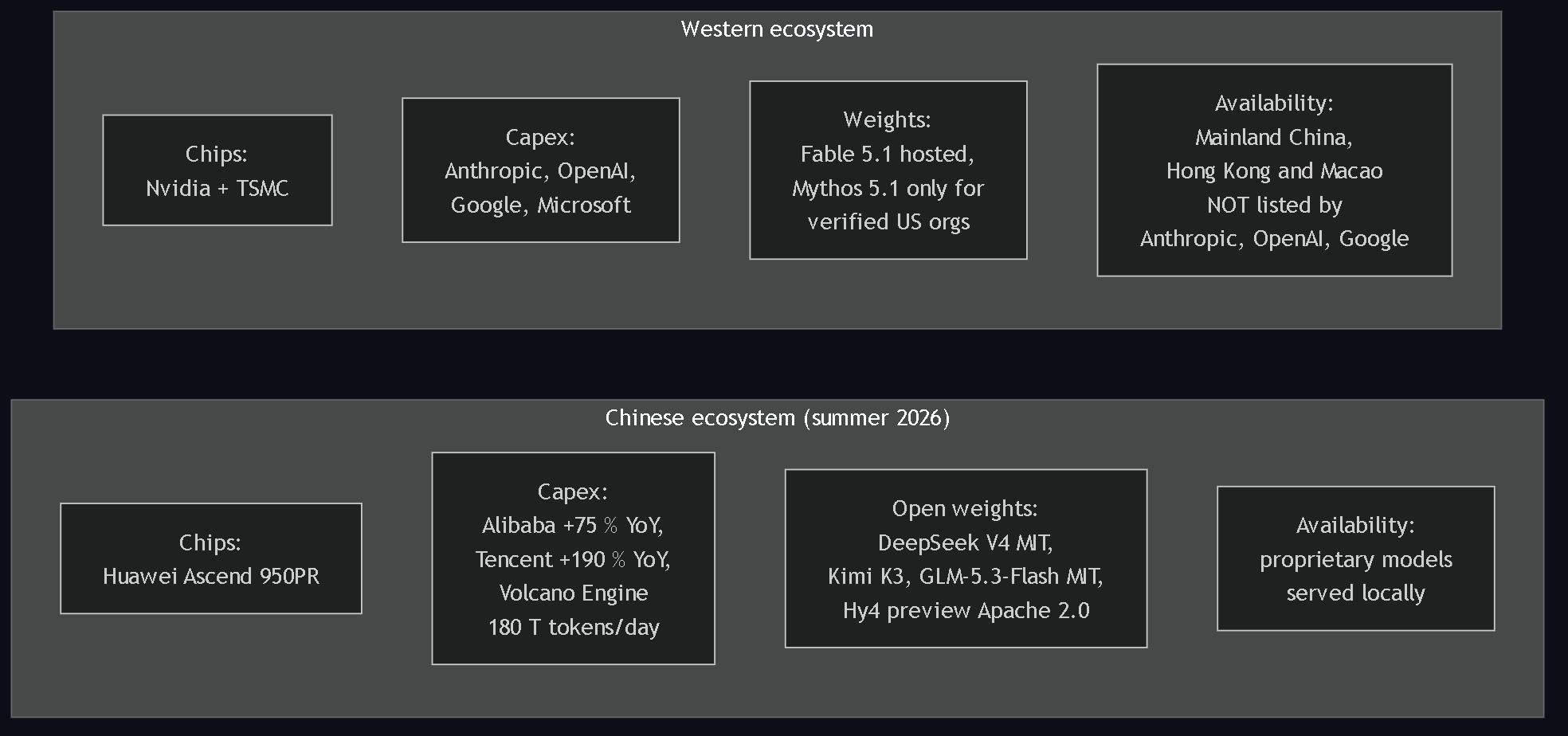
See Mermaid diagram
---
config:
  theme: dark
  themeVariables:
    primaryColor: '#0b0d17'
    primaryTextColor: '#e6f1ff'
    lineColor: '#8892b0'
---
flowchart LR
    subgraph China["Chinese ecosystem (summer 2026)"]
        direction TB
        C1["Chips:
Huawei Ascend 950PR"]
        C2["Capex:
Alibaba +75 % YoY,
Tencent +190 % YoY,
Volcano Engine
180 T tokens/day"]
        C3["Open weights:
DeepSeek V4 MIT,
Kimi K3, GLM-5.3-Flash MIT,
Hy4 preview Apache 2.0"]
        C4["Availability:
proprietary models
served locally"]
    end
    subgraph West["Western ecosystem"]
        direction TB
        W1["Chips:
Nvidia + TSMC"]
        W2["Capex:
Anthropic, OpenAI,
Google, Microsoft"]
        W3["Weights:
Fable 5.1 hosted,
Mythos 5.1 only for
verified US orgs"]
        W4["Availability:
Mainland China,
Hong Kong and Macao
NOT listed by
Anthropic, OpenAI, Google"]
    end
What does technical compliance demand of a foreign site in 2026?
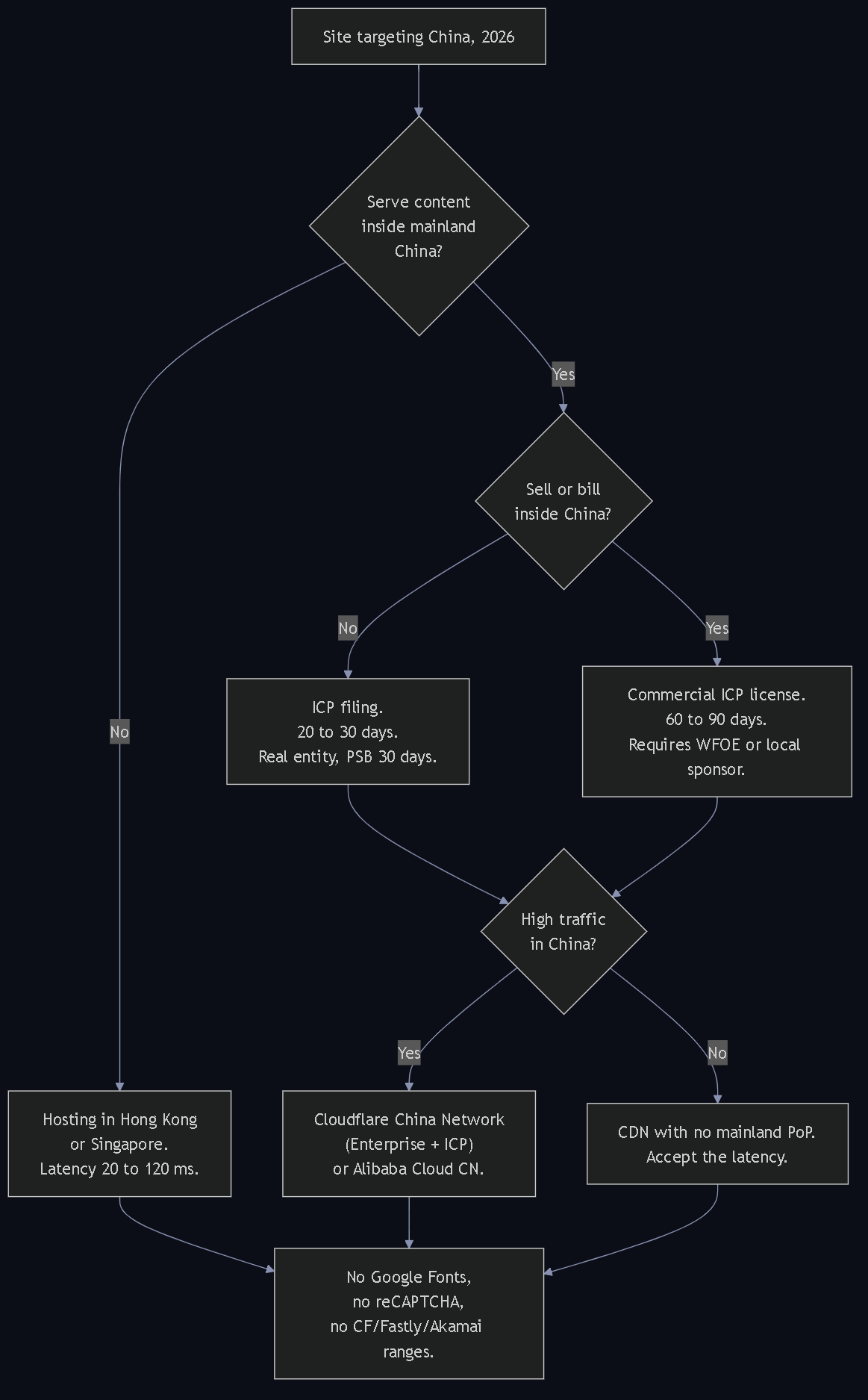
Five hard requirements, direct answer: without ICP filing you do not publish inside China; without a local representative you do not transfer personal data above the CAC threshold; base latency decides hosting; Chinese crawlers do not read <meta noindex>; and llms.txt in the Chinese ecosystem is undocumented.
First, ICP filing (备案). It is not the commercial license. "Real-entity" enforcement tightened in 2026 and you have 30 days to register the site with the Public Security Bureau after approval. TLDs like .io and .app are routinely rejected by MIIT; total cost, between paperwork and local sponsor, runs 5,000 to 15,000 dollars.
Second, personal-data transfer. CAC Certification Measures for personal-data cross-border transfer are in force since January 1, 2026 and valid for three years, requiring a mandatory local representative for foreign processors in the 100,000 to 1 million (non-sensitive) or below 10,000 (sensitive) band.
Third, latency and CDN. Server.HK reports Hong Kong CN2 GIA to Shanghai at 20 to 35 milliseconds versus 220 to 280 from US East; on top of base latency, resources the Great Firewall filters (Google Fonts, reCAPTCHA, Cloudflare, Fastly and Akamai ranges). Separately, Cloudflare China Network is only available on the Enterprise plan and with ICP filing (docs dated April 30, 2026); the two facts are independent.
Fourth, crawlers. Baidu ignores <meta name="robots" content="noindex">: the only reliable exclusion is Disallow in robots.txt. Verification is reverse DNS to .baidu.com or .baidu.jp. Bytespider (ByteDance/Doubao) does not publish IPs and there are reports of it ignoring robots.txt.
Fifth, what does not exist. No 2026 public source documents llms.txt support in Baidu, Doubao, Qwen, DeepSeek or Kimi. We serve it because Western agents do read it; in China we treat it as unsupported until proven otherwise.
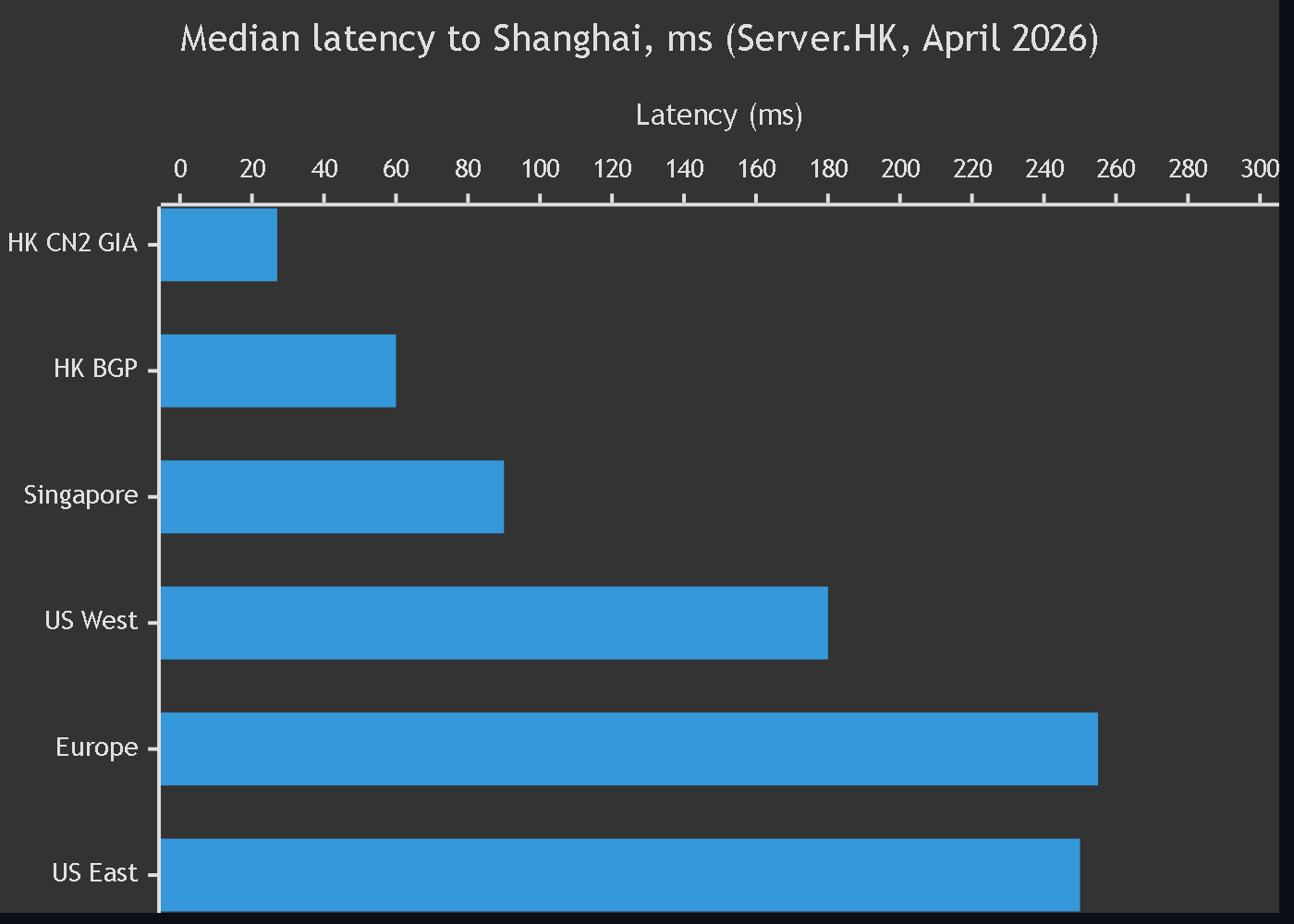
See Mermaid diagram
---
config:
  theme: dark
  themeVariables:
    primaryColor: '#0b0d17'
    lineColor: '#8892b0'
---
xychart-beta horizontal
    title "Median latency to Shanghai, ms (Server.HK, April 2026)"
    x-axis ["HK CN2 GIA", "HK BGP", "Singapore", "US West", "Europe", "US East"]
    y-axis "Latency (ms)" 0 --> 300
    bar [27, 60, 90, 180, 255, 250]
See Mermaid diagram
---
config:
  theme: dark
  themeVariables:
    primaryColor: '#0b0d17'
    primaryTextColor: '#e6f1ff'
    lineColor: '#8892b0'
---
flowchart TD
    Start["Site targeting China, 2026"] --> Q1{"Serve content
inside mainland
China?"}
    Q1 -->|Yes| Q2{"Sell or bill
inside China?"}
    Q1 -->|No| HK["Hosting in Hong Kong
or Singapore.
Latency 20 to 120 ms."]
    Q2 -->|No| Filing["ICP filing.
20 to 30 days.
Real entity, PSB 30 days."]
    Q2 -->|Yes| License["Commercial ICP license.
60 to 90 days.
Requires WFOE or local sponsor."]
    Filing --> CDN{"High traffic
in China?"}
    License --> CDN
    CDN -->|Yes| CFEnt["Cloudflare China Network
(Enterprise + ICP)
or Alibaba Cloud CN."]
    CDN -->|No| Direct["CDN with no mainland PoP.
Accept the latency."]
    HK --> Fonts["No Google Fonts,
no reCAPTCHA,
no CF/Fastly/Akamai ranges."]
    CFEnt --> Fonts
    Direct --> Fonts
What surfaces exist beyond search?
Chinese search is plural. In-app search inside WeChat over Official Accounts; Douyin as a video search engine for demos and reviews; Xiaohongshu (RED) as the start of the B2C consumer journey; Zhihu for B2B; Baidu Baike and Sogou Baike as reference corpora that engines cite; SEO plus SEM when the keyword is saturated; hosting local or in Hong Kong; mobile-first with reported 95 % mobile access in agency samples; real Chinese keyword research (the difference between 抗皱眼霜品牌 and 眼霜 is the one that converts); editorial cadence of 1,200 to 3,000 words per page. In China, "to search" is not one verb; it is a map of walled squares and each one has its own door.
Where does this look like the West?
In that ranking no longer guarantees the citation, on either side. Ahrefs reported that only 12 % of the links ChatGPT, Gemini and Copilot cite appear in Google's top 10 for the same prompt; Search Engine Journal measured the share of AI Overviews citations coming from the organic top 10 dropped from 76 % (July 2025) to 38 % (March 2026); SearchGPT pulls 87 % of its citations from Bing; ChatGPT depends on Wikipedia (47.9 %); Perplexity, on Reddit (46.7 %); Claude, on the Western side, barely cites Reddit and pulls 63 % from niche blogs.
Same physics, different garden. Anthropic, OpenAI and Google do not list mainland China, Hong Kong or Macao in their officially supported regions (official pages verified on September 1, 2026). Fable 5.1 and Mythos 5.1, announced on the same day, are the same model with different safeguard levels; Mythos 5.1 releases only to verified US organizations. On the Chinese side, in the same summer, open weights were released at frontier scale. The conclusion we already wrote in the multi-model orchestration guide and in the AEO guide is the same: here, engines cite third-party indexes and communities; there, the operator cites its own properties. Same physics, a different walled garden.
What does a small firm do with this?
Compete by method, not by size. Our own numbers frame it. The guide we published in July weighs 1,300 words per Ahrefs AI Content Helper (the wc -w on the source markdown gives 2,691 because it includes frontmatter and the source table; Ahrefs measures readable text). The same helper gives it 52 out of 100 for the topic "seo china" in its September 1, 2026 measurement, against 86 out of 100 from two competing guides: Elite Asia (2,400 words) and Sinorbis (2,700 words). Transgenia's domain had DR 4.0 in the same session; competitors had DR 36 and 38.
Here is the method we do sustain: an 11ty pipeline that produces the three versions from a shared translationKey; a robots.txt allowing twelve Chinese crawlers by name; llms.txt published (and honestly reported as unverified in the Chinese ecosystem); reciprocal hreflang derived from the translationKey; production verification with cache-bust on every deploy. We also state the debts: the parent guide has zero internal links, the ZH version is thin, 29 blog URLs sit outside the sitemap, and llms.txt lists no Chinese URLs. This article repeats none of those errors.
It is the parallel with Chinese clouds and labs: they do not compete against Anthropic or OpenAI on size, they compete on installed capacity of their own. At Anthropic, the entry level to the Claude Partner Network is called "Registered", which is where Centrum Transgenia is enrolled; the second level, "Select", is the first with public requirements: 10 active certifications from the program and 2 clients in production (June 3, 2026). OpenAI also uses "Select" as the name of the entry tier of its OpenAI Partner Network (June 15, 2026). You enter by method.
Efraín Carreón Ortiz, Chief Executive Officer at Centrum Transgenia, holds the Claude Partner Badge: Claude Code, issued by Anthropic on August 19, 2026 and verifiable on Credly; it expires February 19, 2027. Centrum Transgenia SAS is an OpenAI Select Partner within the OpenAI Partner Network, status granted August 24, 2026. Centrum Transgenia SAS is a registered partner of Anthropic's Claude Partner Network. And a Huawei Cloud Solution Provider at the Standard tier, valid through January 31, 2027 (official Huawei document). The Anthropic badge is not a certification; the four proctored Anthropic exams (CCAO-F, CCAR-F, CCAR-P, CCDV-F) are, and they are counted separately. We also published the Odoo Enterprise to Community migration case study, which applies the same brief-draft-measured-curation method to a production ERP change.

See Mermaid diagram
---
config:
  theme: dark
  themeVariables:
    primaryColor: '#0b0d17'
    primaryTextColor: '#e6f1ff'
    lineColor: '#8892b0'
---
flowchart LR
    B["Brief with sources
verified by URL"]
    D["v1 draft
with Claude Opus 4.7"]
    F["Freeze
sha256 and claims.csv"]
    C["Human curation:
verify figures,
rewrite or approve"]
    M["Word-level diff:
diff_stats.py
reports
rewrite %"]
    Build["Container build
Node 20:
build_blog.sh"]
    PR["Draft-first
Pull Request"]
    Verify["Production check
with cache-bust"]
    Meas["7-day measurement:
Ahrefs, GSC,
Prompt Mention Rate"]
    B --> D --> F --> C --> M --> Build --> PR --> Verify --> Meas
    Meas -.->|"learn and feed
the next brief"| B
How do we update the composite score for 2026?
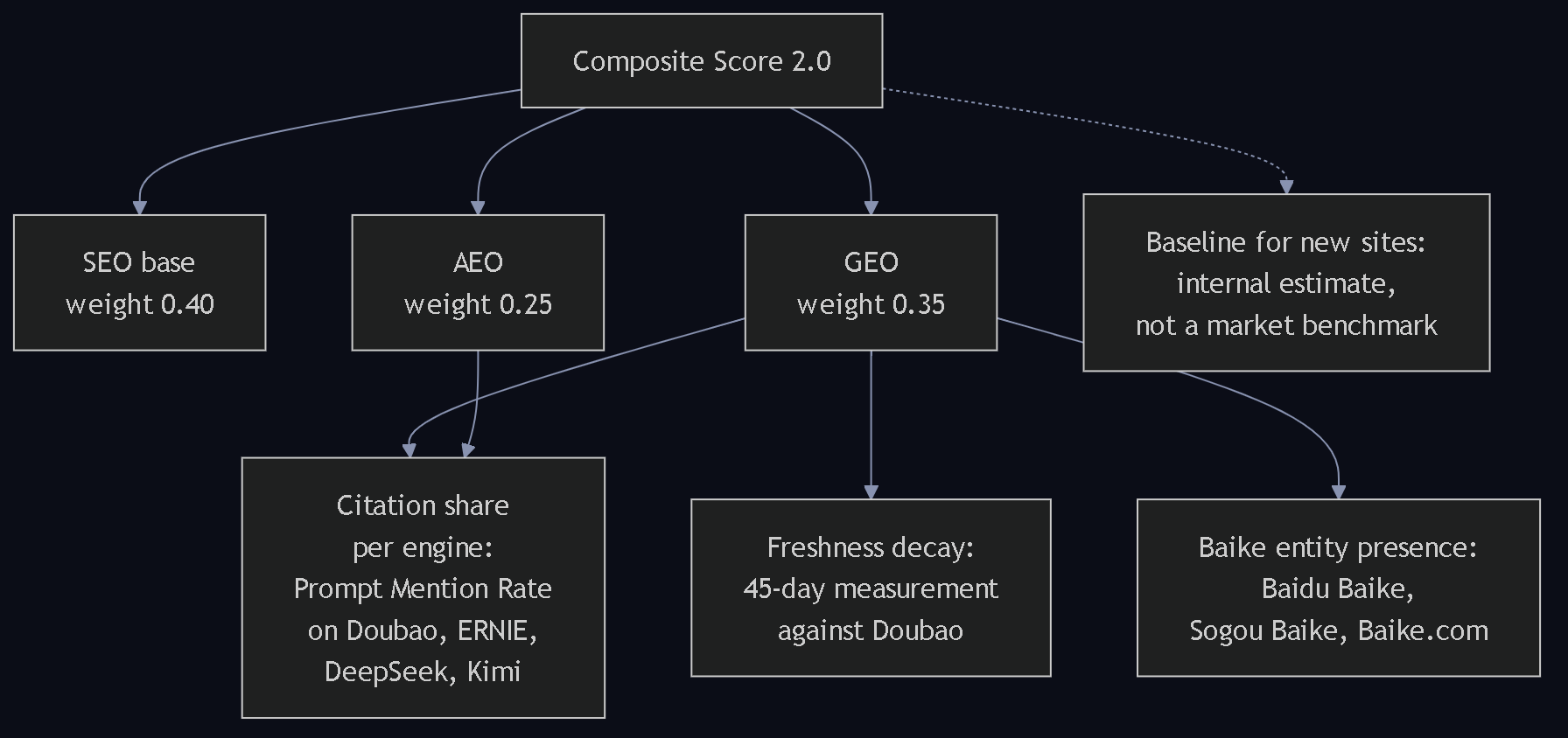
With three indicators the July formula (SEO 0.40, GEO 0.35, AEO 0.25) was missing. First, citation share per engine: measured with fixed prompt lists and Prompt Mention Rate across Doubao, ERNIE, DeepSeek, and Kimi. Second, freshness decay: measured with a fixed question set against Doubao over 45 days, to observe the known drop after one month. Third, Baike entity presence: consistent entry in at least two of the three (Baidu Baike, Sogou Baike, Baike.com), with the same canonical description. The baseline for new sites is still an internal estimate, not a market benchmark.
See Mermaid diagram
---
config:
  theme: dark
  themeVariables:
    primaryColor: '#0b0d17'
    primaryTextColor: '#e6f1ff'
    lineColor: '#8892b0'
---
flowchart TD
    Formula["Composite Score 2.0"]
    SEO["SEO base
weight 0.40"]
    GEO["GEO
weight 0.35"]
    AEO["AEO
weight 0.25"]
    Cite["Citation share
per engine:
Prompt Mention Rate
on Doubao, ERNIE,
DeepSeek, Kimi"]
    Fresh["Freshness decay:
45-day measurement
against Doubao"]
    BaikePres["Baike entity presence:
Baidu Baike,
Sogou Baike, Baike.com"]
    Formula --> SEO
    Formula --> GEO
    Formula --> AEO
    GEO --> Cite
    GEO --> Fresh
    GEO --> BaikePres
    AEO --> Cite
    Note["Baseline for new sites:
internal estimate,
not a market benchmark"]
    Formula -.-> Note
What are the new mistakes for 2026?
Reading StatCounter without the VPN caveat. Ignoring Bing on desktop. Measuring with referrers that no longer arrive. Registering a domain in a TLD that MIIT rejects. Assuming that Chinese engines read llms.txt. Letting a month go by without refreshing content that Doubao no longer cites. Confusing the Select tier with a certification: in both programs the tier is a partner level; certifications exist and are counted separately (Anthropic offers CCAO-F, CCAR-F, CCAR-P, CCDV-F via Pearson VUE; OpenAI targets 300,000 certified consultants as a 2026 goal).
Checklist 2026 (12 items)
- [ ]
robots.txtwith explicitAllowfor Baiduspider, Baiduspider-render, Sogou Spider, 360Spider, Bytespider, and Yisouspider. - [ ]
<meta name="renderer" content="webkit">and<meta http-equiv="X-UA-Compatible" content="IE=edge,chrome=1">on ZH pages. - [ ] Verification in Baidu Webmaster Tools; and in Sogou, 360, and Shenma if they are still operating at deploy time.
- [ ] JSON-LD with
FAQPage,HowTo,Product, orOrganization;speakableon every article. - [ ] ICP filing in force, or hosting in Hong Kong with an agreement on latency.
- [ ] Zero external resources from blocked domains; tested with a fetch from a mainland vantage point.
- [ ] Inverted pyramid on every page, consistent entity across Baidu Baike, Sogou Baike, and Baike.com.
- [ ] Distribution in Zhihu, WeChat Official Account, and 36Kr for B2B; Xiaohongshu for B2C.
- [ ] Baidu URL submission API configured, monthly Prompt Mention Rate against Doubao, ERNIE, DeepSeek, and Kimi.
- [ ] Content refresh every 30 days on pages depending on the Doubao peak.
- [ ]
sitemap-blog.xmlincludes ZH URLs and all reciprocalxhtml:linkalternates. - [ ]
llms.txtlists ES, EN and ZH cornerstone blog URLs (delta pending via separate PR).
Frequently asked questions
Do Baidu's shares change month to month? Yes, visibly. The same source (StatCounter) reports Baidu at 58.23 % in January 2026, 50.83 % in July, and 59.26 % in August. Before quoting a "2026 share", pull this month's reading, or at least cite the month you measured. A "2026 share" without a month attached is not data anymore, it is a legacy label.
Is llms.txt useful for Chinese engines? No 2026 public source documents that Baidu, Doubao, Qwen, DeepSeek, or Kimi read the file. Serve it because Western agents do; for China, treat it as unsupported until proven otherwise and measure actual presence with Prompt Mention Rate rather than assuming the file changes anything on the Chinese side.
Do I need ICP filing or a license? It depends on the use. If the site only publishes information and does not monetize inside China, filing is usually enough and takes 20 to 30 business days. If you sell, bill or run paid ads inside China, you need a commercial ICP license, which requires a local entity or sponsor and takes 60 to 90 business days.
Can I serve the site from Hong Kong? Yes, with higher latency and no Cloudflare China Network. A reasonable choice for corporate content and low-volume B2B. For high-traffic stores or portals, consider mainland hosting; the DPI overhead on international transit adds latency to every request, on top of the base RTT reported in the Server.HK table.
How do I measure citations if referrers no longer arrive? With substitute metrics: Citation Penetration Rate, AI Share of Voice, and Prompt Mention Rate, applied to a fixed prompt list per sector. Run monthly against Doubao, ERNIE, DeepSeek, and Kimi; quarterly against ChatGPT, Perplexity, and Claude for the Western parallel. Keep the prompt list stable across months so drift is measurable.
What is the difference between Anthropic's Select and OpenAI's Select? At Anthropic, the entry level of the Claude Partner Network is called "Registered" (where Transgenia is enrolled); the second level, "Select", requires 10 active certifications from the program and 2 clients in production. In OpenAI, "Select" is the first of three tiers (Select, Advanced, Elite). In both cases the tier is a partner level: proctored certifications exist separately and are issued by Anthropic (via Pearson VUE) and by OpenAI through their own exams.
Close
Ranking is not enough. Distributing in the right walled gardens, measuring with substitute metrics, and complying with local infrastructure is what today separates a foreign site visible in China from an invisible one. If you want to assess your current visibility in the Chinese ecosystem (crawling, Baike entity, per-engine citation share, and the state of technical compliance), get in touch. We also publish full guides in Spanish and in Simplified Chinese; for the Latin American context, the AI value gap in LATAM SMEs sets the baseline against which we built this work.
A note on how this article was written
What the AI did: the thesis, outline, and research brief (with 49 sources verified by URL, listed at the bottom) were produced by Claude Fable 5.1 (Anthropic, model announced September 1, 2026) from an Ahrefs analysis of our July guide. The first Spanish draft (v1) and the English and Simplified Chinese adaptations were written by our Satira agent running on Claude Opus 4.7.
What the human did: Claude Fable 5.1 audited the previous PR (7 blockers and 17 majors, report in the internal repo) and flagged factual deviations that the earlier note had claimed to have verified without doing so. Saurat Xiuhcoatl, founder of Centrum Transgenia, accepted the list and ordered the article rewritten in full. Measured with tools/diff_stats.py against the frozen Spanish v1 (sha256 6b9f37784c1fae57), the rewritten Spanish version changed 45.70 % of the words and touched 34.74 % of the sentences; this English adaptation was produced from that rewritten Spanish text and shipped with its own diff report.
Why we say it: we sell technical AEO curation. When a first curation pass is incomplete and a second one catches deviations, correcting them in public is the same discipline we would ask of a client. The percentage is measured, not estimated. The Simplified Chinese version carries its own disclosure with its own measurement, and its own open gate for native review.
Signed: Efraín Carreón Ortiz, Chief Executive Officer (Director General), Centrum Transgenia SAS
Sources
- StatCounter, all-platform search engine shares in China, August 2026. https://gs.statcounter.com/search-engine-market-share/all/china (retrieved 2026-09-01).
- StatCounter, desktop, August 2026. https://gs.statcounter.com/search-engine-market-share/desktop/china (retrieved 2026-09-02).
- StatCounter, mobile, August 2026. https://gs.statcounter.com/search-engine-market-share/mobile/china (retrieved 2026-09-02).
- The Egg, "Most Popular Search Engines in China", VPN methodology caveat. https://www.theegg.com/seo/china/most-popular-search-engines-in-china (retrieved 2026-09-01).
- Baidu, 6-K Q2 2026 (August 18, 2026). https://www.sec.gov/Archives/edgar/data/0001329099/000119312526355431/d112854dex991.htm (retrieved 2026-09-02).
- Baidu, Q3 2025 earnings transcript, "70 % of mobile results with AI content". https://www.investing.com/news/transcripts/earnings-call-transcript-baidu-q3-2025-sees-ai-cloud-growth-amid-revenue-dip-93CH-4365319 (retrieved 2026-09-02).
- Baidu Creators Conference 2026, dual-agent engine with MCP. https://news.qq.com/rain/a/20260424A05YAK00 (retrieved 2026-09-02).
- Baidu AI Search API on Qianfan, "一键溯源". https://www.qbitai.com/2025/06/294490.html (retrieved 2026-09-02).
- QuestMobile via TechNode, native AI app MAU May 2026. https://technode.com/2026/07/14/questmobile-chinas-ai-native-apps-reach-499-million-monthly-active-users/ (retrieved 2026-09-01).
- Second Talent citing Statista, MAU Q1 2026. https://www.secondtalent.com/resources/top-5-chinese-ai-search-engines/ (retrieved 2026-09-02).
- fp8.co, citation source map per engine. https://fp8.co/articles/AI-Citation-Source-Preferences-GEO-Data-Map (retrieved 2026-09-02).
- iClick, AI Search Optimization in China 2026 GEO Guide. https://www.i-click.com/resources/ai-search-optimization-china-2026-geo-guide/ (retrieved 2026-09-01).
- Yotta Labs, DeepSeek V4 release date, specs, how to access 2026. https://www.yottalabs.ai/post/deepseek-v4-release-date-specs-how-to-access-2026 (retrieved 2026-09-02).
- TrendForce, Huawei Ascend 950PR and DeepSeek V4. https://www.trendforce.com/news/2026/04/07/news-decoding-deepseek-v4-how-huaweis-ascend-950-pr-is-powering-chinas-push-to-break-cuda-dependence/ (retrieved 2026-09-02).
- SemiAnalysis, "Huawei Ascend production ramp", HBM bottleneck. https://newsletter.semianalysis.com/p/huawei-ascend-production-ramp (retrieved 2026-09-02).
- TrendForce, domestic accelerator budget 30 % to 46 %. https://www.trendforce.com/news/2026/07/07/news-chinese-firms-reportedly-raise-domestic-ai-chip-budget-share-from-30-to-46-amid-shift-from-nvidia/ (retrieved 2026-09-02).
- Alibaba, quarterly 6-K 2026-08-20. https://www.sec.gov/Archives/edgar/data/0001577552/000110465926099220/tm2623667d1_ex99-1.htm (retrieved 2026-09-02).
- Alibaba, RMB 380 billion commitment. https://home.alibabagroup.com/en-US/document-1830678592242057216 (retrieved 2026-09-01).
- Intelligent CIO, Alibaba Cloud Mexico data center. https://www.intelligentcio.com/latam/2026/07/09/alibaba-cloud-expands-into-latin-america-with-first-mexico-data-center/ (retrieved 2026-09-02).
- Tencent, Q2 2026 transcript, capex up 190 % YoY. https://www.investing.com/news/transcripts/earnings-call-transcript-tencent-posts-solid-q2-2026-growth-as-ai-spending-surges-93CH-4855197 (retrieved 2026-09-02).
- Volcano Engine, 180 trillion tokens per day. https://www.kucoin.com/news/flash/volcanic-engine-launches-doubao-2-1-with-daily-token-usage-exceeding-180-trillion (retrieved 2026-09-02).
- Huawei Cloud INSPIRE 2026, clusters of 100,000 cards. https://www.huawei.com/en/news/2026/6/inspire-agenticera-agenticinfra (retrieved 2026-09-02).
- Marktech Post, Qwen3.8-Max. https://www.marktechpost.com/2026/08/03/alibaba-qwen-releases-qwen3-8-max/ (retrieved 2026-09-01).
- Codersera, ERNIE 5.1. https://codersera.com/blog/baidu-ernie-5-1-launch-2026/ (retrieved 2026-09-01).
- Hugging Face, Kimi K3. https://huggingface.co/moonshotai/Kimi-K3 (retrieved 2026-09-02).
- llm-releases, 2026 model calendar. https://www.llm-releases.com/ (retrieved 2026-09-01).
- Marktech Post, MiniMax M2.7. https://www.marktechpost.com/2026/04/12/minimax-just-open-sourced-minimax-m2-7-a-self-evolving-agent-model-that-scores-56-22-on-swe-pro-and-57-0-on-terminal-bench-2/ (retrieved 2026-09-02).
- MS Advisory, ICP filing in 2026. https://msadvisory.com/icp-license-china/ (retrieved 2026-09-02).
- China Briefing, CAC Certification Measures. https://www.china-briefing.com/news/china-cross-border-data-transfer-certification/ (retrieved 2026-09-02).
- Server.HK, latency to Shanghai and blocked resources. https://server.hk/blog/speed-up-website-china-technical-optimization-guide/ (retrieved 2026-09-01).
- Cloudflare, China Network docs 2026-04-30. https://developers.cloudflare.com/china-network/ (retrieved 2026-09-02).
- Jademond, Baidu user agents and
robots.txt. https://www.jademond.com/magazine/understanding-baidu-spiders/ (retrieved 2026-09-02). - AgentGrade, Bytespider. https://agentgrade.com/agents/bytespider (retrieved 2026-09-02).
- Jademond, Baidu URL submission API. https://www.jademond.com/magazine/baidu-indexation-alternative-to-xml-sitemaps/ (retrieved 2026-09-02).
- Ahrefs, top-10 overlap with AI citations. https://ahrefs.com/blog/ai-search-overlap/ (retrieved 2026-09-02).
- Search Engine Journal, AI Overviews from 76 % to 38 %. https://www.searchenginejournal.com/google-ai-overview-citations-from-top-ranking-pages-drop-sharply/568637/ (retrieved 2026-09-02).
- 5WPR, "State of AI citations 2026". https://www.5wpr.com/research/state-of-ai-citations-2026/ (retrieved 2026-09-01).
- Anthropic, Claude Fable 5.1 and Mythos 5.1 announcement. https://www.anthropic.com/claude-fable-and-mythos-5-1 (retrieved 2026-09-02).
- Anthropic, supported countries. https://www.anthropic.com/supported-countries (retrieved 2026-09-01).
- OpenAI, supported countries. https://developers.openai.com/api/docs/supported-countries (retrieved 2026-09-01).
- Google, Gemini API available regions. https://ai.google.dev/gemini-api/docs/available-regions (retrieved 2026-09-01).
- Anthropic, Services Track Partner Hub. https://www.anthropic.com/news/services-track-partner-hub (retrieved 2026-09-02).
- Channel Insider, OpenAI Partner Network. https://www.channelinsider.com/news-and-trends/openai-debuts-partner-network-backed-by-150m-investment/ (retrieved 2026-09-02).
- Elite Asia, "SEO in China 2026". https://www.eliteasia.co/seo-in-china/ (retrieved 2026-09-01).
- Sinorbis, "SEO in China". https://www.sinorbis.com/china-seo-evolution (retrieved 2026-09-01, sitemap lastmod 2024-06-24).
- Credly, Claude Partner Badge: Claude Code held by Efraín Carreón Ortiz. https://www.credly.com/badges/127ca3d1-f5cb-4a4d-844d-fc8417dd79b4/public_url (retrieved 2026-09-02).
- SearchEngines.net, comparative market-share guides. https://www.searchengines.net/guides/search-engine-market-share/ (retrieved 2026-09-01).
- Search Engine Land, "How China's fragmented search ecosystem is reshaping SEO in 2026" (Marcus Pentzek, 2026-05-05). https://searchengineland.com/china-fragmented-search-ecosystem-seo-476465 (retrieved 2026-09-01).
- OpenAI, official partner program page. https://openai.com/business/partners/ (retrieved 2026-09-01).
This guide will be updated as Chinese engine shares shift, as regional availability of Western providers changes, and as Baidu indexing policies evolve. Last reviewed: September 2026.