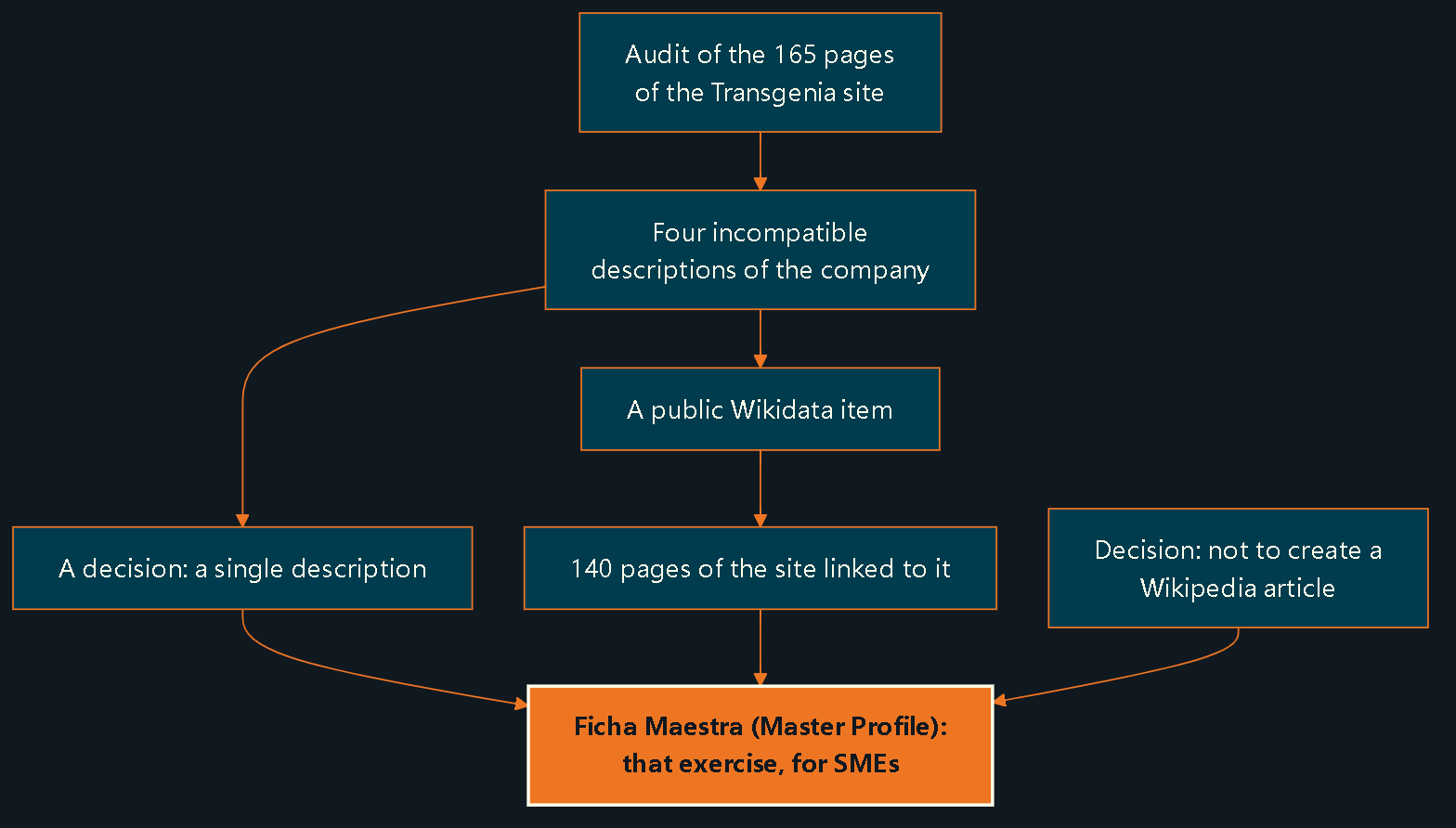
If your site says one set of hours and your Google profile another, whoever searches for you picks which one to believe. That happened to us with our own company's description: when the audit began, our site disagreed with itself. Depending on the language and page, it described Transgenia as a consultancy, a technology boutique, Blockchain and Quantum, or quantum consulting. A wrong version does not look like a mistake; it looks like information. Here is what we found, changed and decided not to do.
Mermaid meta-structure
flowchart TB
    A["Audit of the 165 pages<br/>of the Transgenia site"] --> B["Four incompatible<br/>descriptions of the company"]
    B --> C["A decision: a single description"]
    B --> D["A public Wikidata item"]
    B ~~~ E["Decision: not to create a<br/>Wikipedia article"]
    D --> F["140 pages of the site linked to it"]
    C --> G["Ficha Maestra (Master Profile):<br/>that exercise, for SMEs"]
    F --> G
    E --> G
    class G clave
    classDef clave fill:#EE7623,stroke:#FEFEEA,stroke-width:2px,color:#101820,font-weight:bold
The problem: your company already has a version, and you did not always write it yourself
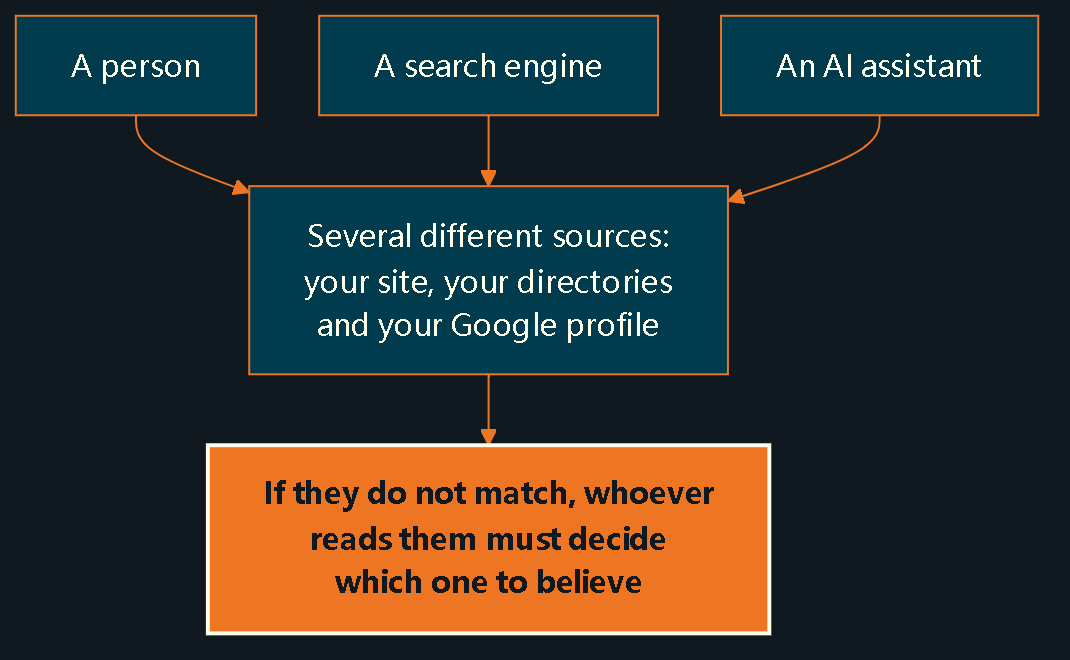
Transgenia starts from a simple idea: a person, a search engine or an artificial intelligence (AI) assistant looking for your company can find several sources: your site, your directories, your Google profile (Google Business Profile). Google documents that an organization's structured data, declared with schema.org, helps Google understand who the organization is and tell it apart from others.
Mermaid meta-structure
flowchart TB
    P1["A person"] --> F
    P2["A search engine"] --> F
    P3["An AI assistant"] --> F
    F["Several different sources:<br/>your site, your directories<br/>and your Google profile"] --> D["If they do not match, whoever<br/>reads them must decide<br/>which one to believe"]
    class D clave
    classDef clave fill:#EE7623,stroke:#FEFEEA,stroke-width:2px,color:#101820,font-weight:bold
Whoever reads those sources together must decide which one to believe, and may get it wrong without you knowing. We started with ourselves. And the problem showed up on our own site.
We audited ourselves first and fared badly
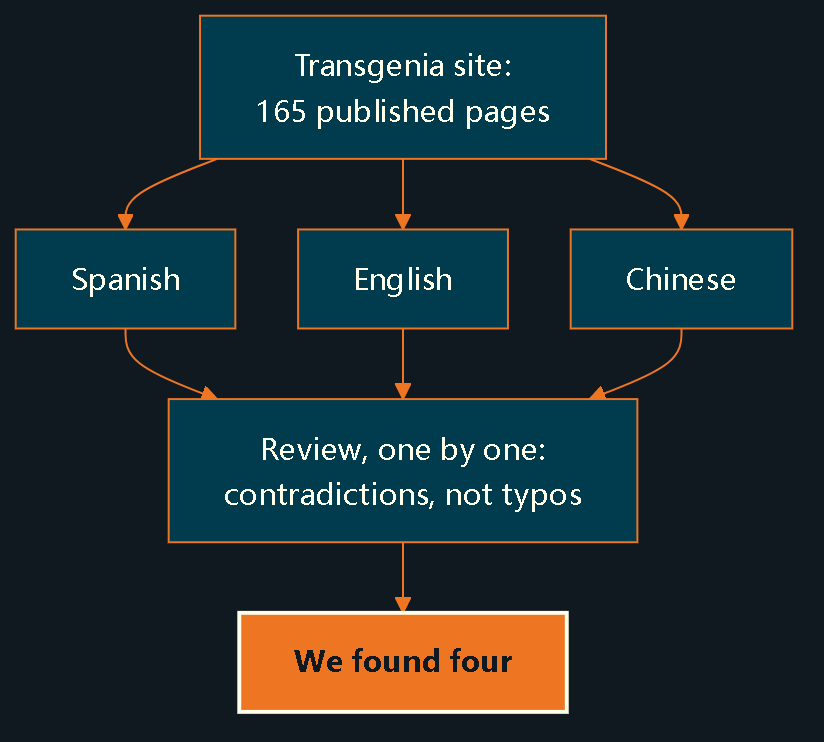
At Transgenia we started with our own site. When the audit began it had 165 published pages in Spanish, English and Chinese. We went through them one by one, looking for contradictions, not typos. We found four, and they fit in a table.
Mermaid meta-structure
flowchart TB
    S["Transgenia site:<br/>165 published pages"] --> I["Spanish"]
    S --> E["English"]
    S --> Z["Chinese"]
    I --> R["Review, one by one:<br/>contradictions, not typos"]
    E --> R
    Z --> R
    R --> H["We found four"]
    class H clave
    classDef clave fill:#EE7623,stroke:#FEFEEA,stroke-width:2px,color:#101820,font-weight:bold
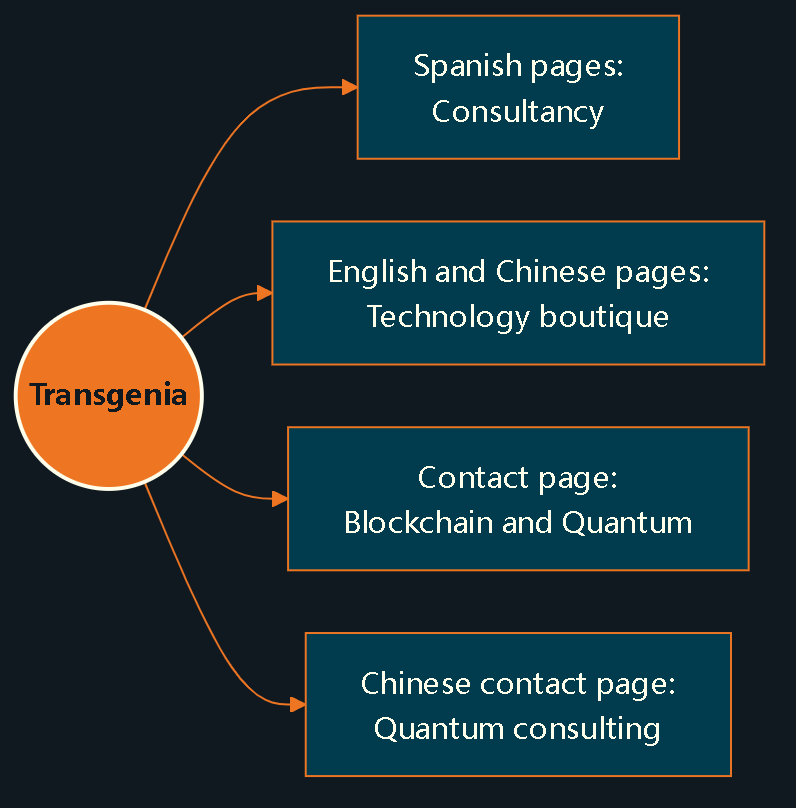
| Where | What it said |
|---|---|
| Spanish pages | Consultancy |
| English and Chinese pages | Technology boutique |
| Contact page | Blockchain and Quantum |
| Chinese contact page | Quantum consulting |
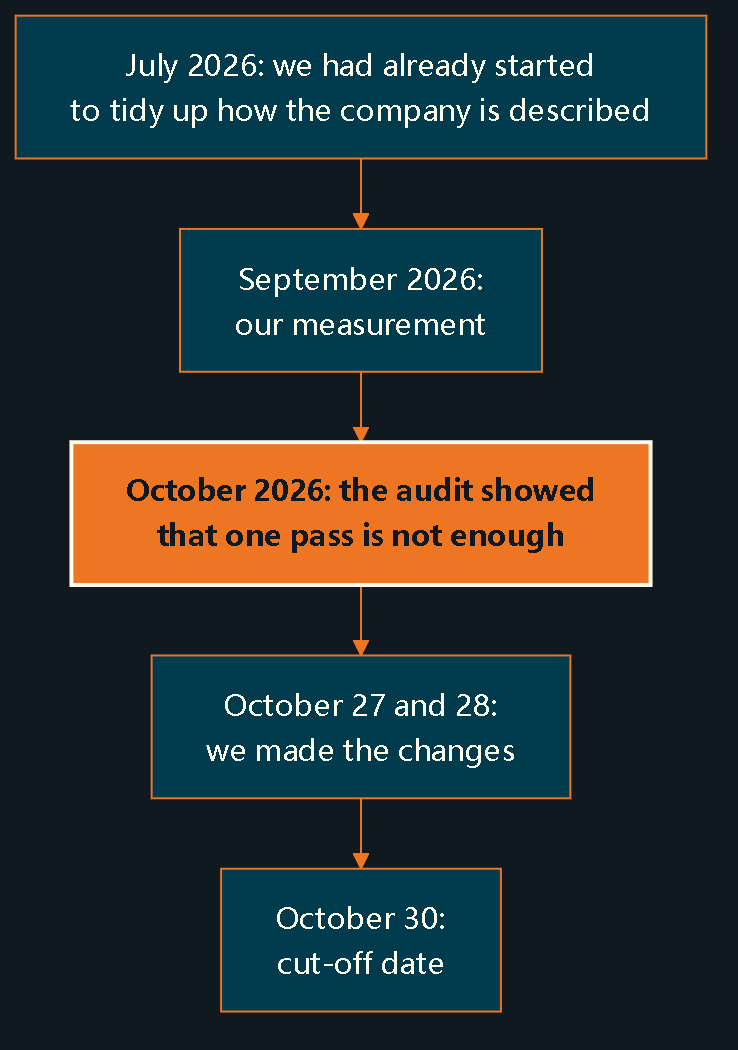
The most striking versions were on the contact pages. In July we had already started to tidy up how the company is described, as we recounted in the AEO guide (optimization for AI assistants' answers); the October audit showed that one pass is not enough.
Mermaid meta-structure
flowchart TB
    A["July 2026: we had already started<br/>to tidy up how the company is described"] --> B["September 2026:<br/>our measurement"]
    B --> C["October 2026: the audit showed<br/>that one pass is not enough"]
    C --> D["October 27 and 28:<br/>we made the changes"]
    D --> E["October 30:<br/>cut-off date"]
    class C clave
    classDef clave fill:#EE7623,stroke:#FEFEEA,stroke-width:2px,color:#101820,font-weight:bold
Whoever read only one of those pages got another description: from consultancy to quantum consulting. How many versions does yours have? Below, questions by type of business to find out.
Mermaid meta-structure
flowchart LR
    T(("Transgenia")) --> A["Spanish pages:<br/>Consultancy"]
    T --> B["English and Chinese pages:<br/>Technology boutique"]
    T --> C["Contact page:<br/>Blockchain and Quantum"]
    T --> D["Chinese contact page:<br/>Quantum consulting"]
    class T clave
    classDef clave fill:#EE7623,stroke:#FEFEEA,stroke-width:2px,color:#101820,font-weight:bold
What we fixed and what came of it
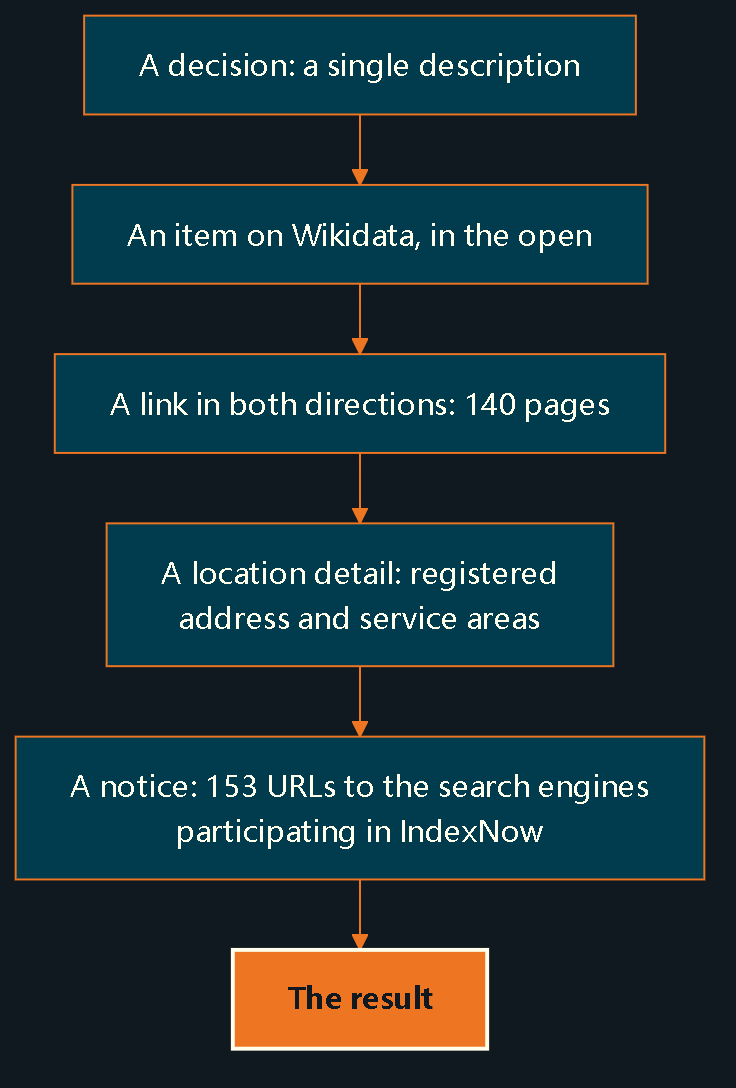
Transgenia made these changes on transgenia.org on October 27 and 28, 2026 (Mexico City time): it chose a single description, created its Wikidata item, linked 140 pages to it, said the same thing about where it is and notified the search engines participating in IndexNow.
Mermaid meta-structure
flowchart TB
    A["A decision: a single description"] --> B["An item on Wikidata, in the open"]
    B --> C["A link in both directions: 140 pages"]
    C --> D["A location detail: registered<br/>address and service areas"]
    D --> E["A notice: 153 URLs to the search engines<br/>participating in IndexNow"]
    E --> F["The result"]
    class F clave
    classDef clave fill:#EE7623,stroke:#FEFEEA,stroke-width:2px,color:#101820,font-weight:bold
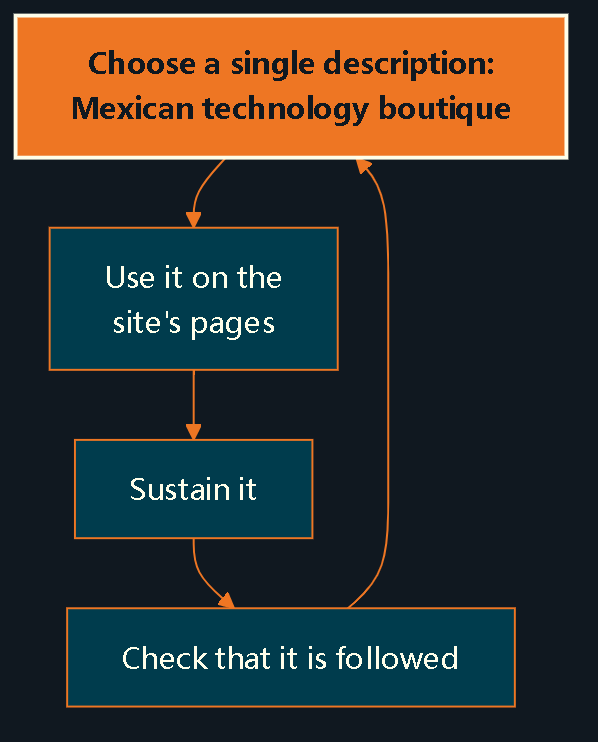
A decision. We chose a single description of the company for the site's pages: Mexican technology boutique. It is a decision you have to sustain: consistency is maintained, not achieved once.
Mermaid meta-structure
flowchart TB
    A["Choose a single description:<br/>Mexican technology boutique"] --> B["Use it on the<br/>site's pages"]
    B --> C["Sustain it"]
    C --> D["Check that it is followed"]
    D --> A
    class A clave
    classDef clave fill:#EE7623,stroke:#FEFEEA,stroke-width:2px,color:#101820,font-weight:bold
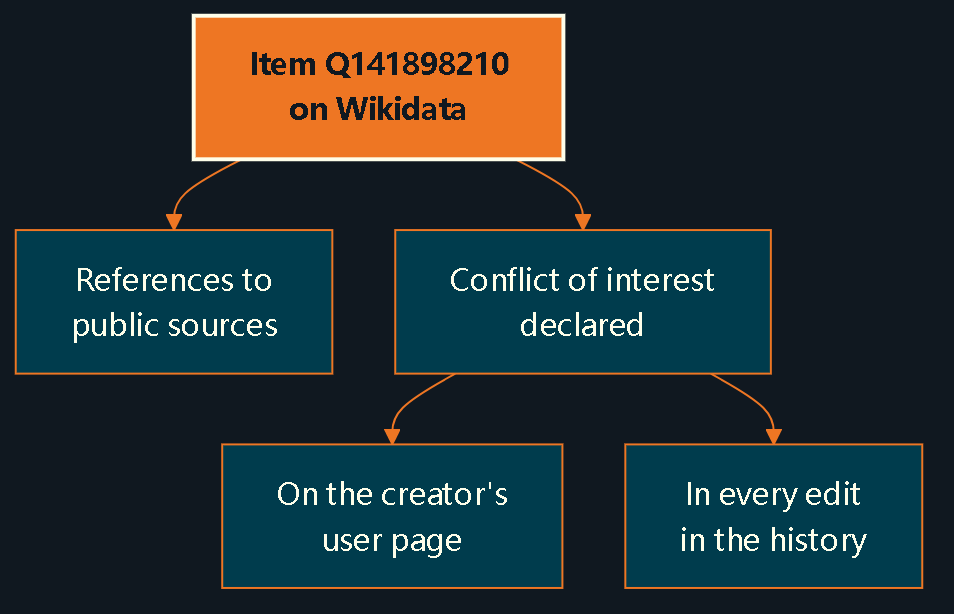
An item on Wikidata, in the open. We created the item Q141898210 on Wikidata, a public database anyone can consult. We did it in the open, with the disclosure its policy requires of paid editors: references to public sources and the conflict of interest declared on the creator's user page and in every edit in the history.
Mermaid meta-structure
flowchart TB
    I["Item Q141898210<br/>on Wikidata"] --> R["References to<br/>public sources"]
    I --> C["Conflict of interest<br/>declared"]
    C --> U["On the creator's<br/>user page"]
    C --> H["In every edit<br/>in the history"]
    class I clave
    classDef clave fill:#EE7623,stroke:#FEFEEA,stroke-width:2px,color:#101820,font-weight:bold
A link in both directions. Before, no page of the site pointed to Wikidata. At the cut-off, 140 do, and the item points back to the site.
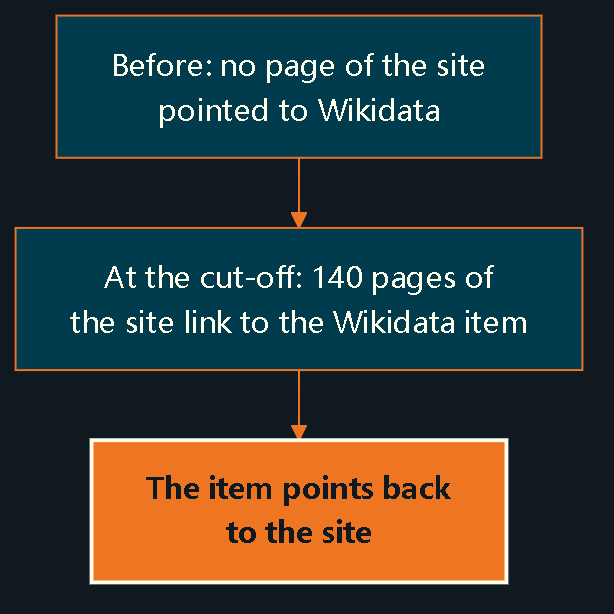
Mermaid meta-structure
flowchart TB
    A["Before: no page of the site<br/>pointed to Wikidata"] --> B["At the cut-off: 140 pages of<br/>the site link to the Wikidata item"]
    B --> C["The item points back<br/>to the site"]
    class C clave
    classDef clave fill:#EE7623,stroke:#FEFEEA,stroke-width:2px,color:#101820,font-weight:bold
A location detail. The registered address is in Ecatepec de Morelos, which is also a service area; Coyoacán, Mexico City and its metropolitan area are other service areas. The site footer, in its three languages, and Wikidata state it consistently; the Odoo implementation in Mexico City page is one example.
A notice. On October 28, 2026 we submitted 153 URLs to the search engines participating in IndexNow, the protocol a site uses to signal that a page was created, changed or deleted. Notifying is not indexing (including the page in their results): each search engine decides whether to index and when.
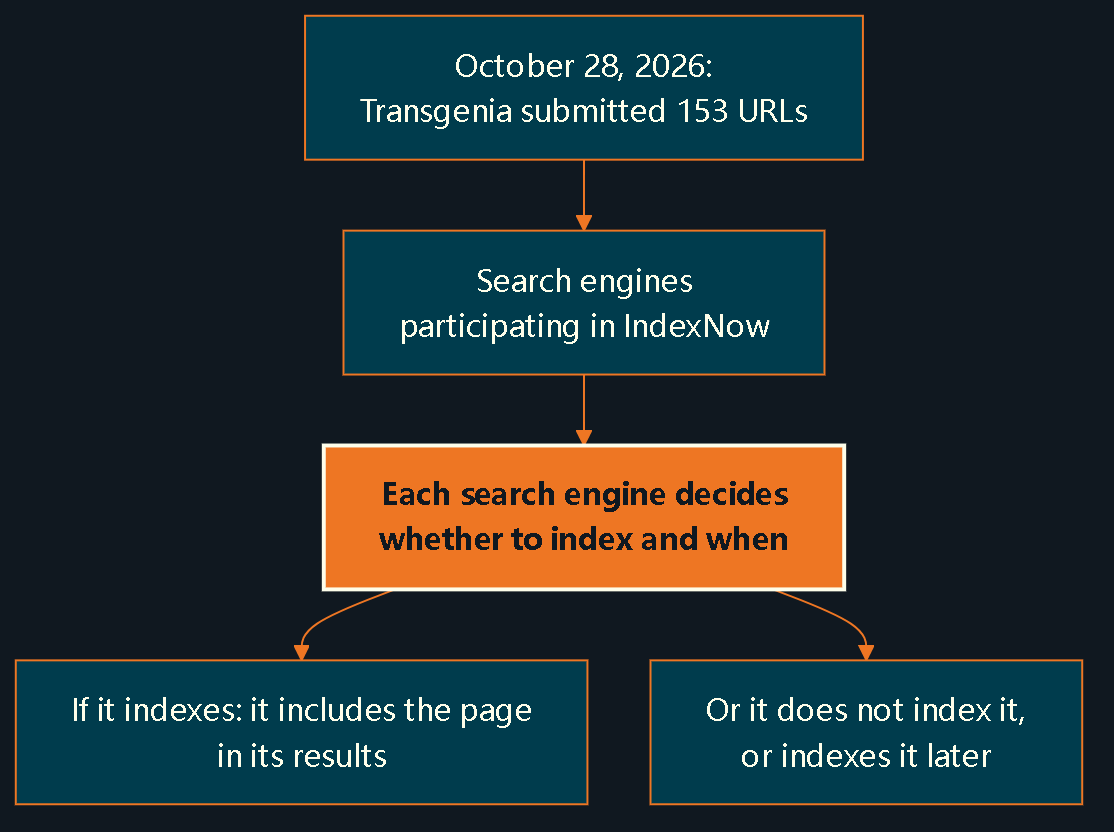
Mermaid meta-structure
flowchart TB
    A["October 28, 2026:<br/>Transgenia submitted 153 URLs"] --> B["Search engines<br/>participating in IndexNow"]
    B --> C["Each search engine decides<br/>whether to index and when"]
    C --> D["If it indexes: it includes the page<br/>in its results"]
    C --> N["Or it does not index it,<br/>or indexes it later"]
    class C clave
    classDef clave fill:#EE7623,stroke:#FEFEEA,stroke-width:2px,color:#101820,font-weight:bold
The result. At the cut-off, whoever opens the Wikidata item or the site footer reads the same registered address and service areas, which do not contradict each other. What search engines and AI assistants decide is not up to us; what they can read about us is.
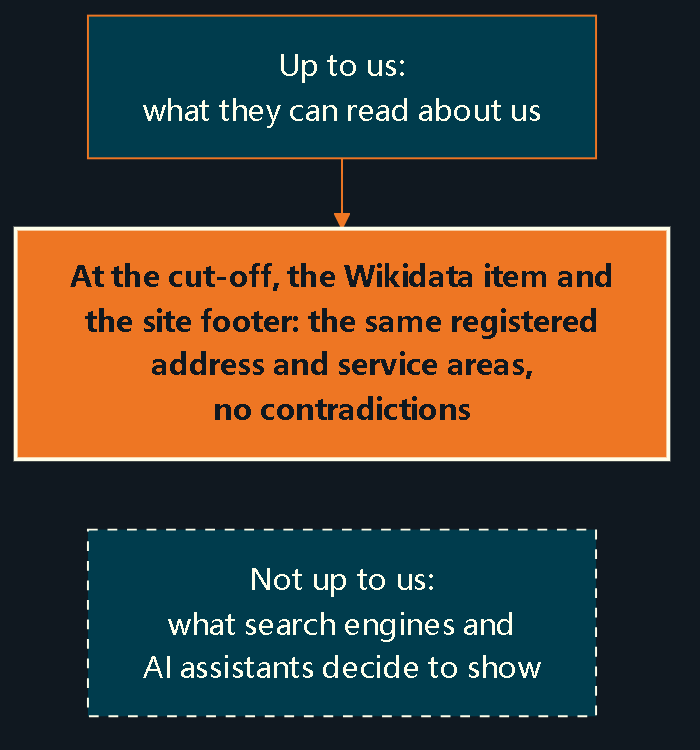
Mermaid meta-structure
flowchart TB
    A["Up to us:<br/>what they can read about us"] --> A1["At the cut-off, the Wikidata item and<br/>the site footer: the same registered<br/>address and service areas,<br/>no contradictions"]
    A1 ~~~ B["Not up to us:<br/>what search engines and<br/>AI assistants decide to show"]
    class A1 clave
    class B fuera
    classDef clave fill:#EE7623,stroke:#FEFEEA,stroke-width:2px,color:#101820,font-weight:bold
    classDef fuera stroke:#FEFEEA,stroke-dasharray:5 5
What we did not do and why
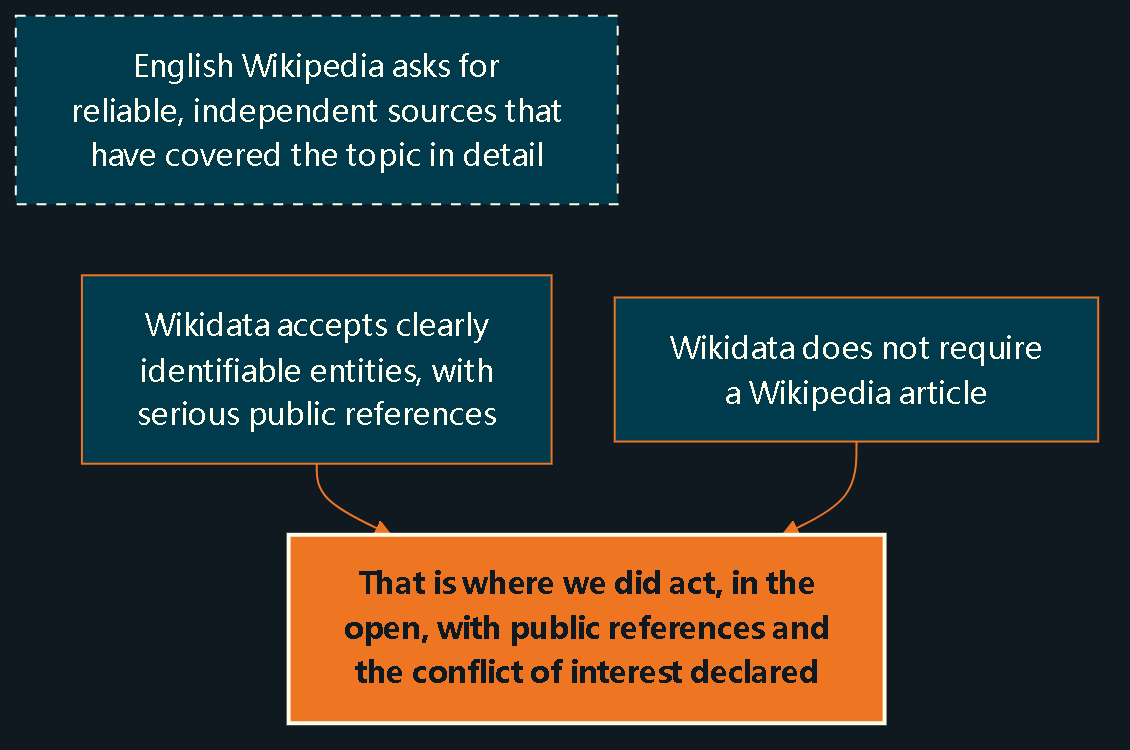
Transgenia decided not to create a Wikipedia article about itself. Independent coverage is insufficient, and writing about your own company is a conflict of interest. English Wikipedia asks for reliable, independent sources that have covered the topic in detail; press releases and the company's own material do not count. And it strongly discourages editing about yourself.
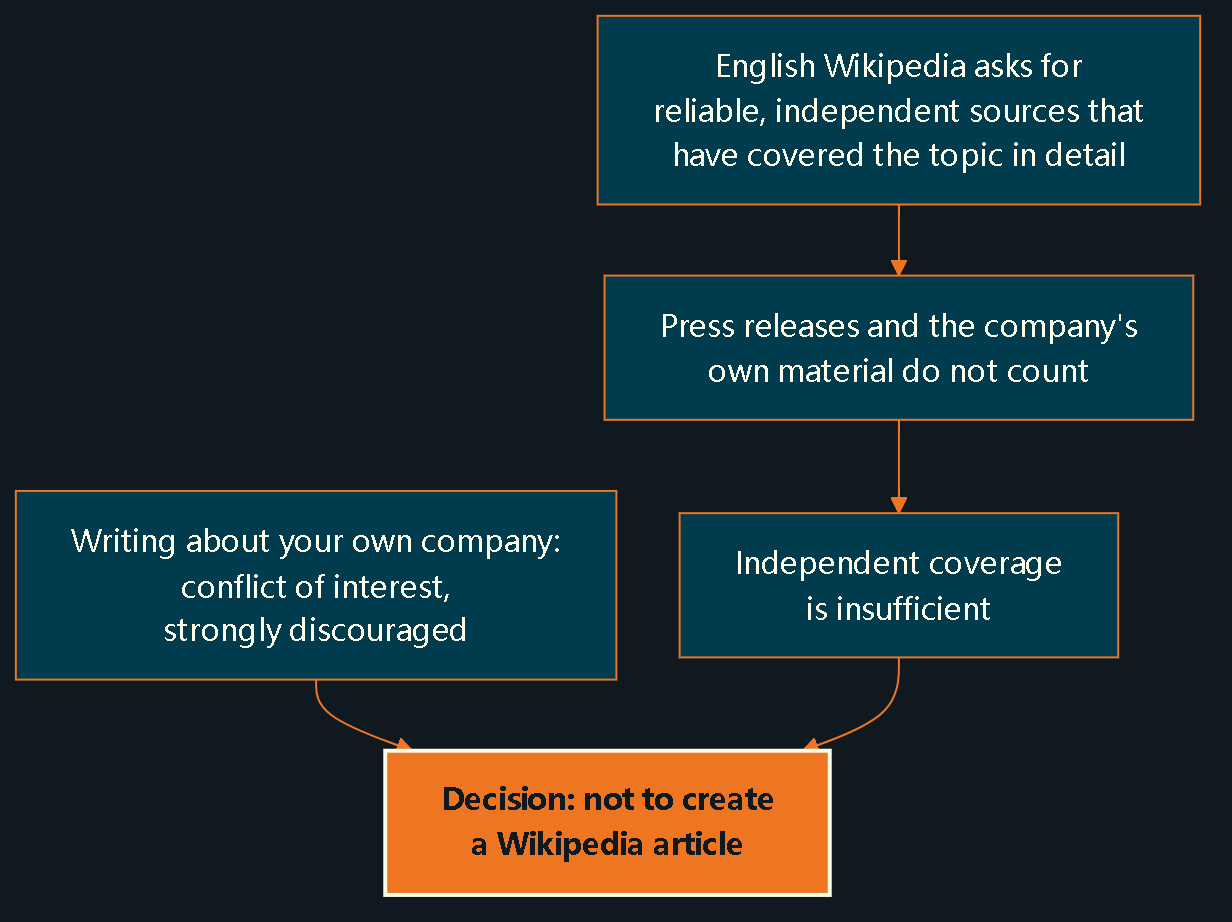
Mermaid meta-structure
flowchart TB
    A["English Wikipedia asks for<br/>reliable, independent sources that<br/>have covered the topic in detail"] --> B["Press releases and the company's<br/>own material do not count"]
    B --> C["Independent coverage<br/>is insufficient"]
    D["Writing about your own company:<br/>conflict of interest,<br/>strongly discouraged"] --> E
    C --> E["Decision: not to create<br/>a Wikipedia article"]
    class E clave
    classDef clave fill:#EE7623,stroke:#FEFEEA,stroke-width:2px,color:#101820,font-weight:bold
Wikidata asks for something else. It does not require a Wikipedia article for the company: it accepts clearly identifiable entities that can be documented with serious public references. That is where we did act, in the open and knowing the community can challenge it: with public references and the conflict of interest declared.
Mermaid meta-structure
flowchart TB
    W["English Wikipedia asks for<br/>reliable, independent sources that<br/>have covered the topic in detail"]
    D1["Wikidata accepts clearly<br/>identifiable entities, with<br/>serious public references"]
    D2["Wikidata does not require<br/>a Wikipedia article"]
    A["That is where we did act, in the<br/>open, with public references and<br/>the conflict of interest declared"]
    W ~~~ D1
    D1 --> A
    D2 --> A
    class A clave
    class W fuera
    classDef clave fill:#EE7623,stroke:#FEFEEA,stroke-width:2px,color:#101820,font-weight:bold
    classDef fuera stroke:#FEFEEA,stroke-dasharray:5 5
Nor did we promise appearances, meaning citations or mentions: Wikidata, structured data and IndexNow do not guarantee them, and neither do we. We promise to measure, and we publish the results of our September 2026 measurement.
Saying no, when going ahead is not appropriate, is part of the service.
Signs that your company needs a review
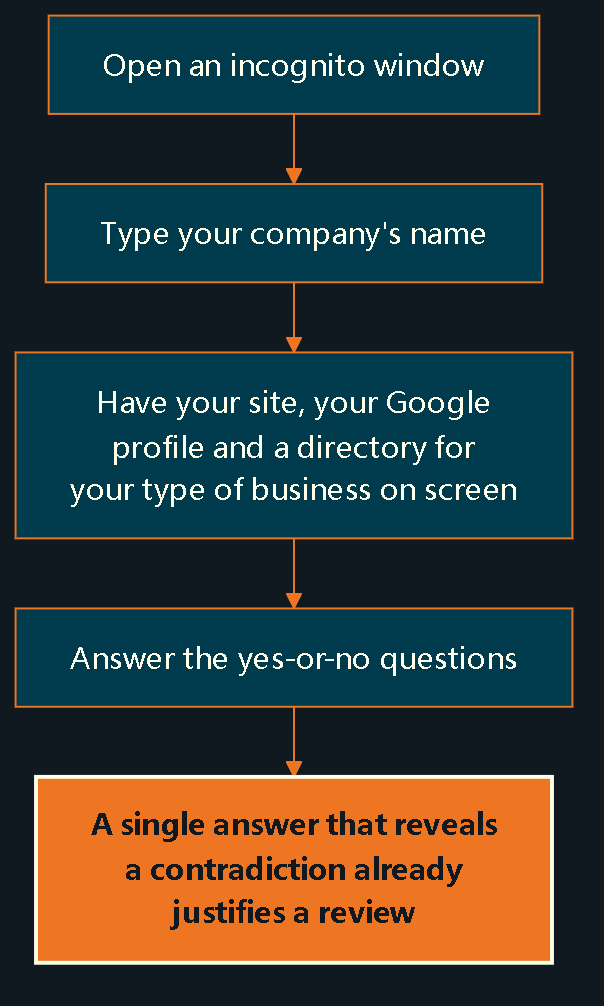
Transgenia found its four versions on public pages of its own site, and you can do a short version of that exercise today. Open an incognito window, type your company's name and have your site, your Google profile and a directory for your type of business on screen. These yes-or-no questions tell you whether a review makes sense.
Mermaid meta-structure
flowchart TB
    A["Open an incognito window"] --> B["Type your company's name"]
    B --> C["Have your site, your Google<br/>profile and a directory for<br/>your type of business on screen"]
    C --> D["Answer the yes-or-no questions"]
    D --> E["A single answer that reveals<br/>a contradiction already<br/>justifies a review"]
    class E clave
    classDef clave fill:#EE7623,stroke:#FEFEEA,stroke-width:2px,color:#101820,font-weight:bold
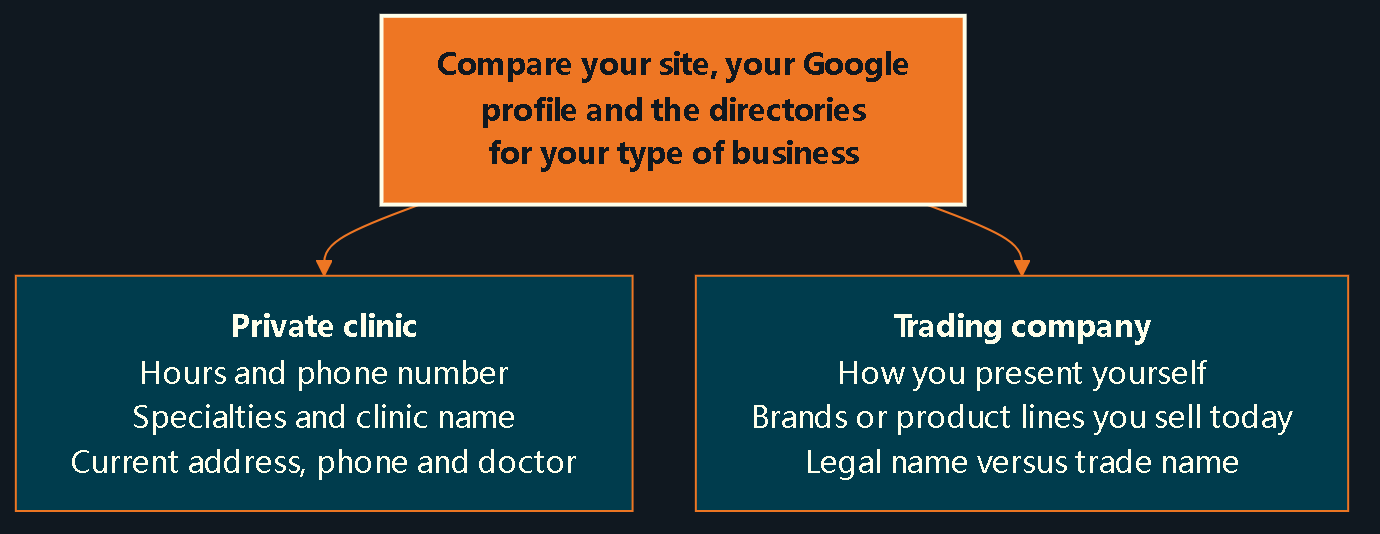
If you run a private clinic:
- Do the hours and phone number on your Google profile match those on your site?
- Do your site and the directories list the same specialties, under the same clinic name?
- Does any directory, or your Google profile, list an address, a phone number or a doctor that is no longer your clinic's?
If you run a trading company that sells to other businesses:
- Does your site present you as a trading company, distributor or wholesaler, depending on the page?
- Are the brands or product lines your site and the directories advertise the ones you sell today?
- Does your legal name appear anywhere as your trade name?
Mermaid meta-structure
flowchart TB
    R["Compare your site, your Google<br/>profile and the directories<br/>for your type of business"]
    R --> C["<b>Private clinic</b><br/>Hours and phone number<br/>Specialties and clinic name<br/>Current address, phone and doctor"]
    R --> M["<b>Trading company</b><br/>How you present yourself<br/>Brands or product lines you sell today<br/>Legal name versus trade name"]
    class R clave
    classDef clave fill:#EE7623,stroke:#FEFEEA,stroke-width:2px,color:#101820,font-weight:bold
A single answer that reveals a contradiction already justifies a review. If your Google profile says one set of hours and your site another, whoever is looking for you decides which to believe, and you may not find out. You can also ask an AI assistant what your company does; if the answer differs from what you publish, write it down and compare it with your sources. And if you hire someone to fix it, this is how you vet a provider.
Where Transgenia stands
A company does not need to be everywhere; it needs to say the same thing wherever it is already named. Whoever looks for it, a person or an artificial intelligence assistant, reads several sources at once, and the one that contradicts the others teaches them to doubt all of them. That is why we believe consistency should be checked before spending to appear more, and that it is maintained, not achieved once. We also believe that whoever sells this work should do it first in their own house, in the open and with conflicts of interest declared, and should say what they do not control: what a search engine or an assistant decides to show is not in our hands.
Sources
- Organization structured data (Google Search Central, read on October 30, 2026).
- Wikidata:Notability (Wikidata, read on October 30, 2026).
- Wikidata:Disclosure of paid editing (Wikidata, read on October 30, 2026).
- Wikipedia:Notability (English Wikipedia, read on October 30, 2026).
- Wikipedia:Conflict of interest (English Wikipedia, read on October 30, 2026).
- IndexNow documentation (IndexNow, read on October 30, 2026).
- Transgenia item Q141898210 on Wikidata (consulted on October 30, 2026).
- Internal record of the site audit (October 27 and 28, 2026): not public; figures are quoted as they were written.
- Internal record of the IndexNow notice (October 28, 2026): 153 URLs; not public.
Frequently asked questions
Can you get me on Wikipedia?
No. No one can guarantee you an article: the encyclopedia asks for coverage from reliable sources independent of the company, and writing about your own company is a conflict of interest. That is why Transgenia decided not to create its own. What we do is check whether your company qualifies for a Wikidata item, and tell you the truth if it does not.
Do you guarantee I will appear in ChatGPT?
No. Transgenia does not guarantee appearances in ChatGPT, Gemini, Perplexity or Google: we do not control what they answer. What we do is work so that what anyone can read about your company in public sources says the same thing, and measure how that evolves.
Is it the same as SEO?
No. SEO aims to get you found and clicked on; AEO aims to get you cited, and our guide explains it. What Transgenia did with the 165 pages of its site prepares the ground for AEO: first, a single version of the company that anyone can consult; being cited is outside our control.
How long does it take?
The timeline for our work is agreed in writing before each package starts, once we know your case. We neither decide nor promise how long a search engine takes to reflect the changes: each engine decides whether to index and when.
What do you need from me?
To start, one person who can decide how your company is described. The rest we define with you in the QuickLook, which is free and takes 15 minutes. Transgenia does not claim your Google profile: it belongs to the business owner, not to an agency.
Next step
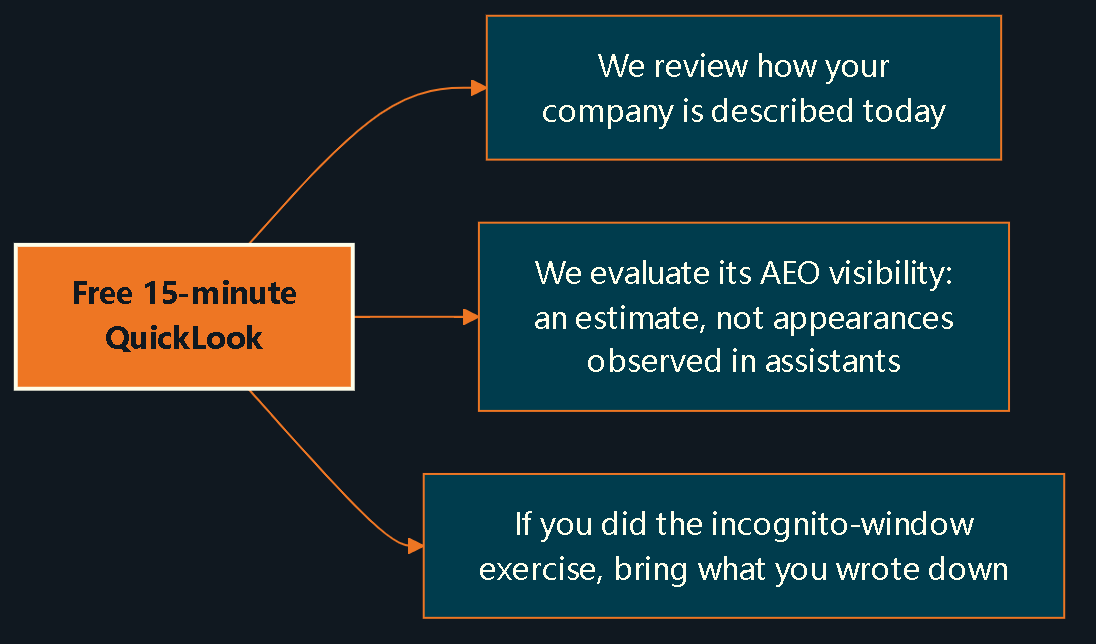
Transgenia offers a free 15-minute QuickLook to get started. We review how your company is described today and evaluate its AEO visibility with our internal tools, as an estimate and not as appearances observed in assistants; if you did the incognito-window exercise, bring what you wrote down. Book a QuickLook.
Mermaid meta-structure
flowchart LR
    Q["Free 15-minute<br/>QuickLook"] --> A["We review how your<br/>company is described today"]
    Q --> B["We evaluate its AEO visibility:<br/>an estimate, not appearances<br/>observed in assistants"]
    Q --> C["If you did the incognito-window<br/>exercise, bring what you wrote down"]
    class Q clave
    classDef clave fill:#EE7623,stroke:#FEFEEA,stroke-width:2px,color:#101820,font-weight:bold
About the author and Transgenia
Efraín Carreón Ortiz is Director General (Chief Executive Officer) of Centrum Transgenia, a Mexican technology boutique. He holds the official Claude Code badge (Claude Partner Badge) issued by Anthropic, verifiable on Credly.
Transgenia is an OpenAI Select Partner within the OpenAI Partner Network and a registered partner in Anthropic's Claude Partner Network. Team: Víctor Estrada Bello, Chief PMO; Danild Johan Zambrana López, Chief Technology Officer; Jaime Lozano Castañeda, Chief Marketing Officer; Efraín Carreón Ortiz, Director General (Chief Executive Officer).
Let's talk: contacto@transgenia.org, WhatsApp +52 55 8034 0405, 15-minute call or the contact page.
Keep reading
- We audited our own server with Claude Mythos 5.1: what frontier AI can do in defensive cybersecurity.
- The definitive guide to optimizing your website's AEO: what we published in July about AEO.
- AI Search Visibility: How to Measure It and Find New Keywords: the results of our September 2026 measurement.
- About us: the company's details.
- Guide to hiring someone to integrate AI with Odoo in Mexico: how to vet a provider.
- AI implementation and Odoo integration: another Transgenia service.
- Odoo implementation in Mexico City: where we provide Odoo service.
- Ficha Maestra: KYC verification for AEO: the service we offer.
Hashtags: #StructuredData #Wikidata #GoogleBusinessProfile #AISearch #AEO #KnowledgeGraph #SchemaMarkup #EntitySEO #LocalSEO #SmallBusiness