If you already run Odoo and someone offers to "connect AI to it", the right question is not which model they use, but what it will be able to read, what it will be able to write, who approves it and what you receive at the end. This guide gives you the criteria to check any provider, Transgenia included.
View Mermaid diagram
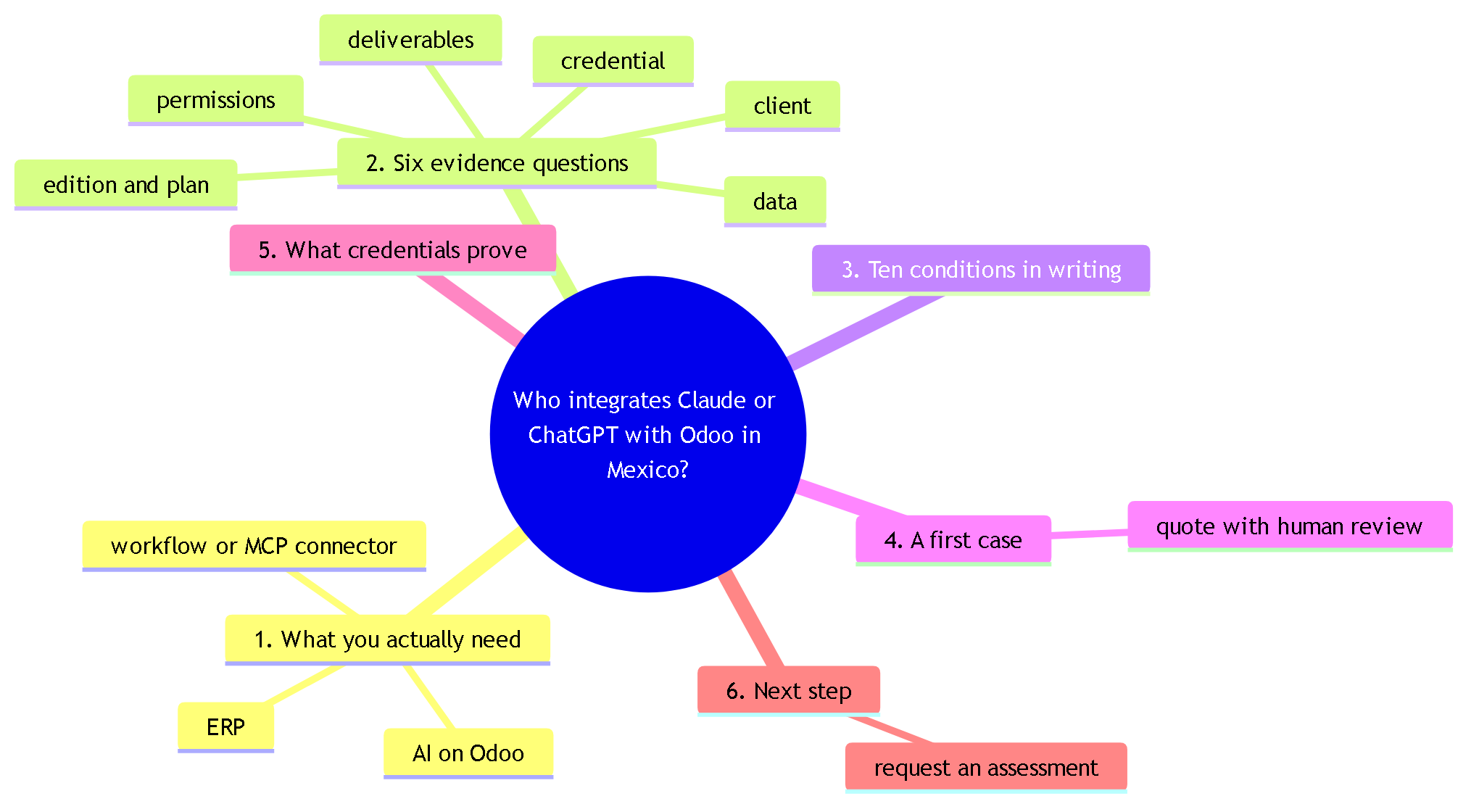
mindmap
  root(("Who integrates Claude or ChatGPT with Odoo in Mexico?"))
    1. What you actually need
      ERP
      AI on Odoo
      workflow or MCP connector
    2. Six evidence questions
      client
      edition and plan
      credential
      permissions
      data
      deliverables
    3. Ten conditions in writing
    4. A first case
      quote with human review
    5. What credentials prove
    6. Next step
      request an assessment
First decide what you actually need
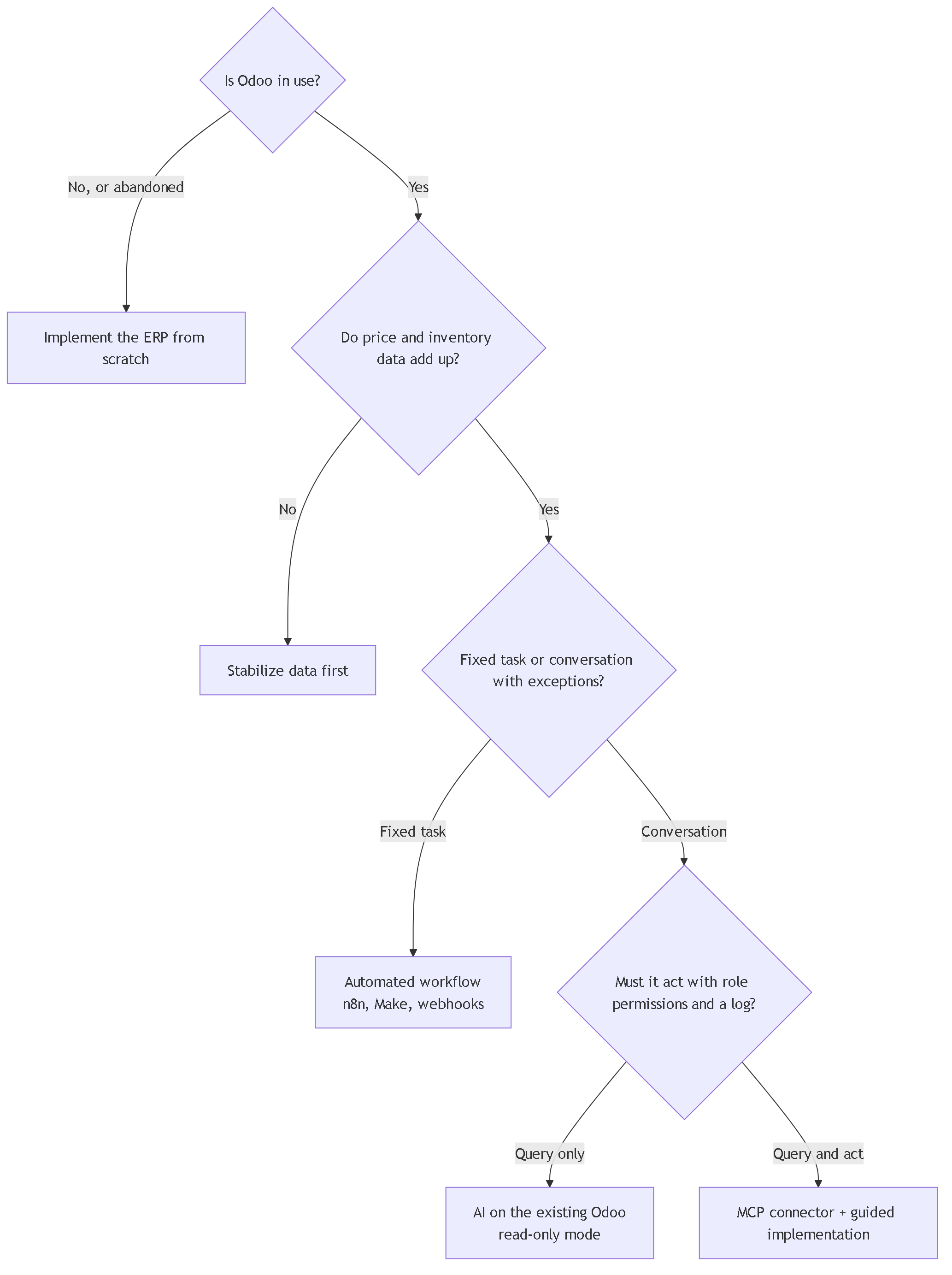
"Integrating AI with Odoo" describes four different things, with different prices, risks and deliverables. Before requesting quotes, place your case in one of these rows.
| Option | When it applies | What it does not solve |
|---|---|---|
| Implement the ERP from scratch | You do not have Odoo, or you have an abandoned one that nobody uses. | This is not AI integration; it is an implementation project. Start with Odoo implementation in Mexico City. |
| AI on the Odoo you already use | Odoo works and you want to query data or prepare drafts in natural language. | It does not fix dirty data or broken processes. If inventory does not reconcile, you first need to stabilize it. |
| Automated workflow (n8n, Make, webhooks) | A repetitive task with fixed inputs and outputs, for example copying an order from a form into Odoo. | It does not converse, does not decide exceptions and does not respect role-based permissions unless someone programs them one by one. |
| MCP connector | You want an agent to read and act on Odoo with defined permissions and a log of every action. | A connector is not a service: it has to be configured, limited, tested and operated. That part is the implementation. |
View Mermaid diagram
flowchart TB
    A{"Is Odoo in use?"}
    A -- "No, or abandoned" --> ERP["Implement the ERP from scratch"]
    A -- "Yes" --> B{"Do price and inventory data add up?"}
    B -- "No" --> EST["Stabilize data first"]
    B -- "Yes" --> C{"Fixed task or conversation with exceptions?"}
    C -- "Fixed task" --> FLU["Automated workflow
n8n, Make, webhooks"]
    C -- "Conversation" --> D{"Must it act with role permissions and a log?"}
    D -- "Query only" --> IA["AI on the existing Odoo
read-only mode"]
    D -- "Query and act" --> MCP["MCP connector + guided implementation"]
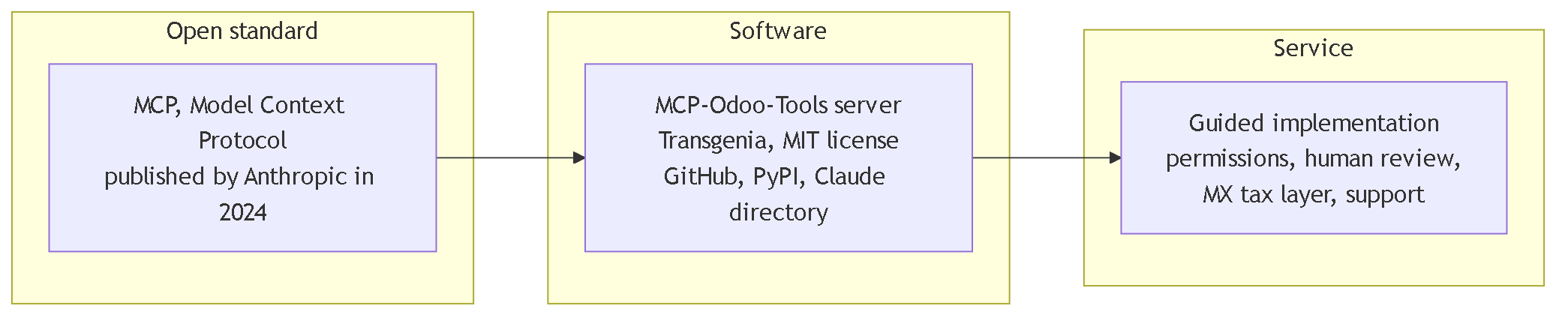
MCP (Model Context Protocol) is an open standard published by Anthropic in 2024 so that language models can connect to tools and data. It does not belong to Transgenia or to any integrator. What each provider contributes is the server that implements it for Odoo and the service around it. Always ask which of the two you are hiring. If what you have is a legacy Odoo that should be migrated or rescued before thinking about AI, the Odoo Enterprise to Community migration field study shows what you gain and what you pay on that path.
View Mermaid diagram
flowchart LR
    subgraph P["Open standard"]
        M["MCP, Model Context Protocol
published by Anthropic in 2024"]
    end
    subgraph S["Software"]
        T["MCP-Odoo-Tools server
Transgenia, MIT license
GitHub, PyPI, Claude directory"]
    end
    subgraph V["Service"]
        I["Guided implementation
permissions, human review,
MX tax layer, support"]
    end
    M --> T --> I
How to verify that a provider knows how to integrate Claude or ChatGPT with Odoo
Any provider can say they integrate AI with Odoo. These six questions separate those who have done it from those who will try it out on you. The reference answers we give come from the public documentation of our own server, MCP-Odoo-Tools, version 1.4.0; ask each provider for the equivalent.
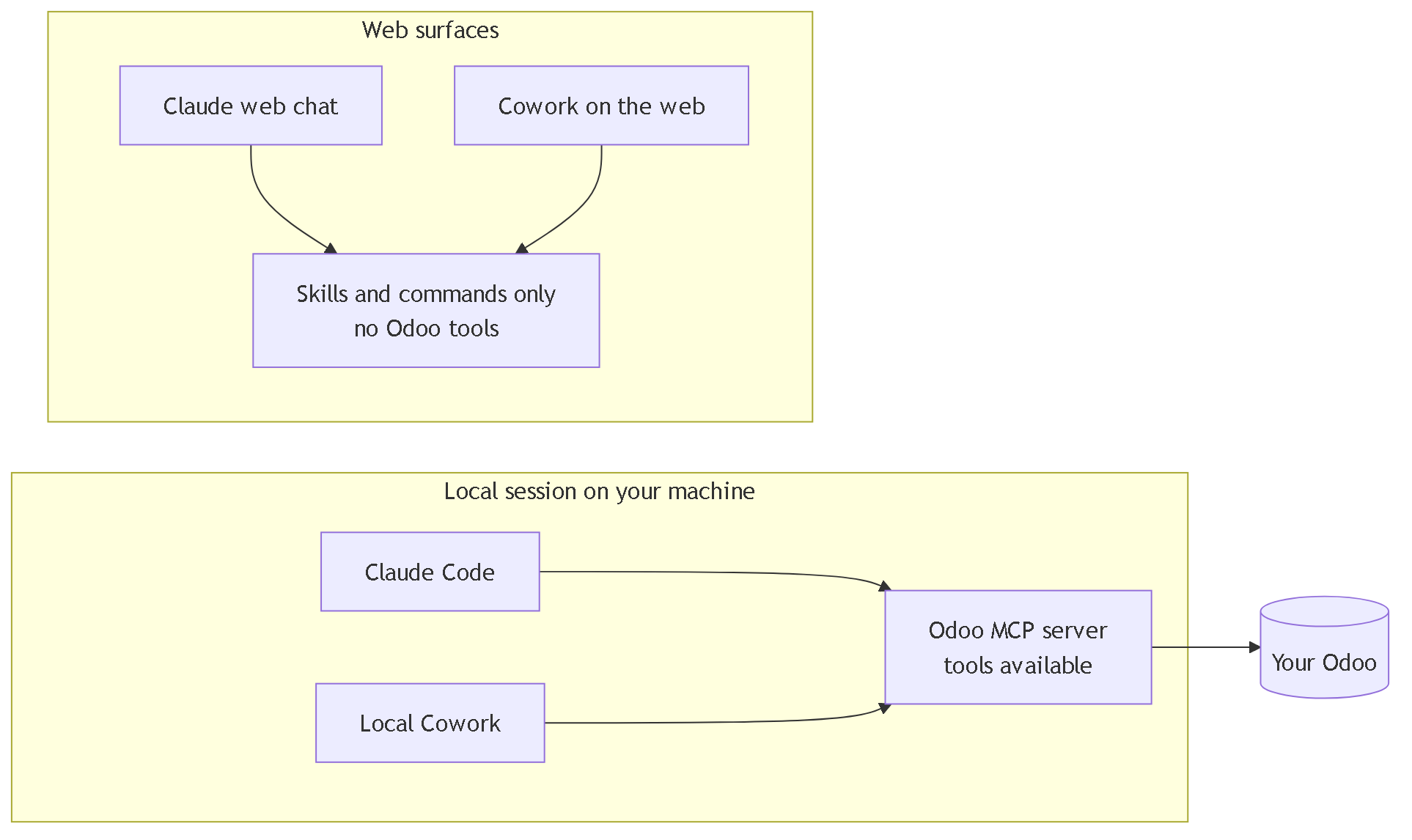
1. Which client will my team work from? A local MCP server runs on the user's machine. In our case, the Odoo tools work in Claude Code and in local Cowork sessions; the Claude web chat and Cowork on the web load skills and commands, but not local MCP servers. If your team will only use the browser chat, you need a different deployment and you should know that before signing.
View Mermaid diagram
flowchart LR
    subgraph L["Local session on your machine"]
        CC["Claude Code"]
        CW["Local Cowork"]
        SRV["Odoo MCP server
tools available"]
        CC --> SRV
        CW --> SRV
    end
    subgraph W["Web surfaces"]
        CH["Claude web chat"]
        CWW["Cowork on the web"]
        SK["Skills and commands only
no Odoo tools"]
        CH --> SK
        CWW --> SK
    end
    SRV --> O[("Your Odoo")]
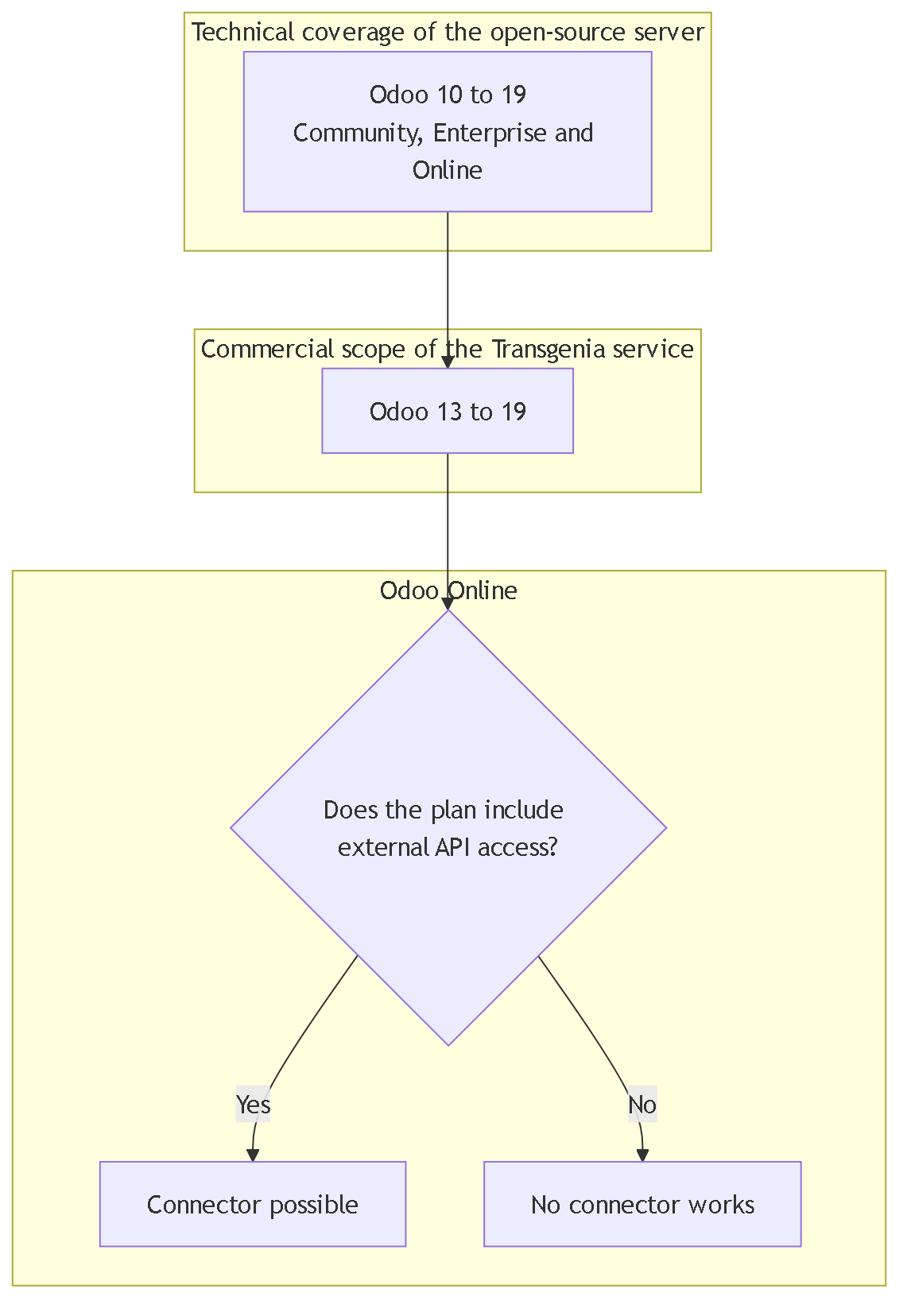
2. Which Odoo edition, version and plan do I have, and what is left out? The open-source server covers Odoo 10 to 19, Community, Enterprise and Online; Transgenia's implementation service is offered for Odoo 13 to 19. On Odoo Online, the plan must include external API access; without it, no connector works. Ask which features will not be available on your specific version.
View Mermaid diagram
flowchart TB
    subgraph T["Technical coverage of the open-source server"]
        V["Odoo 10 to 19
Community, Enterprise and Online"]
    end
    subgraph C["Commercial scope of the Transgenia service"]
        S["Odoo 13 to 19"]
    end
    subgraph O["Odoo Online"]
        P{"Does the plan include external API access?"}
        P -- "Yes" --> OK["Connector possible"]
        P -- "No" --> NO["No connector works"]
    end
    V --> S
    S --> P
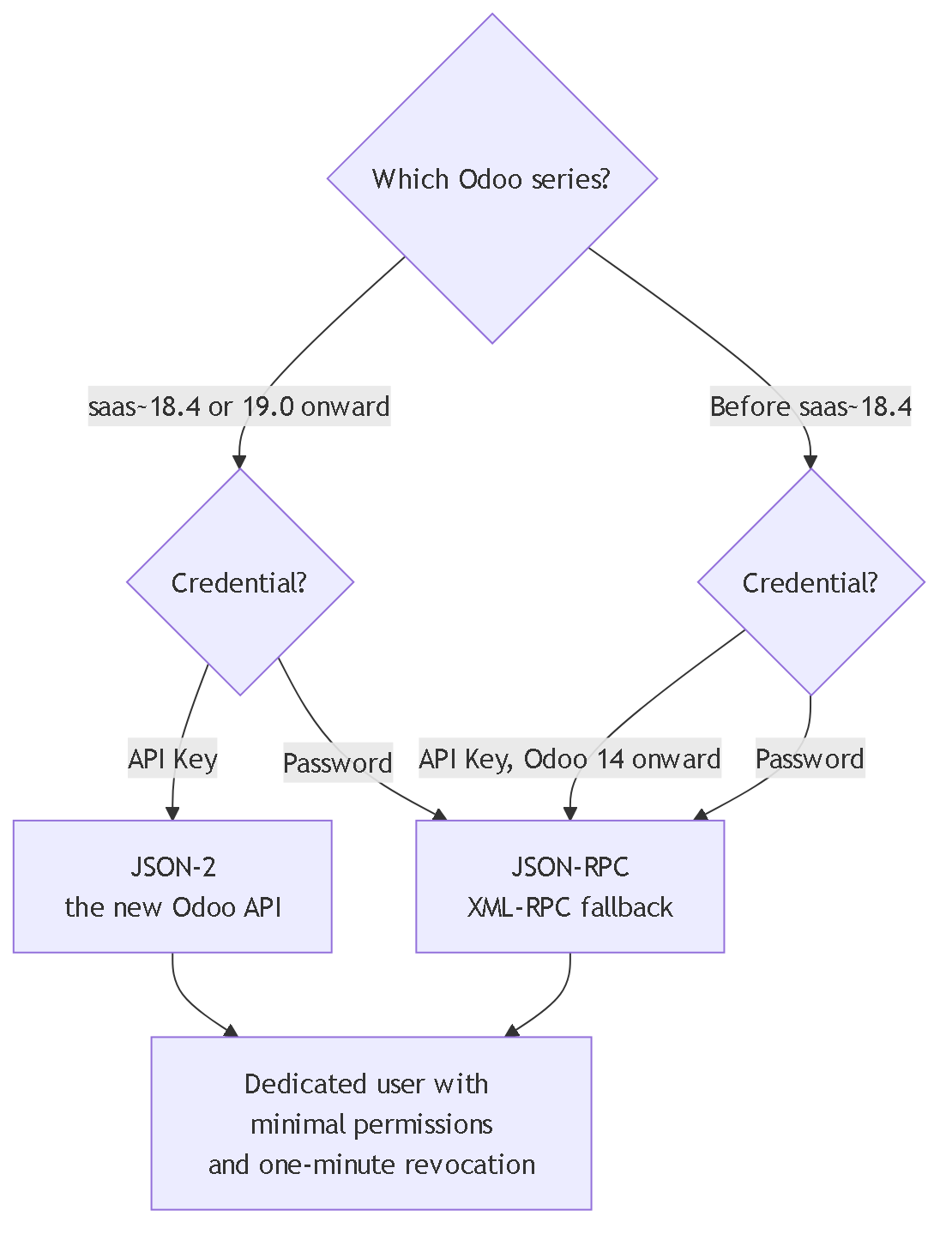
3. Which credential will they ask me for, and with which user? JSON-RPC and XML-RPC accept a password or an API Key (API Keys have existed since Odoo 14); Odoo's new API, JSON-2, only accepts an API Key and is available on saas~18.4 and 19.0 onward. Demand a dedicated Odoo user with minimal permissions and a procedure to revoke the key in one minute.
View Mermaid diagram
flowchart TB
    A{"Which Odoo series?"}
    A -- "saas~18.4 or 19.0 onward" --> B{"Credential?"}
    B -- "API Key" --> J2["JSON-2
the new Odoo API"]
    B -- "Password" --> JR["JSON-RPC
XML-RPC fallback"]
    A -- "Before saas~18.4" --> C{"Credential?"}
    C -- "API Key, Odoo 14 onward" --> JR
    C -- "Password" --> JR
    J2 --> U["Dedicated user with minimal permissions
and one-minute revocation"]
    JR --> U
4. What can the agent write, and who approves it? Our server has a read-only mode that rejects every write before touching Odoo. Human review of each write (what we call VoBo) is not part of the public package: it is part of the guided implementation and is configured with you. Be wary of anyone who promises that "the AI already asks for permission on its own". This is how we run our own governed AI agents and the B2B sales agent: draft first, human approval second.

View Mermaid diagram
flowchart LR
    subgraph N["Public core of the server"]
        R["Read-only mode
rejects every write"]
        L["Queries and drafts"]
    end
    subgraph I["Guided implementation"]
        V["Human review per operation
VoBo before writing"]
        W["Write to production
with a record of who approved"]
    end
    L --> V --> W
    R -. "protects until there is a VoBo" .-> L
5. Which data leaves the ERP, to whom and under what terms? With the plugin running on your machine, Transgenia does not receive, relay or retain data: no credentials, no records, no prompts. The results that Odoo returns do travel to your MCP client and from there to the model provider you choose (Anthropic for Claude, OpenAI for ChatGPT), as with any tool. That leg is governed by the terms of your Odoo and of your AI provider. If you hire an implementation or hosting service, ask for that service's privacy notice separately.

View Mermaid diagram
flowchart LR
    O[("Your Odoo")] -- "authorized query" --> S["MCP server
on your machine"]
    S -- "result" --> C["Your MCP client
Claude Code or Cowork"]
    C -- "result as context" --> M["Model provider
Anthropic or OpenAI"]
    T["Transgenia
outside the flow:
does not receive, relay or retain"]
    T -.- S
6. What do I receive at closing? Documentation of the configuration, the user and permissions created, the list of enabled operations, the revocation procedure, the support terms and the knowledge transfer to your team. If the provider disappears tomorrow, your integration must keep working and your people must know how to operate it.
What you should demand in writing
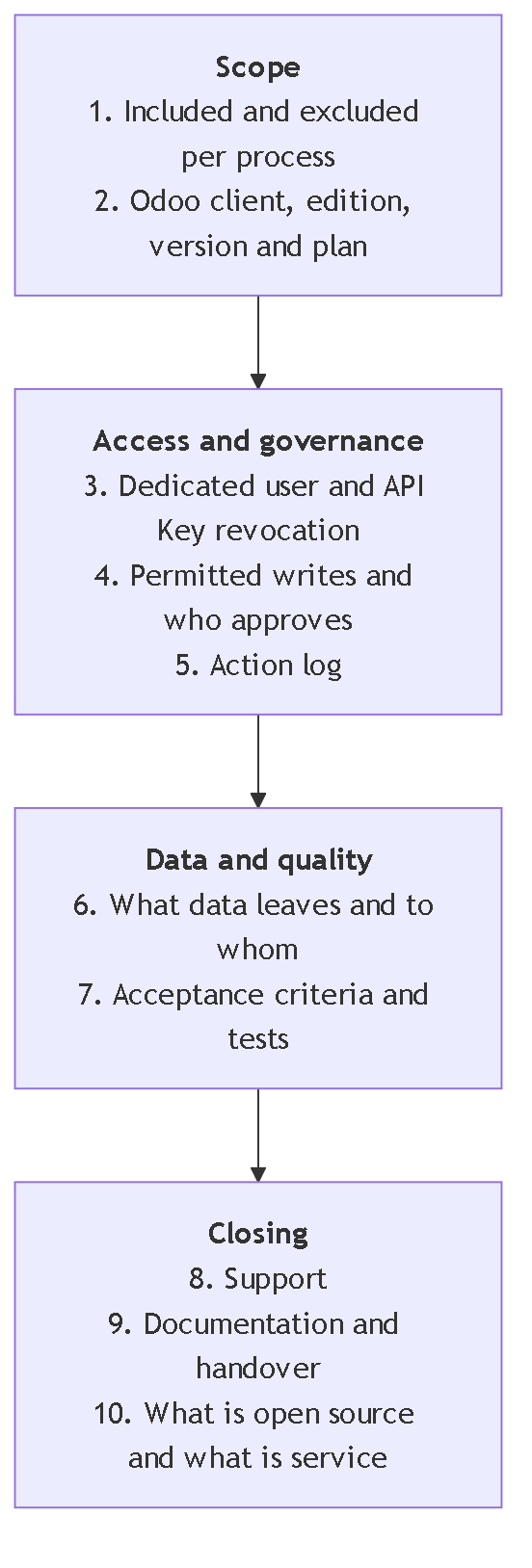
A serious integration proposal fits on one page and answers these ten points without vague amounts or promises of results.
- Scope included and excluded, by process: quoting, inventory, orders, collections.
- Odoo client, edition, version and plan that the provider commits to.
- Dedicated Odoo user, minimal permissions and API Key revocation procedure.
- Permitted write operations and who approves them.
- Action log: where it is kept, who can consult it and how long it is retained.
- Which data leaves the ERP, to which model provider and under what terms.
- Acceptance criteria and tests with sample data before going to production.
- Support: hours, channel and response times.
- Documentation and handover to the client at closing.
- Which part is open source, with license and public repository, and which part is service.
View Mermaid diagram
flowchart TB
    G1["Scope
1. Included and excluded per process
2. Odoo client, edition, version and plan"]
    G2["Access and governance
3. Dedicated user and API Key revocation
4. Permitted writes and who approves
5. Action log"]
    G3["Data and quality
6. What data leaves and to whom
7. Acceptance criteria and tests"]
    G4["Closing
8. Support
9. Documentation and handover
10. What is open source and what is service"]
    G1 --> G2 --> G3 --> G4
In our case, point 10 is answered like this: the MCP-Odoo-Tools server is open source under the MIT license, published on GitHub and on PyPI, and available as a plugin in the Claude directory; the Mexican tax layer, human review of writes and the backup tools are part of the implementation service. We explain it in detail in the plugin article and on the product page.
A first case: quoting from Odoo with human review
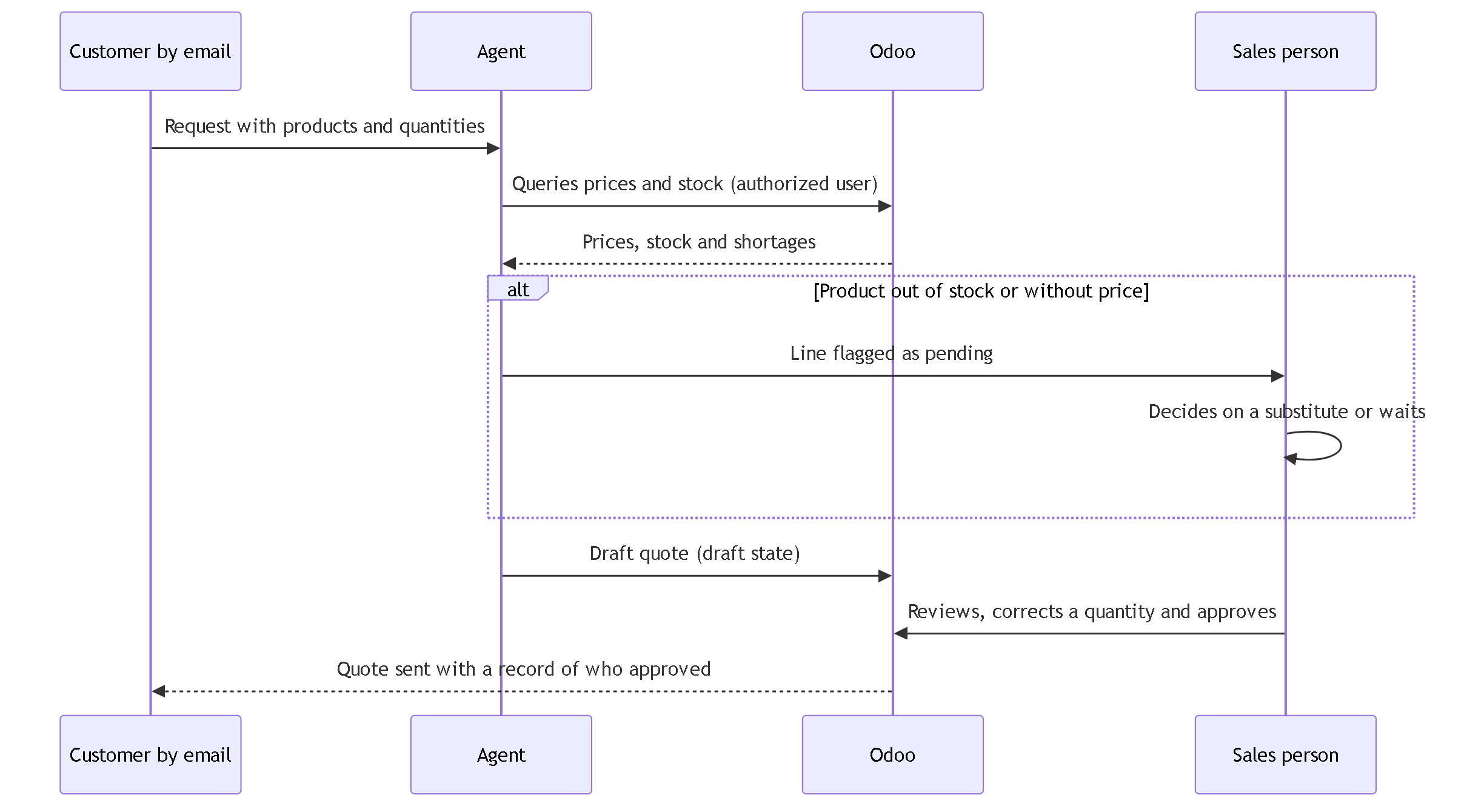
This example is hypothetical and is meant to show you what to ask for in a demo; it is not a client case. A trading company receives an email request with products and quantities. The agent queries prices and stock in Odoo with an authorized user, prepares a draft quote and leaves it in draft state. A salesperson reviews it, corrects a quantity and approves sending it. Checking stock does not reserve it or commit a sale. If your company is a trading or wholesale business, the Odoo for trading companies page describes the processes that benefit most; if it is a clinic, the Nova House case applies the same principle to patient follow-up.
The typical exception appears when a product has no stock or no price on the applicable price list. In that case the agent does not invent a price: it flags the line as pending and the person decides. If the provider you are evaluating cannot show you that flow with sample data, with the draft visible in Odoo and with a log of who approved what, they are not showing you a governed integration. Before the first test with real data it pays to know what to isolate in an Odoo copy; and if your inventory syncs with marketplaces, the MercadoLibre Full replenishment bug is the kind of exception an agent must not resolve on its own.
View Mermaid diagram
sequenceDiagram
    participant V as Customer by email
    participant A as Agent
    participant O as Odoo
    participant H as Sales person
    V->>A: Request with products and quantities
    A->>O: Queries prices and stock (authorized user)
    O-->>A: Prices, stock and shortages
    alt Product out of stock or without price
        A->>H: Line flagged as pending
        H->>H: Decides on a substitute or waits
    end
    A->>O: Draft quote (draft state)
    H->>O: Reviews, corrects a quantity and approves
    O-->>V: Quote sent with a record of who approved
Our AI implementation offer describes the requirements, the cost factors and the next step to request an assessment.
What the credentials prove, and what they do not
Credentials help you filter, but they do not replace the six questions above. Ours, with their exact names:
- OpenAI Select Partner, at company level, within the OpenAI Partner Network. It proves the commercial relationship with OpenAI; it does not prove a specific integration with your Odoo.
- Anthropic Registered Partner in the Claude Partner Network. It means Anthropic recognizes us as a partner, not that it certifies or audits our MCP server.
- Claude Partner Badge for Claude Code, personal, held by Efraín Carreón Ortiz, verifiable on Credly. It is an individual credential, not a corporate one.
Ask each provider for the same breakdown: what belongs to the company, what is personal and what is demonstrated with an implementation you can see.
Frequently asked questions
Do I need to implement Odoo first, or can I integrate AI on the one I already have?
If your Odoo works and your price and inventory data are reliable, you can integrate AI on top of it without reimplementing. If the ERP is abandoned or the data does not reconcile, it first has to be implemented or stabilized; integrating AI on dirty data only accelerates the errors.
What is the difference between Claude, Claude Code and ChatGPT when working with Odoo?
Claude and ChatGPT are models and their chat applications. Claude Code is Anthropic's work tool that runs local MCP servers, which is why the Odoo plugin runs there. ChatGPT connects to Odoo through integrations that use the OpenAI API or each provider's own connectors. What matters is which data each one reads, what it can write and who approves.
What is MCP and who created it?
MCP (Model Context Protocol) is an open standard published by Anthropic to connect language models with tools and data. Any company can implement it. Transgenia develops and maintains an MCP server for Odoo under the MIT license; the protocol does not belong to Transgenia.
Which Odoo versions and editions does it work with?
The open-source MCP server covers Odoo 10 to 19 on Community, Enterprise and Online. Transgenia's implementation service is offered for Odoo 13 to 19. On Odoo Online, the plan must include external API access.
What can the AI query, and what requires a person's approval?
It depends on the Odoo user's permissions and the server configuration. In read-only mode the agent queries and prepares drafts, but does not write. Writes in production are enabled per operation and with human review in the guided implementation.
Does my data pass through Transgenia's servers?
No, when the plugin runs on your machine. Data goes from your Odoo to your MCP client and from there to the model provider you choose. Transgenia does not receive, relay or retain credentials, records or prompts from the plugin. A contracted implementation or hosting service has its own privacy notice.
What do Transgenia's credentials prove?
OpenAI Select Partner proves the commercial relationship with OpenAI at company level. Anthropic Registered Partner proves registration in the Claude Partner Network. The Claude Partner Badge for Claude Code is a personal credential of Efraín Carreón Ortiz. None of them replaces an implementation demonstrated with sample data.
How much does it cost to integrate Claude or ChatGPT with Odoo?
There is no fixed rate. The cost depends on the process, the data, the integrations, the permissions, the testing, the support and the acceptance criteria. It is quoted by scope after an assessment; a proposal that gives a price without that information is guessing.
What is the next step if I already use Odoo?
Request an assessment stating the process you want to improve, your Odoo edition and version, and whether you use Online. With that we define scope, permissions and acceptance criteria before quoting. We do not ask for credentials in the form and we do not promise a free pilot.
About the author and Transgenia
Efraín Carreón Ortiz is CEO of Centrum Transgenia, a Mexican technology boutique. He holds the official Claude Code badge (Claude Partner Badge) issued by Anthropic, verifiable on Credly.
Transgenia is an OpenAI Select Partner within the OpenAI Partner Network and a registered partner in Anthropic's Claude Partner Network. Team: Víctor Estrada Bello, Chief PMO; Danild Johan Zambrana López, Chief Technology Officer; Jaime Lozano Castañeda, Chief Marketing Officer; Efraín Carreón Ortiz, Director General (Chief Executive Officer).
Let's talk: contacto@transgenia.org, WhatsApp +52 55 8034 0405, 15-minute call or the contact page.
Keep reading
- AI implementation and Odoo integration: the offer, the requirements and the form to request an assessment.
- Connect Odoo to Claude with an API Key and create views without Python: the technical tutorial for the base layer.
- Implementing Claude in your company: a phased guide: the adoption and governance method.
- We published MCP-Odoo-Tools: what the open-source MCP server is, its catalog and its license.
- MCP Transgenia Odoo: the product page with its editions.
- Odoo Enterprise to Community migration: field study: what happens when the ERP is rescued before integrating AI.
- What to isolate before testing an AI agent on an Odoo copy: the safe test before any write.
- How Transgenia runs with governed AI agents: the draft-first and VoBo model we demand from any integration.
- Claude implementation methodology: phases, roles and acceptance criteria.
- Guide: what is Claude: for those still comparing models before comparing integrators.
- Odoo for trading companies and Odoo and AI for clinics: the two verticals where we apply this method.