An MCP infrastructure inventory is the verified map of which MCP servers a company has, where they run, who comes in through them and with what permissions. At Transgenia we made ours in one afternoon, with a reading phase that modified no services and three Claude sessions.
Short answer. Before offering AI integrations to a client, it pays to inventory your own: which connectors exist, where each server runs, which credential it uses to get in and who responds if it goes down. The inventory fixes nothing: it separates looking from fixing, which is why it can be repeated at low risk.
What is an MCP infrastructure inventory and what should it include?
It is a verifiable document, not a spreadsheet filled in from memory. Each MCP server must answer five questions, with its evidence:
| Question | What to record | Minimum evidence |
|---|---|---|
| Where does it run? | Machine, container or service, and who maintains it | A command or a screen that shows it |
| Who gets in? | The account or identity each client connects with | The server's access log |
| What can it do? | Enabled tools and permissions | List of tools and of exposed models |
| What traffic does it receive? | Real calls in a time window | Call log |
| Who responds if it goes down? | An owner and a date for each open item | Minutes or a tracking board |
What did Transgenia achieve in October 2026?
There were two achievements. The first is MCP-Odoo-Tools, our open-source MCP server for Odoo, which we introduced in an earlier article. Its version 1.4.0 is public under the MIT license on GitHub, on PyPI as odoo-mcp-tools and as the container image ghcr.io/transgenia/odoo-mcp-tools:1.4.0. It covers Odoo 10 to 19 in Community, Enterprise and Odoo Online and, according to its README, exposes 28 tools.
According to the management panel, version 1.4.0 appears as published and approved by a directory reviewer, and the plugin has appeared since October 5, 2026 in the Anthropic Directory catalog that our Claude account queries. It does not appear on the public page claude.com/marketplace/plugins (we checked without signing in on October 7, 2026). Being a registered partner does not mean that Anthropic endorses this plugin.
The second is the inventory of Transgenia's own internal MCP infrastructure, made with three Claude sessions.
How do the local plugin, the custom connector and the remote server differ?
During the inventory we found that we were using a single phrase for three different things.
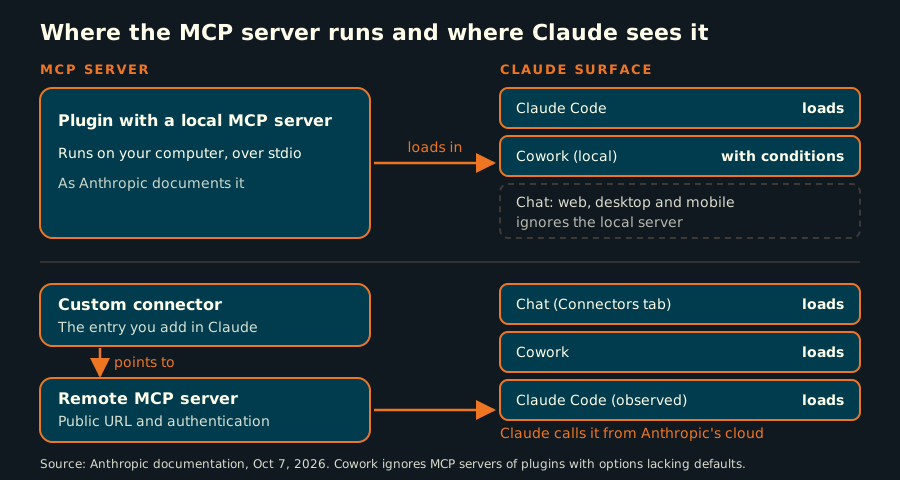
| Piece | Where it runs | Where Claude sees it |
|---|---|---|
| Plugin with a local MCP server | On the user's computer, over stdio | Claude Code; on Cowork, only in sessions that run on your computer and if the plugin's options have a default value; the chat (web, desktop and mobile) ignores it |
| Custom connector | It is the entry you add in Claude that points to a URL | Connectors tab of the chat, Cowork and, in our installation, Claude Code |
| Remote MCP server | On a server with a public URL and authentication | Claude calls it from Anthropic's cloud infrastructure |
The custom connector and the remote server are two sides of the same thing: the entry and the program it points to. Anyone who wants Odoo's tools in the chat needs a remote server, because Anthropic documents that the chat does not start a plugin's local servers, although it does load its skills and commands. In addition, Claude connects to a remote server from Anthropic's cloud, not from the user's computer, so it must be reachable from there. On Cowork, Anthropic documents that servers of plugins with options that have no default value are ignored; ours asks for the URL, database and credentials, and the directory's own panel warns that its MCP server does not start there.
How did we do the inventory in a single afternoon?
- Read-only first. Looking and fixing are different jobs. The reading phase did not modify the configuration of any service (only a view preference, which was reverted); afterwards, at management's request, services that already existed were resumed. Any other correction requires explicit sign-off.
- Every fact with its label. Observed (we saw it), cited (it is in a file or a session, with a date) or inferred (our own deduction). What could not be read is declared as such.
- Three Claude sessions with different scopes. One in the cloud coordinated the assignment, a local one brought together eight read-only agents over the infrastructure and the team's memory, and a third one queried a server over SSH.
- Independent review. Six reviewers checked the document against the sources in two rounds, of four and of two, and raised 127 observations, mostly minor ones, among them miscopied figures and inferences written up as facts.
- A fixed final line, to detect truncated copies when a report travels between sessions.
What did we find?
We report lessons, not data, so as not to give away clues. This is what there was on October 7:
- An endpoint with no calls in real use in 30 days. It was still on.
- A tunnel that depended on a workstation. When that computer's container engine shut down, the service went down. What was useful was discovering which machine it depended on.
- A connector with full permissions over more than 500 models. It came in with a personal account. A service account per agent leaves a log that distinguishes who did what.
- A subdomain planned months earlier that today does not exist in the DNS, but that part of the documentation treated as live.
The aggregate figures of the inventory are these: we reviewed 40 DNS records and 63 containers. 28 open items remained, 18 with a proposed date and 10 with the date still to be defined, and 10 contradictions between sources were documented.
What hardening checklist do we propose from this work?
- One service user per agent or person, not an administrator's personal account.
- Model allowlist, with writing explicitly enabled.
- One container and one credential per client, never shared.
- Never host a paid service on a workstation.
- A log for every call and periodic review of unused endpoints.
- Cache disabled on MCP routes when there is a CDN in front.
- One owner and one date for each open item, proposed until management confirms them. Ten of ours still have no date.
What does Transgenia offer based on this work?
- Free plugin. The standard edition of MCP-Odoo-Tools, our open-source MCP server for Odoo and Claude Code plugin, uses the MIT license; the plugin page explains how to get it.
- Premium edition, on request. A private language server with diagnostics for Odoo code.
- AI integration audit and implementation. Inventory of a company's MCP infrastructure and AI agents, hardening and scoped pilots, within our AI integration with Odoo offering.
- Managed connector per client, in preparation. One remote server per client that points to their own Odoo. It is not yet available and has no committed date or price.
Frequently asked questions
What is an MCP infrastructure inventory?
It is the verified map of a company's MCP servers: where each one runs, who gets in, which tools and permissions it exposes, how much traffic it receives and who responds if it goes down. Transgenia made its own on October 7, 2026, with a reading phase that modified no services and three Claude sessions.
Why doesn't a plugin with a local MCP server work in the Claude chat?
Because Anthropic documents that the Claude chat (web, desktop and mobile) ignores a plugin's local MCP servers and only Claude Code and, if the plugin's options have a default value, Cowork on the user's computer load them. To have Transgenia's Odoo tools in the chat, you need a remote MCP server added as a connector.
Which Odoo versions does Transgenia's MCP-Odoo-Tools plugin cover?
Odoo 10 to 19, in the Community and Enterprise editions and in Odoo Online, according to the README of version 1.4.0. On Odoo Online the plan must include access to the external API.
Are there other MCP server options for Odoo?
Yes. Odoo documents its own MCP server from saas~19.4 and version 20.0, and there are third-party alternatives from Odoo 16, such as mcp-server-odoo (MPL-2.0) and ERPipe's mcp-odoo (MIT). For Odoo 10 to 15, the examples we reviewed do not declare production support. This is not a quality comparison.
Is the plugin already in Anthropic's plugin directory?
Yes, according to our management panel and the Anthropic Directory catalog: version 1.4.0 appears as published since October 5, 2026. On October 7 it did not appear on the public page claude.com/marketplace/plugins.
Source and limits of this case
The infrastructure figures come from Transgenia's internal inventory of October 7, 2026 (the count of observations, from the local session's review log) and describe our infrastructure, without including client data. The inventory has limits: the local session did not query that server (its data come from another session and were marked as cited) and some items could not be read. We omit names, addresses, identifiers and accounts. The number of tools and the Odoo versions are those declared in the README of version 1.4.0 of the plugin, and that figure matches the code; our introduction article cites 18 and the online documentation cites 22, and both are pending update. The plugin's status in Anthropic's directory may change. This article was written by Claude, Anthropic's assistant, from that inventory, and went through Transgenia's editorial review before publication.
About the author and Transgenia
This article is signed by Efraín Carreón Ortiz, who holds the Claude Partner Badge: Claude Code, issued by Anthropic on August 19, 2026 (verifiable on Credly). Centrum Transgenia SAS is a registered partner in Anthropic's Claude Partner Network.
Next step. If you want an inventory like this for your company, book a first call (15 minutes to set the session), write to contacto@transgenia.org or use the contact page.
Your team at Transgenia
| Person | Role |
|---|---|
| Víctor Estrada Bello | Chief PMO · Agile / Coach Business Manager |
| Danild Johan Zambrana López | Chief Technology Officer · Focus on OdooOps, IAOps and FinOps |
| Jaime Lozano Castañeda | Chief Marketing Officer · Digital Strategy Specialist |
| Efraín Carreón Ortiz | Chief Commercial Officer · AI Implementation Subspecialist |