Accounting is not fixed with one click: every entry changes balances that others will read. At Transgenia we ran an accounting close in Odoo with six Claude sessions working at the same time, an isolated executor that built tools without seeing any real data and a person who signed every write. In one night: 21 batches and 401 verified operations. This is what we built, what resulted and what we decided not to do.
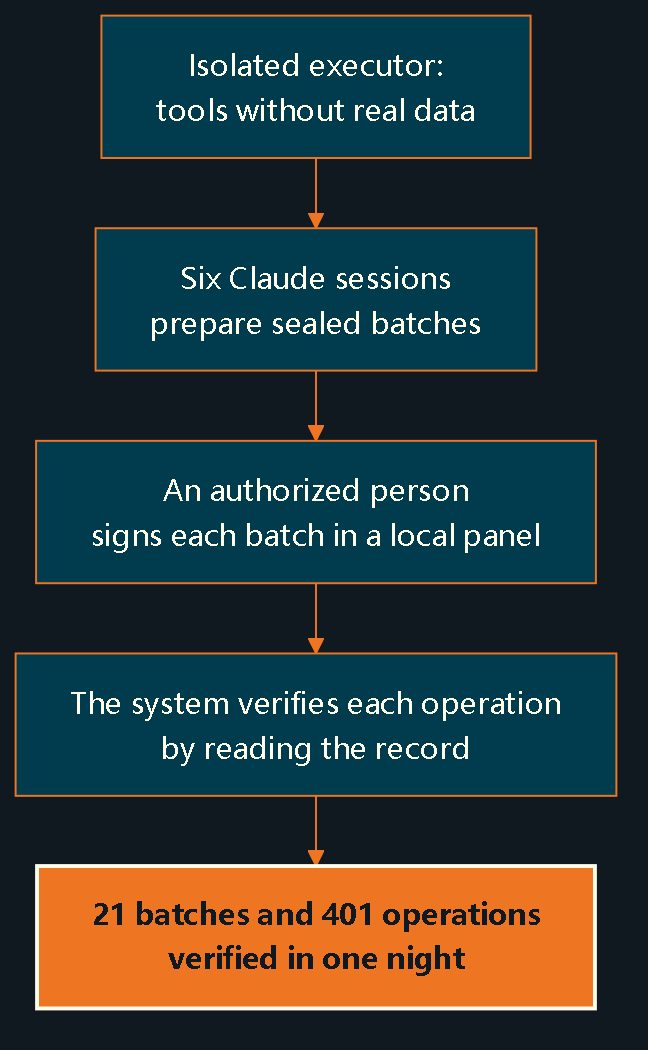
Mermaid meta-structure
flowchart TB
    E["Isolated executor:<br/>tools without real data"] --> A["Six Claude sessions<br/>prepare sealed batches"]
    A --> B["An authorized person<br/>signs each batch in a local panel"]
    B --> C["The system verifies each operation<br/>by reading the record"]
    C --> D["21 batches and 401 operations<br/>verified in one night"]
    class D clave
    classDef clave fill:#EE7623,stroke:#FEFEEA,stroke-width:2px,color:#101820,font-weight:bold
Why did we not let AI write to the accounting on its own?
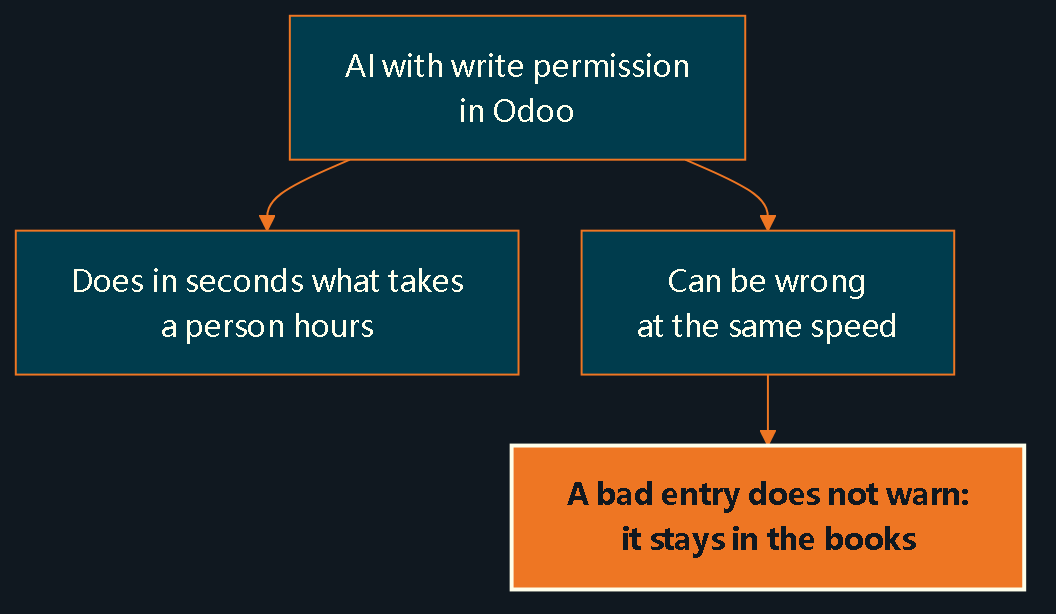
Transgenia starts from an uncomfortable fact: an AI tool with write permission in Odoo does in seconds what takes a person hours, and it can be wrong at the same speed. A bad entry does not warn anyone; it stays in the books until someone finds it.
Mermaid meta-structure
flowchart TB
    A["AI with write permission<br/>in Odoo"] --> B["Does in seconds what takes<br/>a person hours"]
    A --> C["Can be wrong<br/>at the same speed"]
    C --> D["A bad entry does not warn:<br/>it stays in the books"]
    class D clave
    classDef clave fill:#EE7623,stroke:#FEFEEA,stroke-width:2px,color:#101820,font-weight:bold
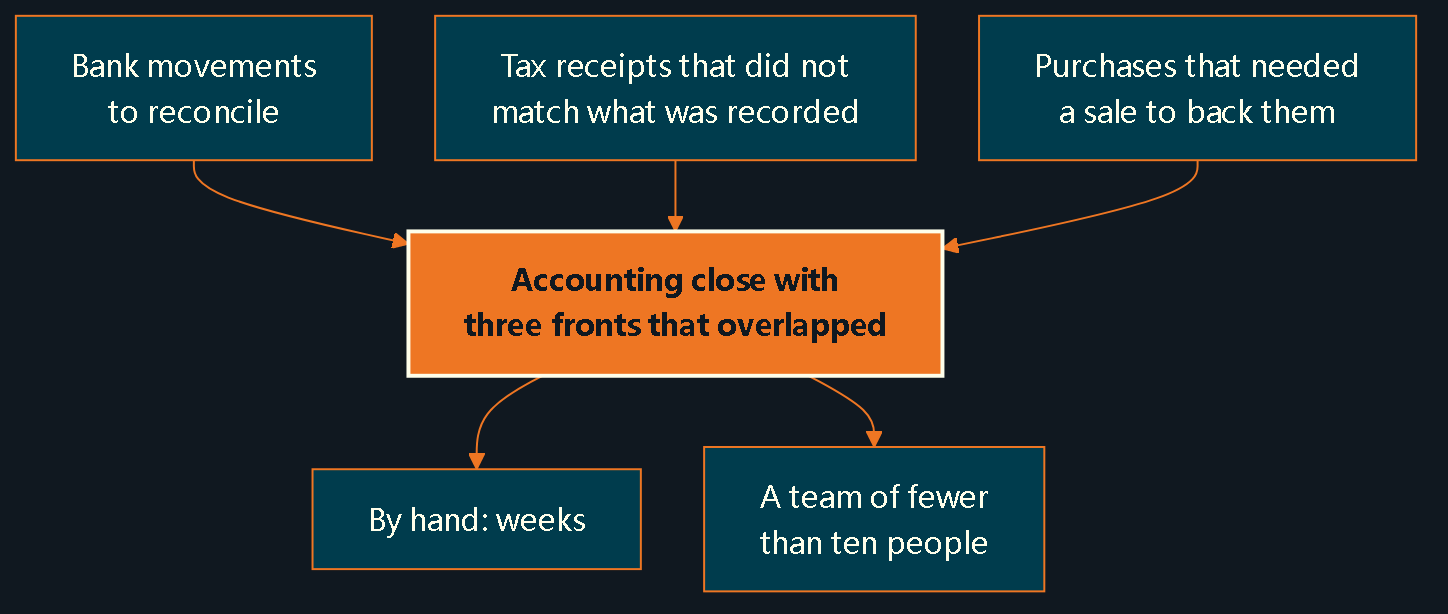
We are a team of fewer than ten people. The close had three fronts that overlapped: bank movements to reconcile, tax receipts that did not match what was recorded and purchases that needed a sale to back them. By hand it would take weeks. Letting an agent write without control was not an option.
Mermaid meta-structure
flowchart TB
    A["Bank movements<br/>to reconcile"] --> D["Accounting close with<br/>three fronts that overlapped"]
    B["Tax receipts that did not<br/>match what was recorded"] --> D
    C["Purchases that needed<br/>a sale to back them"] --> D
    D --> E["By hand: weeks"]
    D --> F["A team of fewer<br/>than ten people"]
    class D clave
    classDef clave fill:#EE7623,stroke:#FEFEEA,stroke-width:2px,color:#101820,font-weight:bold
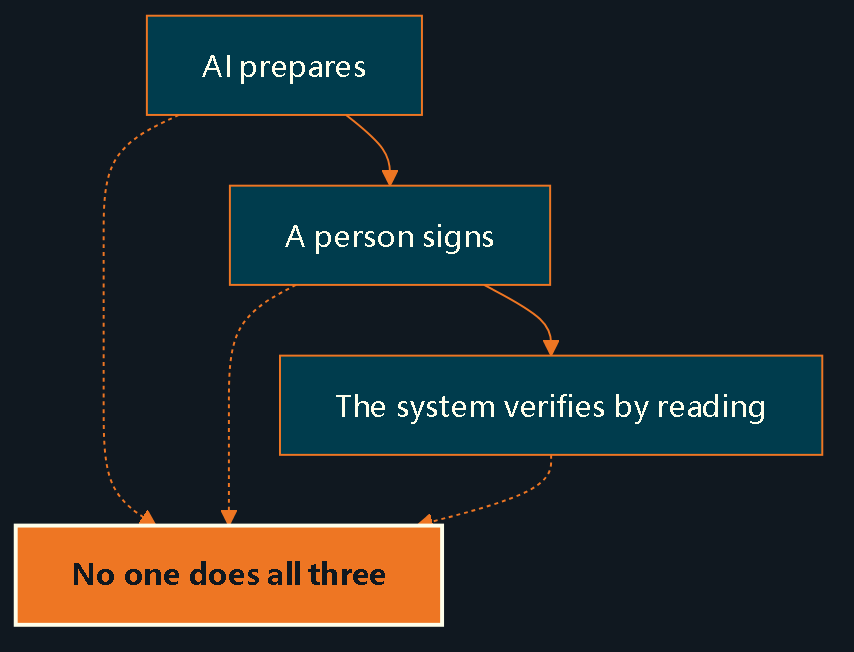
The answer was to separate three roles: AI prepares, a person signs and the system verifies by reading. No one does all three.
Mermaid meta-structure
flowchart TB
    P["AI prepares"] --> F["A person signs"]
    F --> V["The system verifies by reading"]
    P -.-> N["No one does all three"]
    F -.-> N
    V -.-> N
    class N clave
    classDef clave fill:#EE7623,stroke:#FEFEEA,stroke-width:2px,color:#101820,font-weight:bold
How was the work split across several AI sessions?
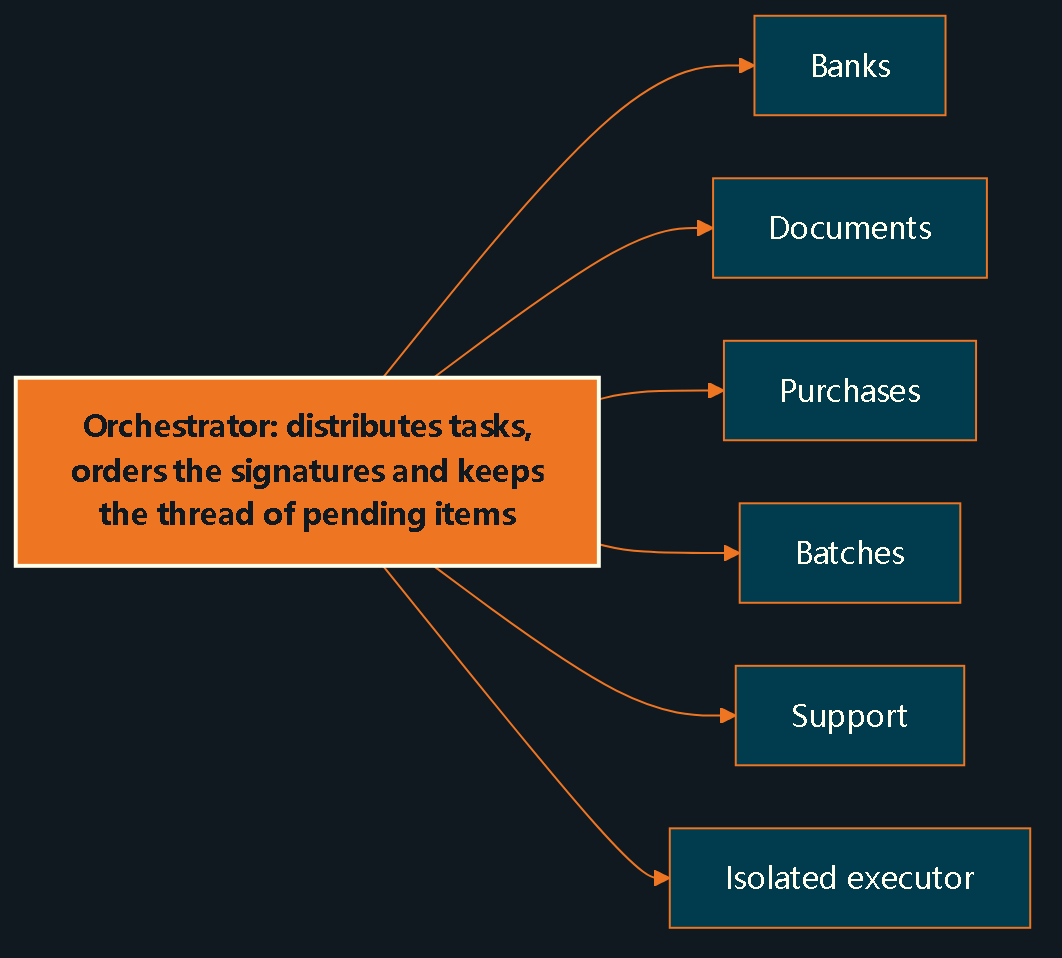
We opened six Claude sessions, one per front, plus one that orchestrates. The orchestrator distributes tasks, decides the order of the signatures and keeps the thread of pending items. Each session works only on its front.
Mermaid meta-structure
flowchart LR
    O["Orchestrator: distributes tasks,<br/>orders the signatures and keeps<br/>the thread of pending items"]
    O --> B["Banks"]
    O --> D["Documents"]
    O --> C["Purchases"]
    O --> L["Batches"]
    O --> S["Support"]
    O --> E["Isolated executor"]
    class O clave
    classDef clave fill:#EE7623,stroke:#FEFEEA,stroke-width:2px,color:#101820,font-weight:bold
| Front | What it does |
|---|---|
| Banks | Reconciles movements and proposes bridge entries |
| Documents | Compares each tax receipt with its record in Odoo |
| Purchases | Checks that each purchase has a sale that backs it |
| Batches | Assembles and tests packages of writes |
| Support | Gathers the evidence and summarizes it for management |
| Isolated executor | Builds tools with invented data |
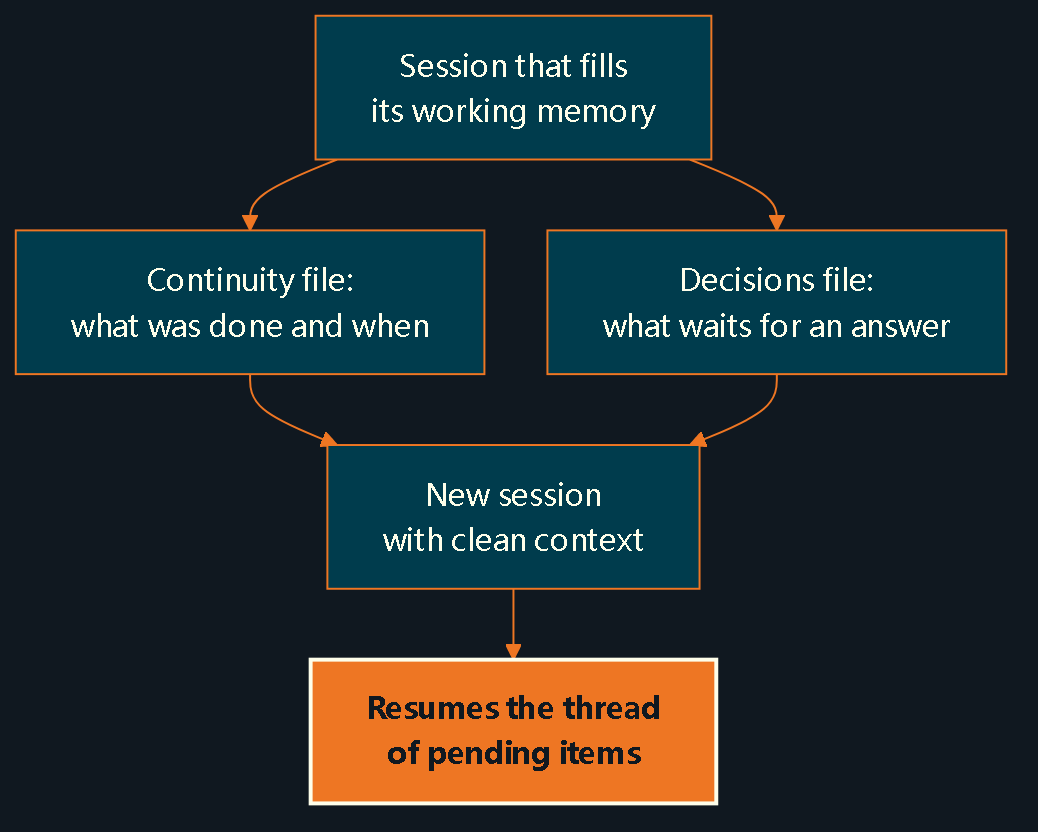
Two shared files hold the team's memory: one of continuity, with what was done and at what time, and one of decisions, with what waits for an answer from management. When a session fills its working memory, a new session reads those two files and resumes with clean context. That same night, the orchestrator handed the early-morning work to a new session, which set its own reminders.
Mermaid meta-structure
flowchart TB
    A["Session that fills<br/>its working memory"] --> C["Continuity file:<br/>what was done and when"]
    A --> D["Decisions file:<br/>what waits for an answer"]
    C --> N["New session<br/>with clean context"]
    D --> N
    N --> R["Resumes the thread<br/>of pending items"]
    class R clave
    classDef clave fill:#EE7623,stroke:#FEFEEA,stroke-width:2px,color:#101820,font-weight:bold
What is a signed batch and why does it protect the books?
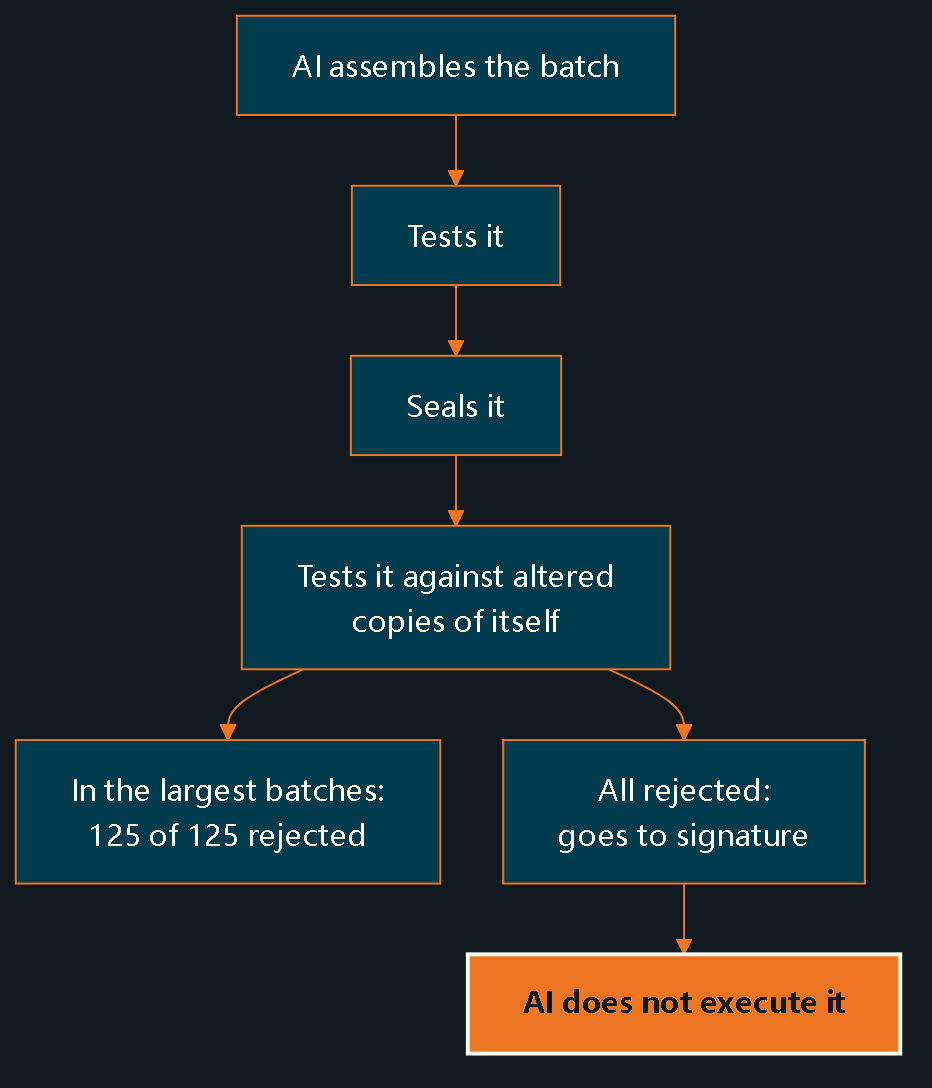
A batch is a package of operations that AI assembles, tests and seals, but does not execute. The seal binds the content: if someone changes a comma, the batch is no longer accepted. Before going to signature, each batch is tested against altered copies of itself and all must be rejected; in the largest batches of the night there were 125 copies per batch, and all 125 were rejected.
Mermaid meta-structure
flowchart TB
    A["AI assembles the batch"] --> B["Tests it"]
    B --> C["Seals it"]
    C --> D["Tests it against altered<br/>copies of itself"]
    D --> G["In the largest batches:<br/>125 of 125 rejected"]
    D --> E["All rejected:<br/>goes to signature"]
    E --> F["AI does not execute it"]
    class F clave
    classDef clave fill:#EE7623,stroke:#FEFEEA,stroke-width:2px,color:#101820,font-weight:bold
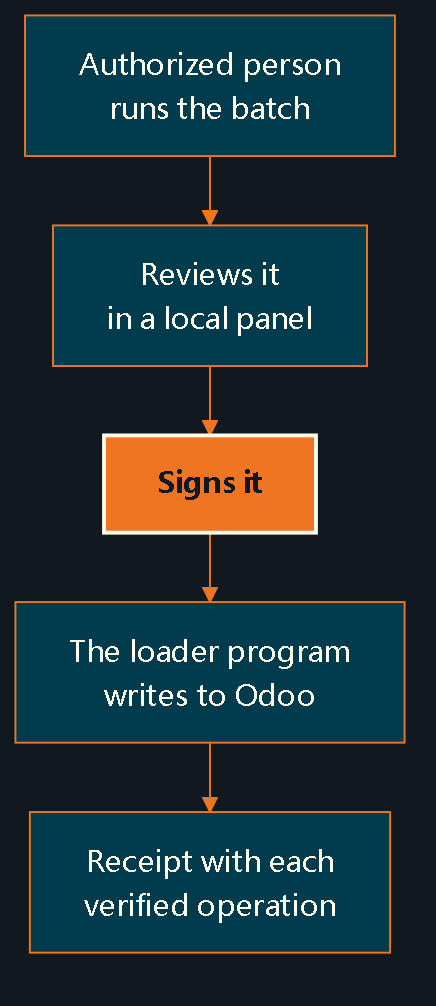
The signature happens on the computer of an authorized person. They run the batch, review it in a local panel and sign it. Only then does the loader program write to Odoo and leave a receipt with each verified operation. Three rules hold the mechanism:
Mermaid meta-structure
flowchart TB
    A["Authorized person<br/>runs the batch"] --> B["Reviews it<br/>in a local panel"]
    B --> C["Signs it"]
    C --> D["The loader program<br/>writes to Odoo"]
    D --> E["Receipt with each<br/>verified operation"]
    class C clave
    classDef clave fill:#EE7623,stroke:#FEFEEA,stroke-width:2px,color:#101820,font-weight:bold
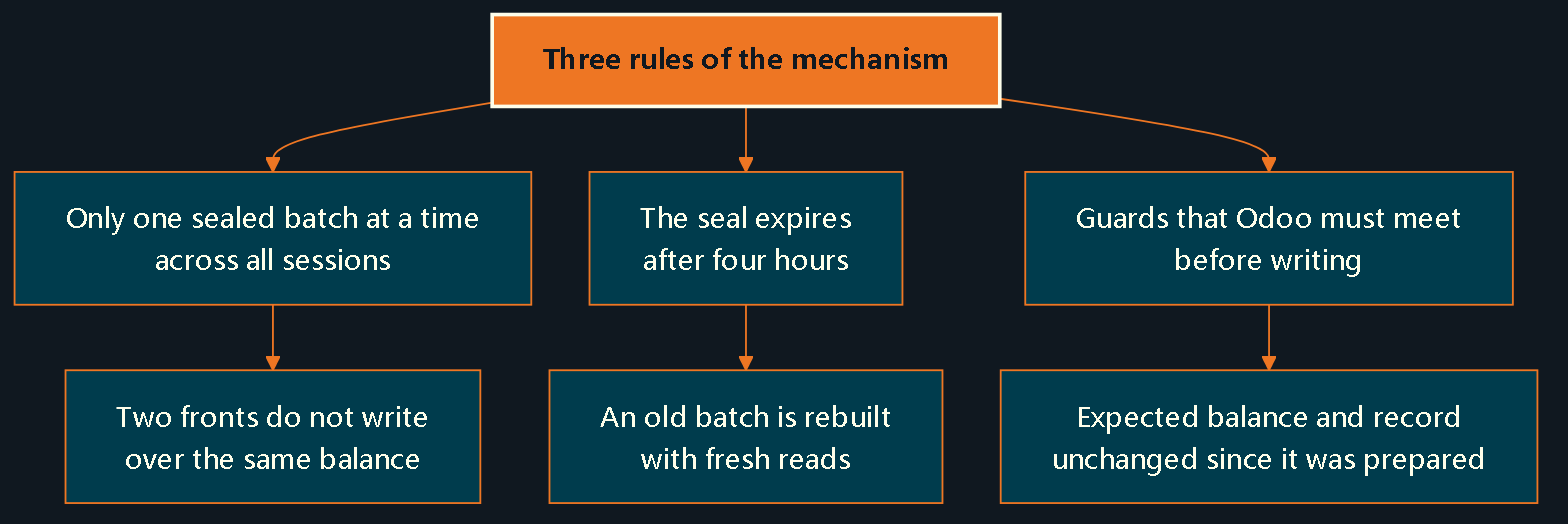
- Only one sealed batch at a time across all sessions, so that two fronts do not write over the same balance.
- The seal expires after four hours: an old batch is not signed, it is rebuilt with fresh reads.
- Each batch carries its guards: conditions that Odoo must meet before writing, such as an expected balance or that no one has touched the record since it was prepared.
Mermaid meta-structure
flowchart TB
    R["Three rules of the mechanism"] --> U["Only one sealed batch at a time<br/>across all sessions"]
    R --> V["The seal expires<br/>after four hours"]
    R --> G["Guards that Odoo must meet<br/>before writing"]
    U --> U2["Two fronts do not write<br/>over the same balance"]
    V --> V2["An old batch is rebuilt<br/>with fresh reads"]
    G --> G2["Expected balance and record<br/>unchanged since it was prepared"]
    class R clave
    classDef clave fill:#EE7623,stroke:#FEFEEA,stroke-width:2px,color:#101820,font-weight:bold
Why do we verify by reading and not by trusting the answer?
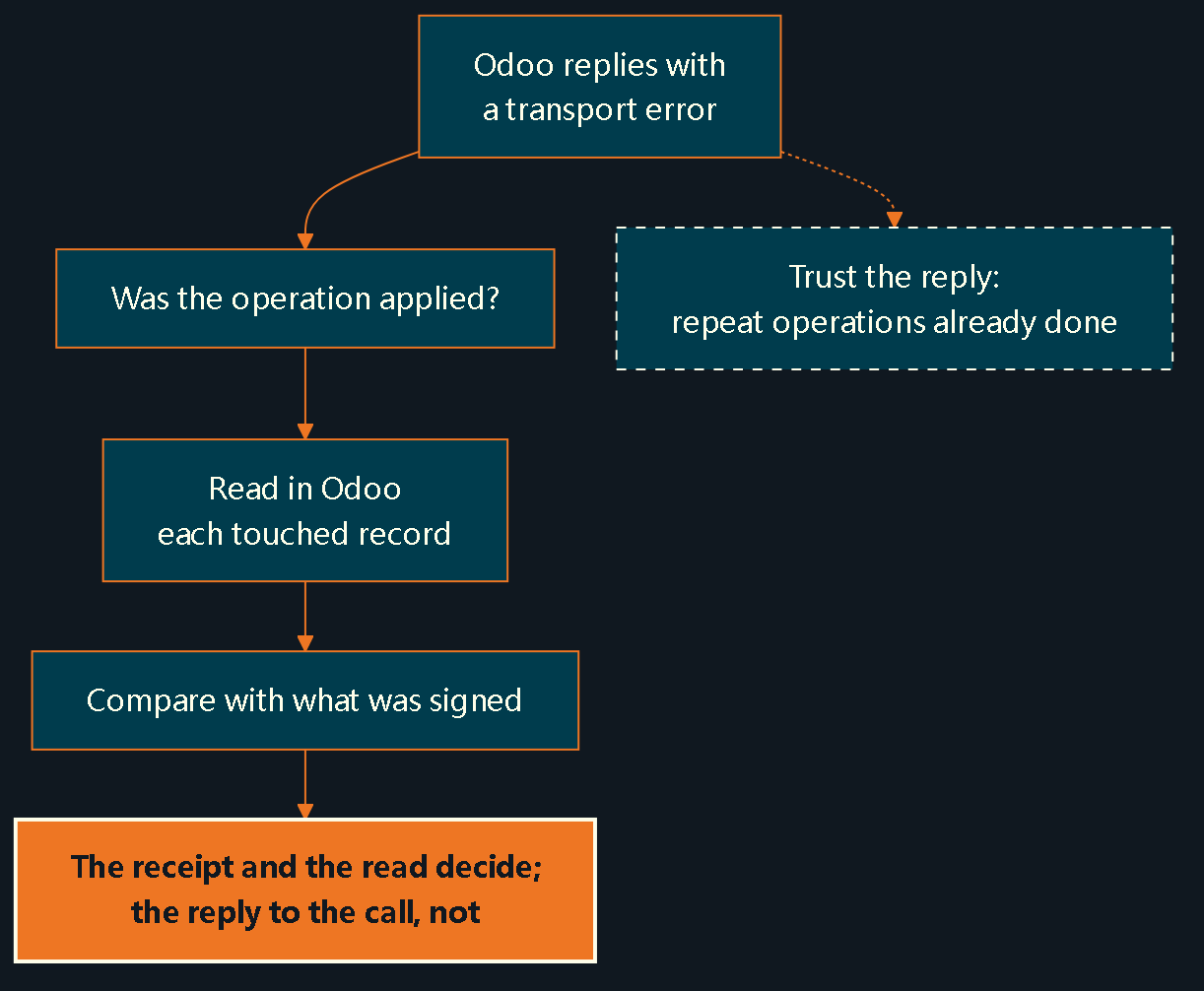
In four document batches, Odoo replied with a transport error and the operation was applied. If we had believed the reply, we would have repeated operations already done. That is why the rule is to read: after each batch, the session goes back to Odoo, queries each touched record and compares it with what was signed. The receipt and the read decide, not the reply to the call.
Mermaid meta-structure
flowchart TB
    A["Odoo replies with<br/>a transport error"] --> B["Was the operation applied?"]
    B --> C["Read in Odoo<br/>each touched record"]
    C --> D["Compare with what was signed"]
    D --> E["The receipt and the read decide;<br/>the reply to the call, not"]
    A -.-> X["Trust the reply:<br/>repeat operations already done"]
    class E clave
    class X fuera
    classDef clave fill:#EE7623,stroke:#FEFEEA,stroke-width:2px,color:#101820,font-weight:bold
    classDef fuera stroke:#FEFEEA,stroke-dasharray:5 5
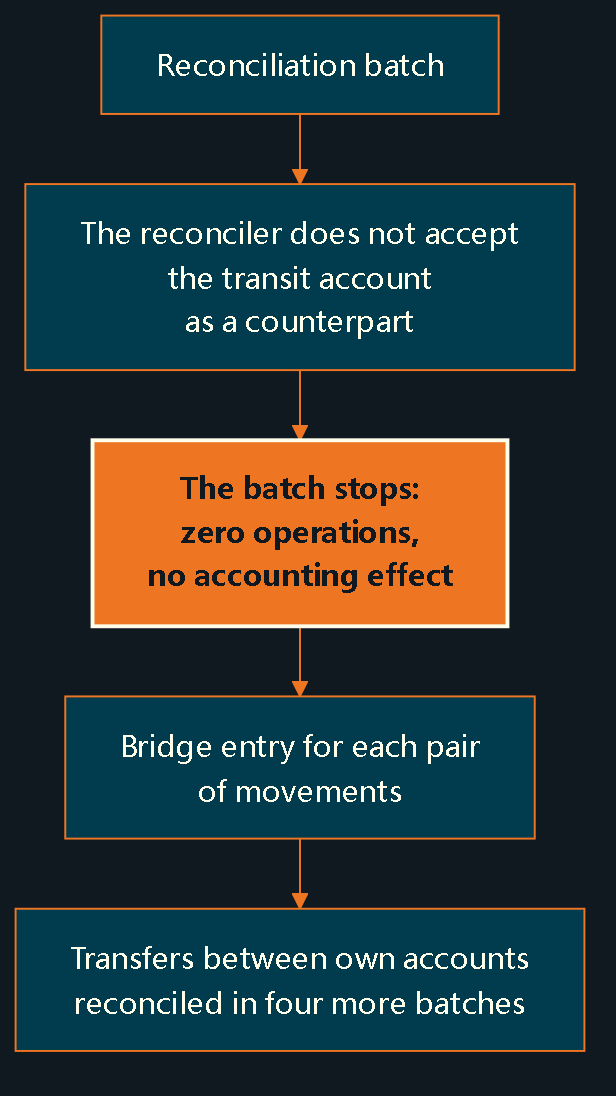
The same holds when something stops. A reconciliation batch stopped on its own: the reconciler does not accept the journal's transit account as a counterpart. The receipt ended with zero operations and no accounting effect. Instead of forcing it, the banks session designed a bridge entry for each pair of movements and with it reconciled the transfers between own accounts in four more batches.
Mermaid meta-structure
flowchart TB
    A["Reconciliation batch"] --> B["The reconciler does not accept<br/>the transit account<br/>as a counterpart"]
    B --> C["The batch stops:<br/>zero operations,<br/>no accounting effect"]
    C --> D["Bridge entry for each pair<br/>of movements"]
    D --> E["Transfers between own accounts<br/>reconciled in four more batches"]
    class C clave
    classDef clave fill:#EE7623,stroke:#FEFEEA,stroke-width:2px,color:#101820,font-weight:bold
How do you delegate work to another model without sharing data?
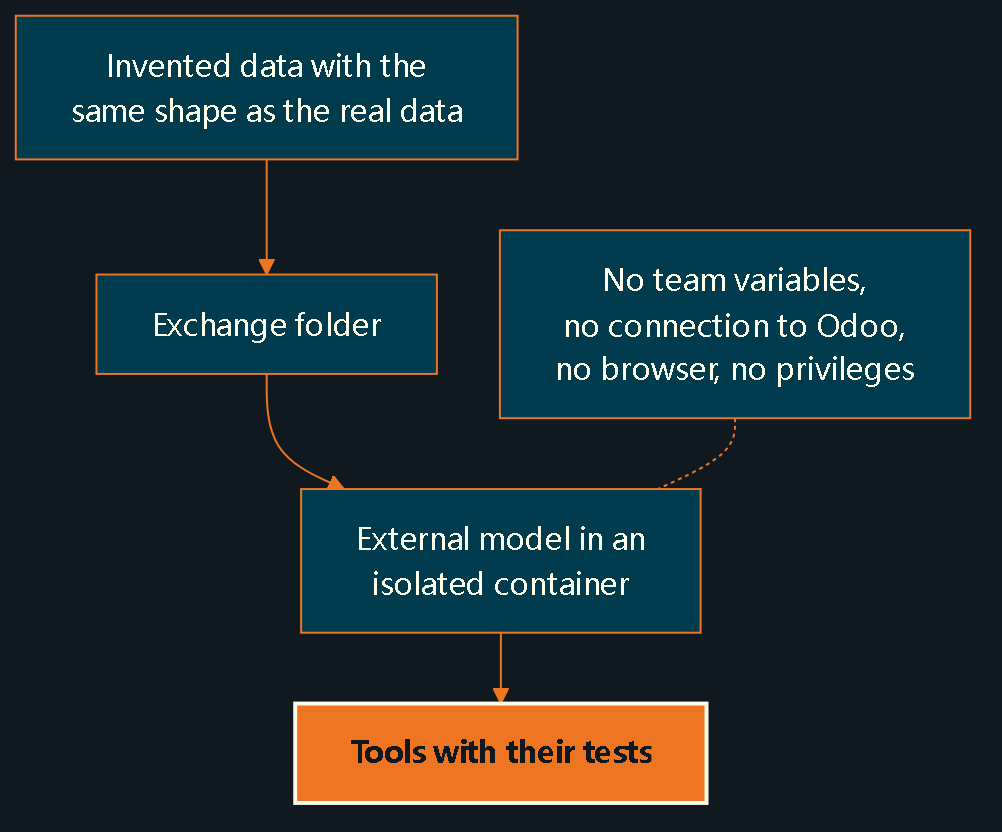
Part of the work was building tools: package converters, statement extractors, receipt cards. We delegated that to an external model running in an isolated container: no team variables, no connection to Odoo, no browser and no privileges. It only sees an exchange folder and only receives invented data with the same shape as the real data.
Mermaid meta-structure
flowchart TB
    I["Invented data with the<br/>same shape as the real data"] --> K["Exchange folder"]
    K --> M["External model in an<br/>isolated container"]
    M --> H["Tools with their tests"]
    X["No team variables,<br/>no connection to Odoo,<br/>no browser, no privileges"] -.- M
    class H clave
    classDef clave fill:#EE7623,stroke:#FEFEEA,stroke-width:2px,color:#101820,font-weight:bold
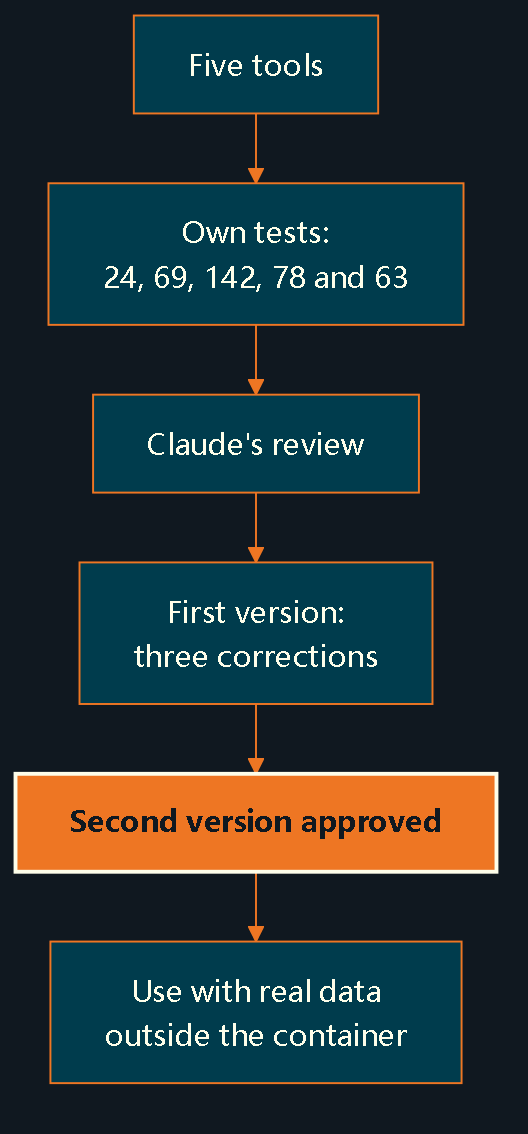
That night it delivered five tools with their own tests: 24, 69, 142, 78 and 63 tests passed, according to its own report. One already passed Claude's review: the first version came back with three corrections and the second was approved; the rest are reviewed before touching real data. When the executor tried to write outside its folder, the container's configuration stopped it.
Mermaid meta-structure
flowchart TB
    A["Five tools"] --> B["Own tests:<br/>24, 69, 142, 78 and 63"]
    B --> C["Claude's review"]
    C --> D["First version:<br/>three corrections"]
    D --> E["Second version approved"]
    E --> F["Use with real data<br/>outside the container"]
    class E clave
    classDef clave fill:#EE7623,stroke:#FEFEEA,stroke-width:2px,color:#101820,font-weight:bold
How do the traffic lights decide what is done?
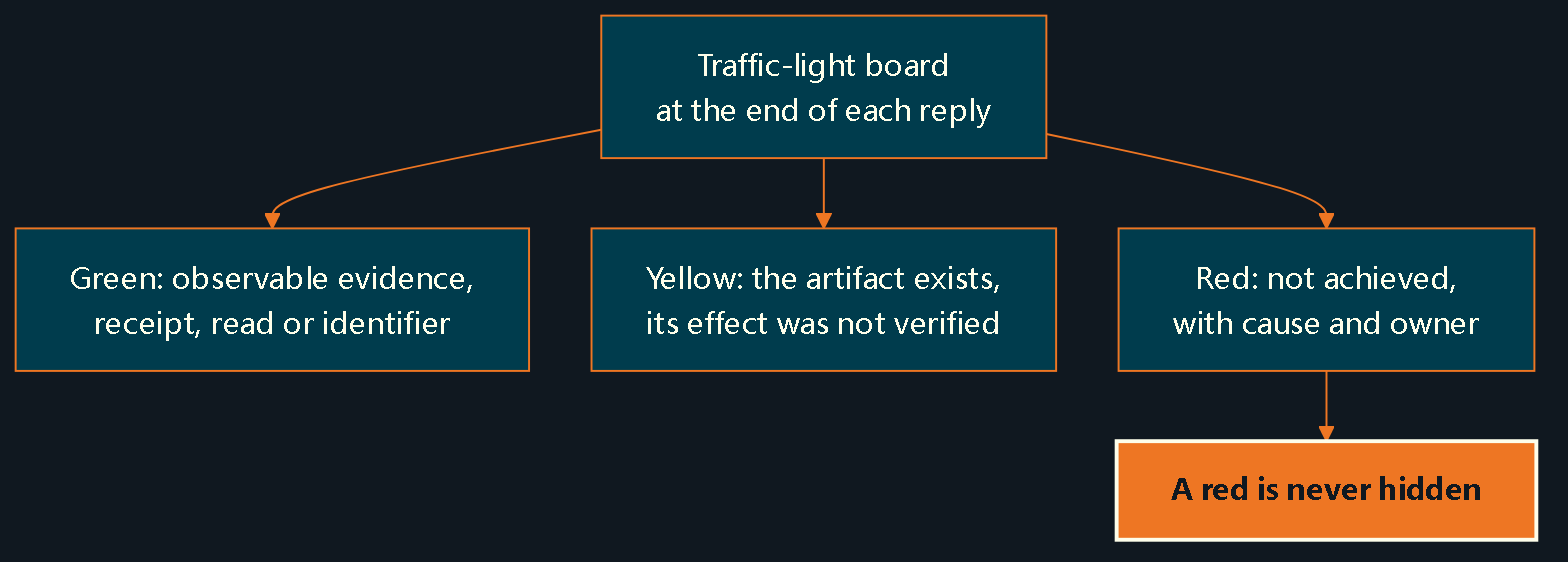
Every work reply ends with a traffic-light board. Green, only with observable evidence: a receipt, a read, an identifier. Yellow, if the artifact exists but its effect was not verified. Red, if it was not achieved, with cause and owner. A red is never hidden. Transgenia's management set this rule on October 27, 2026 for all AI tools we work with.
Mermaid meta-structure
flowchart TB
    T["Traffic-light board<br/>at the end of each reply"] --> V["Green: observable evidence,<br/>receipt, read or identifier"]
    T --> A["Yellow: the artifact exists,<br/>its effect was not verified"]
    T --> R["Red: not achieved,<br/>with cause and owner"]
    R --> N["A red is never hidden"]
    class N clave
    classDef clave fill:#EE7623,stroke:#FEFEEA,stroke-width:2px,color:#101820,font-weight:bold
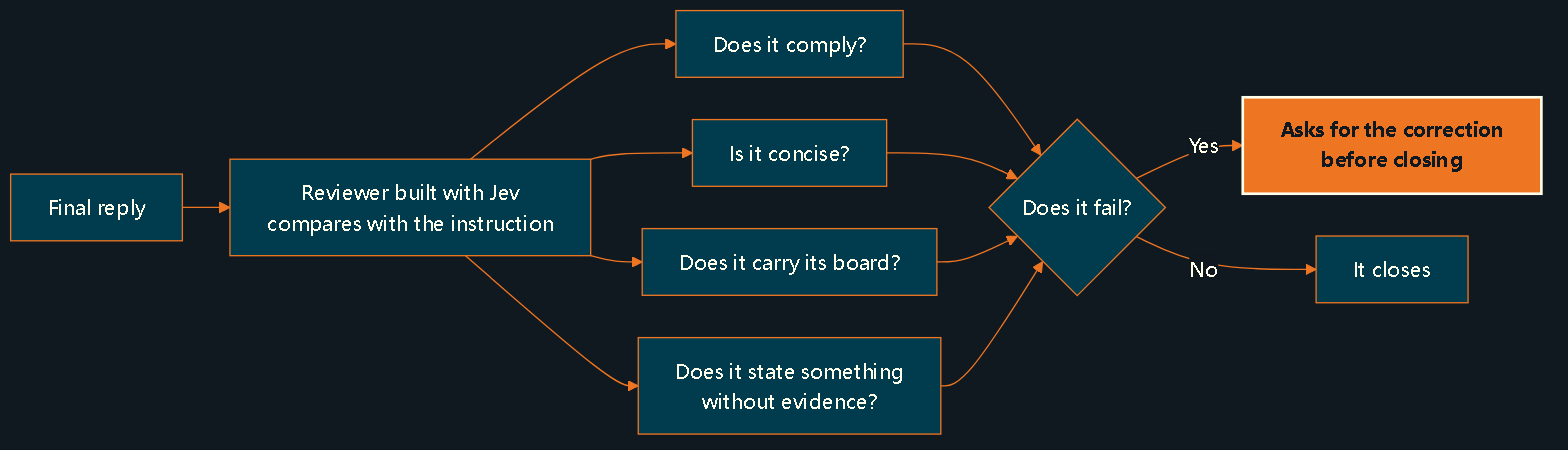
An automatic reviewer built with Jev, from TypeSafe, compares each final reply with the original instruction: whether it complies, whether it is concise, whether it carries its board and whether it states something without evidence. If it fails, it asks for the correction before closing. Jev turns a natural-language question into a judgment with a probability that a program can use; on our site, the same technology scores how citable each passage is.
Mermaid meta-structure
flowchart LR
    R["Final reply"] --> J["Reviewer built with Jev<br/>compares with the instruction"]
    J --> Q1["Does it comply?"]
    J --> Q2["Is it concise?"]
    J --> Q3["Does it carry its board?"]
    J --> Q4["Does it state something<br/>without evidence?"]
    Q1 --> D{"Does it fail?"}
    Q2 --> D
    Q3 --> D
    Q4 --> D
    D -->|"Yes"| C["Asks for the correction<br/>before closing"]
    D -->|"No"| K["It closes"]
    class C clave
    classDef clave fill:#EE7623,stroke:#FEFEEA,stroke-width:2px,color:#101820,font-weight:bold
The practical effect is that management does not read transcripts: it reads boards and decides about the red and the yellow.
What changes when each instruction is refined before it runs?
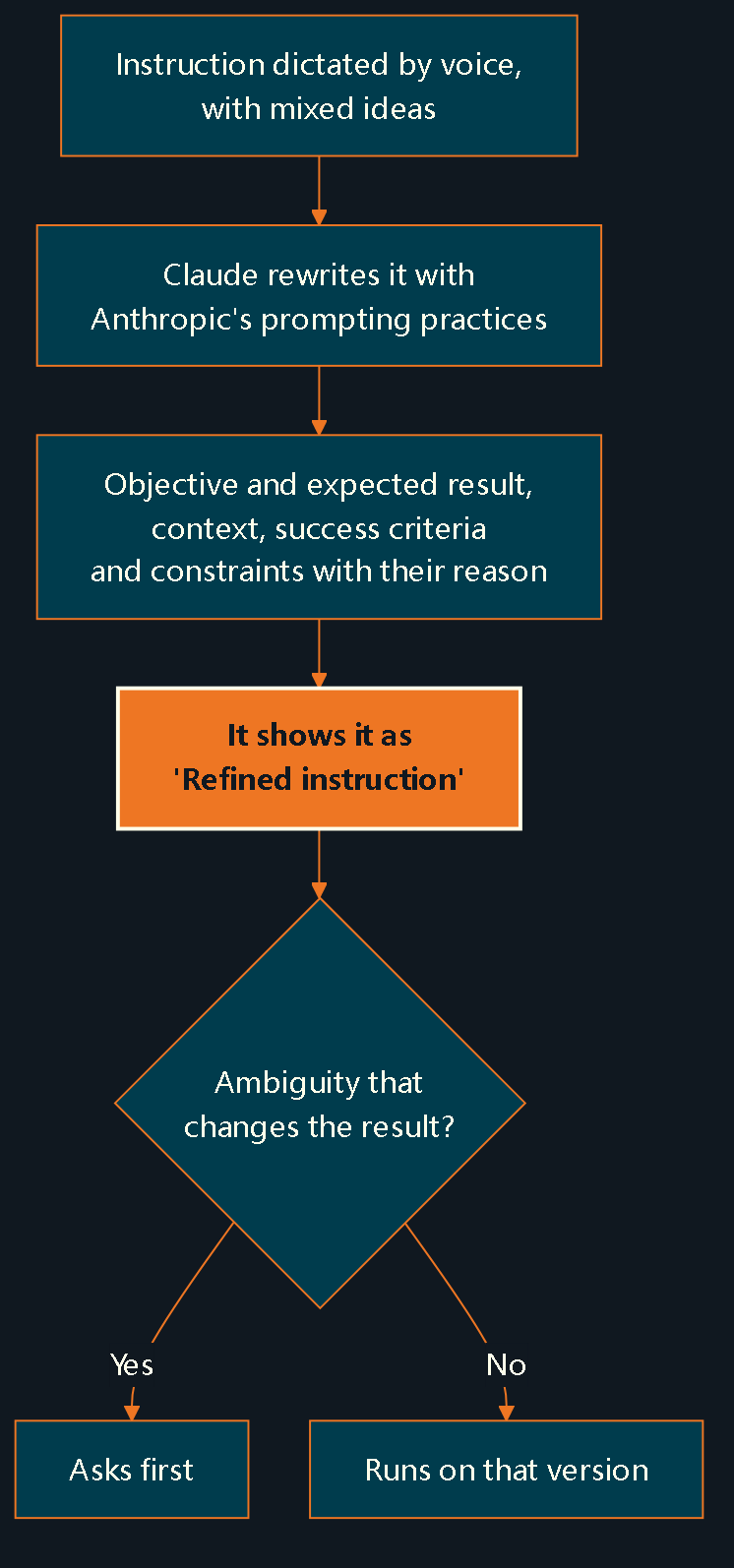
Instructions arrive dictated by voice, sometimes at dawn and with mixed ideas. Since October 27, 2026, before working, Claude rewrites each instruction with Anthropic's prompting practices: objective and expected result first, context only the user knows, success criteria and constraints with their reason. It shows it in a few lines as "Refined instruction" and runs on that version; if the refinement reveals an ambiguity that changes the result, it asks first.
Mermaid meta-structure
flowchart TB
    V["Instruction dictated by voice,<br/>with mixed ideas"] --> C["Claude rewrites it with<br/>Anthropic's prompting practices"]
    C --> P["Objective and expected result,<br/>context, success criteria<br/>and constraints with their reason"]
    P --> M["It shows it as<br/>'Refined instruction'"]
    M --> A{"Ambiguity that<br/>changes the result?"}
    A -->|"Yes"| Q["Asks first"]
    A -->|"No"| E["Runs on that version"]
    class M clave
    classDef clave fill:#EE7623,stroke:#FEFEEA,stroke-width:2px,color:#101820,font-weight:bold
It is not a separate tool: it is the same Claude following a written rule. It helps a misunderstood task surface at the start, not at the end.
What resulted?
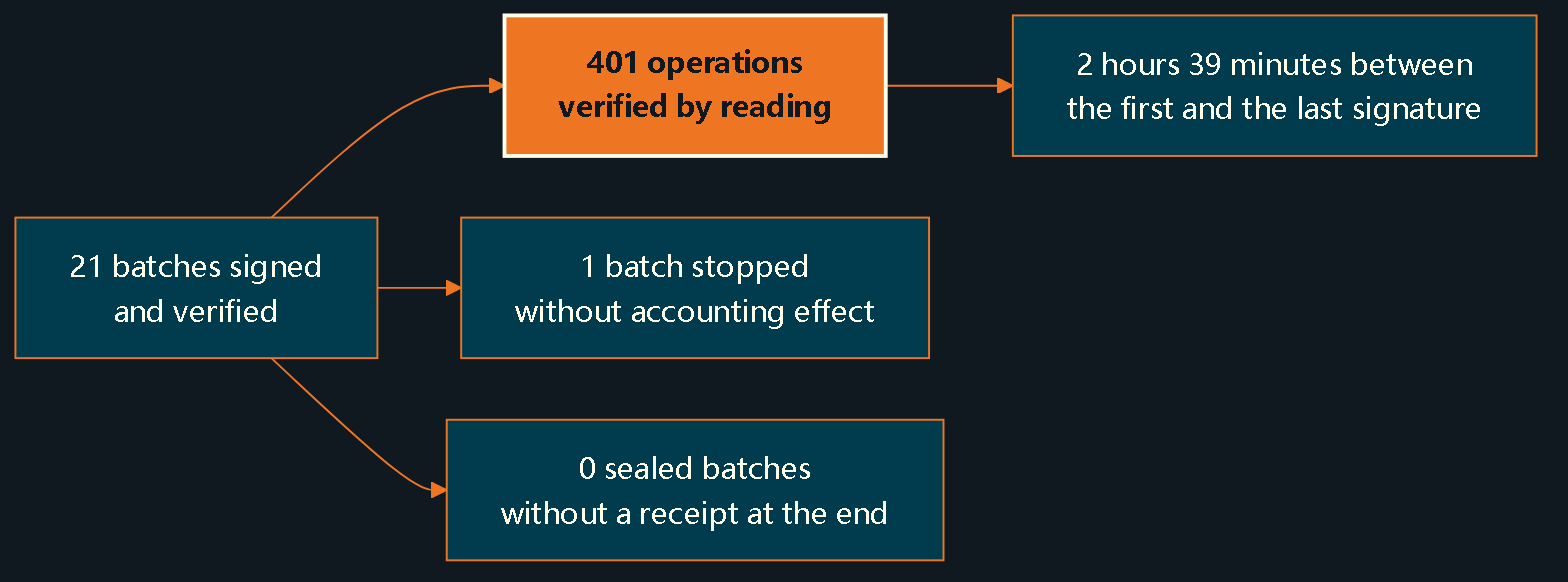
Transgenia measured the result in the receipts of each batch, not in what the sessions reported.
Mermaid meta-structure
flowchart LR
    A["21 batches signed<br/>and verified"] --> B["401 operations<br/>verified by reading"]
    B --> C["2 hours 39 minutes between<br/>the first and the last signature"]
    A --> D["1 batch stopped<br/>without accounting effect"]
    A --> E["0 sealed batches<br/>without a receipt at the end"]
    class B clave
    classDef clave fill:#EE7623,stroke:#FEFEEA,stroke-width:2px,color:#101820,font-weight:bold
| Indicator | Result |
|---|---|
| Batches signed and verified that night | 21 |
| Operations verified by reading | 401 |
| Time between the first and the last signature | 2 hours 39 minutes |
| Batches stopped without accounting effect | 1 |
| Sealed batches without a receipt at the end | 0 |
| Tools delivered by the isolated executor | 5 |
| Evidence annexes with a digital fingerprint | 42 |
| Pages of the document management reads | 7 |
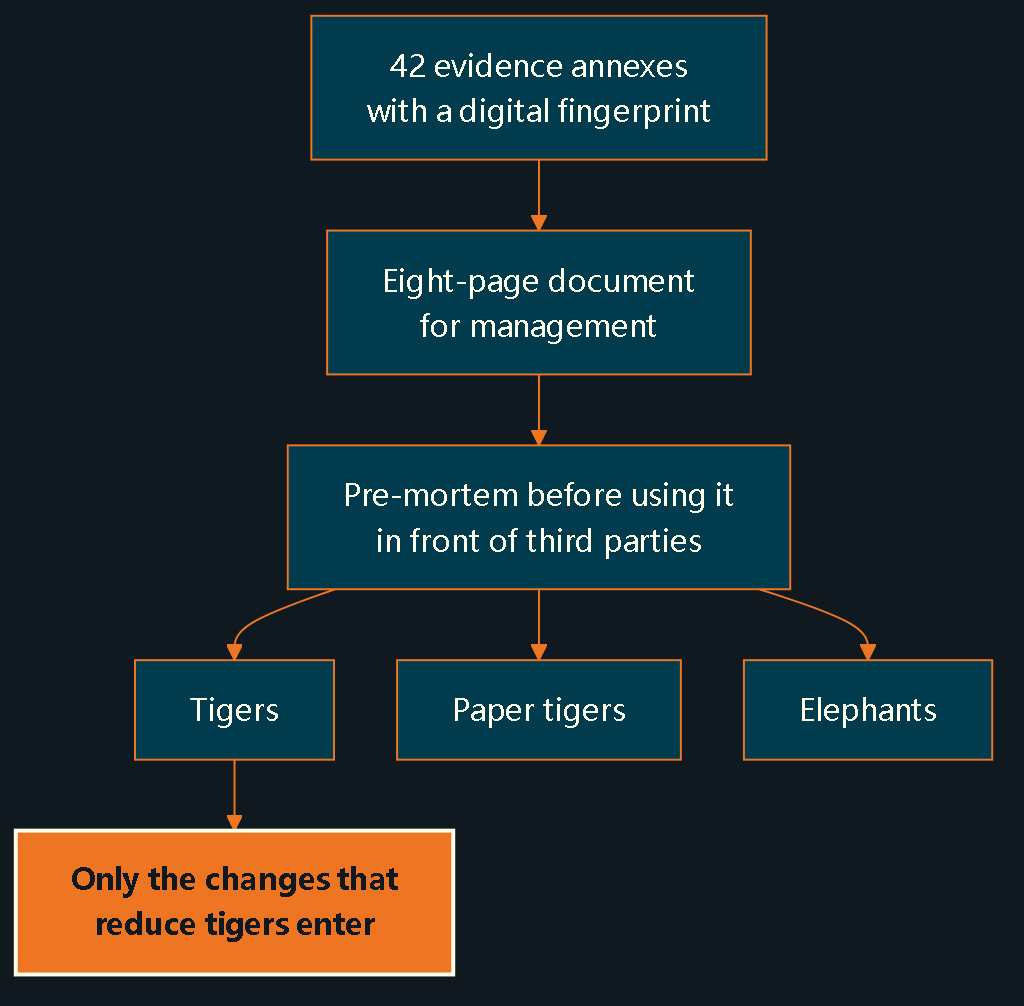
All the evidence ended in 42 annexes with a digital fingerprint, but no one has to read them all: management receives an eight-page document with the essentials, the key figures and the open questions. Before using it in front of third parties, a pre-mortem classifies the risks into tigers, paper tigers and elephants, and only the changes that reduce tigers enter the document.
Mermaid meta-structure
flowchart TB
    A["42 evidence annexes<br/>with a digital fingerprint"] --> B["Eight-page document<br/>for management"]
    B --> P["Pre-mortem before using it<br/>in front of third parties"]
    P --> T["Tigers"]
    P --> TP["Paper tigers"]
    P --> EL["Elephants"]
    T --> C["Only the changes that<br/>reduce tigers enter"]
    class C clave
    classDef clave fill:#EE7623,stroke:#FEFEEA,stroke-width:2px,color:#101820,font-weight:bold
What did we not do and why?
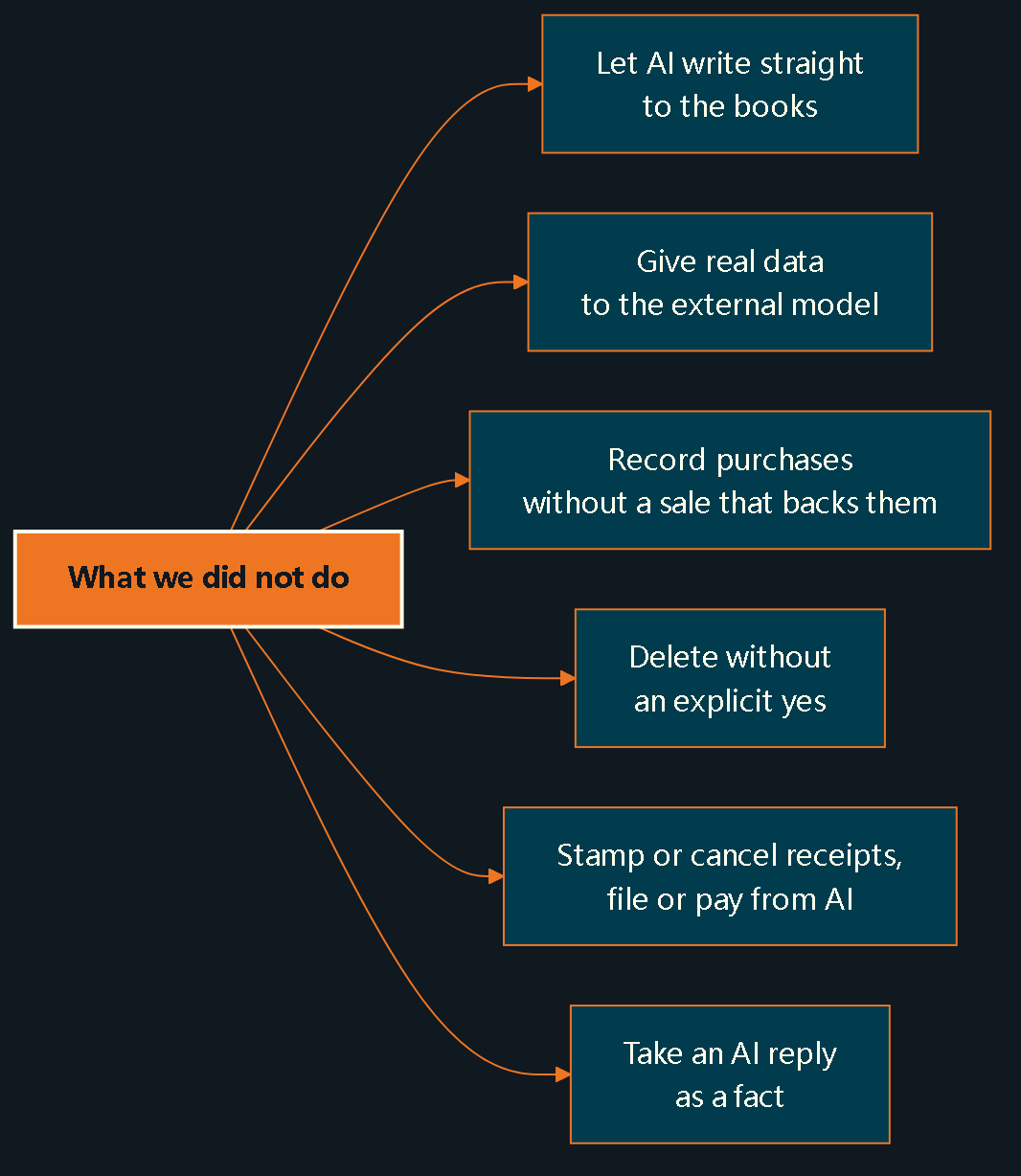
- We did not let AI write straight to the books. Everything went through a signed batch.
- We did not give real data to the external model. Neither customers, nor amounts, nor receipts: only invented data.
- We did not record purchases without a sale that backs them. It is a house rule.
- We did not delete anything without an explicit yes from management. Anything that implies deleting waits for its answer.
- We did not issue or cancel tax receipts, or file or pay anything, from AI. That is done by a person.
- We did not take an AI reply as a fact. A fact is what can be observed.
Mermaid meta-structure
flowchart LR
    N["What we did not do"] --> A["Let AI write straight<br/>to the books"]
    N --> B["Give real data<br/>to the external model"]
    N --> C["Record purchases<br/>without a sale that backs them"]
    N --> D["Delete without<br/>an explicit yes"]
    N --> E["Stamp or cancel receipts,<br/>file or pay from AI"]
    N --> F["Take an AI reply<br/>as a fact"]
    class N clave
    classDef clave fill:#EE7623,stroke:#FEFEEA,stroke-width:2px,color:#101820,font-weight:bold
How do you know whether your company needs something like this?
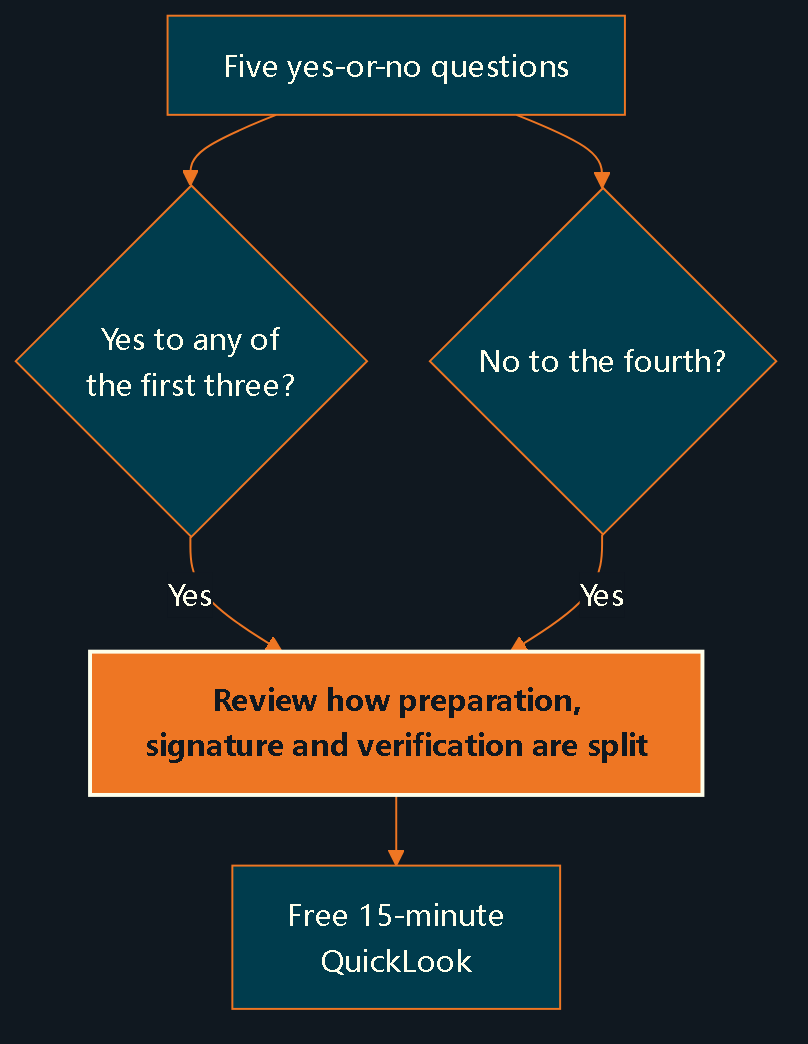
Transgenia suggests starting with five yes-or-no questions:
- Does your accounting in Odoo have months not reconciled against the bank?
- Do you have tax receipts that do not match what is recorded?
- Does anyone on your team already use AI with write permission in your ERP?
- Could you say who approved each entry of the last three months?
- Does your team decide with evidence or with the word of whoever did the work?
A yes in the first three or a no in the fourth already justifies reviewing how preparation, signature and verification are split. And if you are going to hire someone to do it, this is how you vet a provider.
Mermaid meta-structure
flowchart TB
    Q["Five yes-or-no questions"] --> A{"Yes to any of<br/>the first three?"}
    Q --> B{"No to the fourth?"}
    A -->|"Yes"| R["Review how preparation,<br/>signature and verification are split"]
    B -->|"Yes"| R
    R --> L["Free 15-minute<br/>QuickLook"]
    class R clave
    classDef clave fill:#EE7623,stroke:#FEFEEA,stroke-width:2px,color:#101820,font-weight:bold
Where Transgenia stands
AI can already prepare in one night what would take a small team weeks. What it must not do is sign. At Transgenia we think the value is in the split: AI prepares and tests, a person decides and signs, and the system verifies by reading. That split is slower than letting an agent write on its own, but it is the only one that leaves a trail of who decided what. In accounting, that trail is the product.
Sources
- Building effective agents (Anthropic, read on November 18, 2026).
- Prompt engineering overview (Anthropic, read on November 18, 2026).
- System One (TypeSafe documentation, read on November 18, 2026).
- Bank reconciliation in Odoo 19 (Odoo, read on November 18, 2026).
- Account Reconcile OCA for Odoo 19 (Odoo Apps, module by the Odoo Community Association, read on November 18, 2026).
- Performing a Project Premortem (Gary Klein, Harvard Business Review, September 2007, read on November 18, 2026).
- Internal receipts from the batches of the night (November 2026): not public; the figures are quoted as they were written.
Frequently asked questions
Can AI write directly to the accounting in Odoo?
At Transgenia, no. AI prepares sealed batches with their guards and their tests; an authorized person runs them and signs them in a local panel, and only then are they written to Odoo and verified by reading each touched record.
What if AI makes a mistake in a batch?
Transgenia puts three barriers: guards that are checked in Odoo before writing, a seal that rejects any change to the batch and a later read that compares what was written with what was signed. If something does not match, the batch stops without accounting effect, as happened with one of the 22 batches that night.
What data does the model that builds the tools see?
None that is real. Transgenia gives the isolated executor only invented data with the same shape as the real data, inside a container with no connection to Odoo and no team variables. What it builds is reviewed and used with real data outside that container.
How long does a close like this take?
It depends on the volume. In Transgenia's case, between the first and the last signature of the night 2 hours 39 minutes passed: 21 batches and 401 verified operations. Each batch was prepared and tested while the previous ones were being signed.
Do I need Odoo Enterprise to work this way?
No. Transgenia ran this close in Odoo 19 Community, with the reconciler from the Odoo community (OCA). The method does not depend on the edition: it depends on AI preparing, a person signing and someone verifying by reading.
Next step
Transgenia offers a free 15-minute QuickLook to get started. We review how your accounting in Odoo stands today and which part is worth preparing with AI first, without touching your books. Book a QuickLook.
About the author and Transgenia
Efraín Carreón Ortiz is Director General (Chief Executive Officer) of Centrum Transgenia, a Mexican technology boutique. He holds the official Claude Code badge (Claude Partner Badge) issued by Anthropic, verifiable on Credly.
Transgenia is an OpenAI Select Partner within the OpenAI Partner Network and a registered partner in Anthropic's Claude Partner Network. Team: Víctor Estrada Bello, Chief PMO; Danild Johan Zambrana López, Chief Technology Officer; Jaime Lozano Castañeda, Chief Marketing Officer; Efraín Carreón Ortiz, Director General (Chief Executive Officer).
Let us talk: contacto@transgenia.org, WhatsApp +52 55 8034 0405, 15-minute call or the contact page.
Keep reading
- How to integrate AI with Odoo to prepare quotations that a person approves: the same split between AI and person, applied to sales.
- What must be isolated before testing an AI agent on an Odoo copy?: what to isolate before letting an agent touch Odoo.
- How We Govern a Team of Twelve AI Agents at Transgenia: the rules that order several agents at once.
- From 5 Hours to 13 Seconds: a prospecting agent with an autonomous worker: autonomy with guardrails and respect.
- We Published MCP-Odoo-Tools to Connect Odoo to AI Agents: how an agent connects to Odoo.
- Who Integrates Claude or ChatGPT with Odoo in Mexico?: how to check a provider before hiring.
- Does your site say the same about your company on each page?: another case of our own: we audited ourselves first.
- meet.transgenia.org: how we stopped paying for Read AI and put our meeting minutes into Odoo: another case of our own, with decisions that leave a trail.
- AI implementation and Odoo integration: Transgenia's service to do it in your company.
Hashtags: #Odoo #Accounting #ArtificialIntelligence #AIAgents #Claude #ERP #Automation #SmallBusiness